Refine search
Actions for selected content:
26079 results in Abstract analysis
PRM volume 113 issue 3-4 Cover and Front matter
-
- Journal:
- Proceedings of the Royal Society of Edinburgh. Section A: Mathematics / Volume 113 / Issue 3-4 / 1989
- Published online by Cambridge University Press:
- 14 November 2011, pp. f1-f2
- Print publication:
- 1989
-
- Article
-
- You have access
- Export citation
Illuminating sets of constant width
- Part of
-
- Journal:
- Mathematika / Volume 35 / Issue 2 / December 1988
- Published online by Cambridge University Press:
- 26 February 2010, pp. 180-189
- Print publication:
- December 1988
-
- Article
- Export citation
The two-ball property: transitivity and examples
- Part of
-
- Journal:
- Mathematika / Volume 35 / Issue 2 / December 1988
- Published online by Cambridge University Press:
- 26 February 2010, pp. 190-197
- Print publication:
- December 1988
-
- Article
- Export citation
The magnetic field perturbations produced by an ellipsoidal cavity in a uniform conductor
- Part of
-
- Journal:
- Mathematika / Volume 35 / Issue 2 / December 1988
- Published online by Cambridge University Press:
- 26 February 2010, pp. 247-255
- Print publication:
- December 1988
-
- Article
- Export citation
Tauberian theorems for Jakimovski and Karamata-Stirling methods
-
- Journal:
- Mathematika / Volume 35 / Issue 2 / December 1988
- Published online by Cambridge University Press:
- 26 February 2010, pp. 216-224
- Print publication:
- December 1988
-
- Article
- Export citation
-
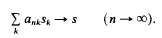
We shall deal throughout with regular matrix methods of summability defined by a stochastic matrix A = (ank). Thus
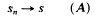
means
A generalization of mixed invariant sets
- Part of
-
- Journal:
- Mathematika / Volume 35 / Issue 2 / December 1988
- Published online by Cambridge University Press:
- 26 February 2010, pp. 198-206
- Print publication:
- December 1988
-
- Article
- Export citation
-
The concept of mixed invariant set is due to Bandt [1], Bedford [2], Dekking [3, 4], Marion [4] and Schulz [10]. An m-tuple B = (B1, …, Bm) of closed and bounded subsets Bi of a complete finitely compact (bounded and closed subsets are compact) metric space X is called a mixed invariant set with respect to contractions f1, …, fm and a transition matrix M = (mij), if, and only if,
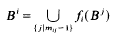
for every i ∈ {1, …, m}. In the papers quoted an essential condition is that all mappings f1, …, fm be contractions. We will show that, under certain conditions, the construction of mixed invariant sets also works in cases where some of the mappings are isometries or even expanding mappings.
Systems of parameters for non-finitely generated modules and big Cohen–Macaulay modules
- Part of
-
- Journal:
- Mathematika / Volume 35 / Issue 2 / December 1988
- Published online by Cambridge University Press:
- 26 February 2010, pp. 207-215
- Print publication:
- December 1988
-
- Article
- Export citation
-
Let (R,
 ) be a commutative Noetherian local ring. We investigate conditions for a non-finitely generated R-module M to have a system of parameters. We prove that if
then any system of parameters for R/AnR (M) is a system of parameters for M. As an application we characterize by means of systems of parameters those balanced big Cohen–Macaulay R-modules M for which SuppR (M) = suppR (M).
 ) be a commutative Noetherian local ring. We investigate conditions for a non-finitely generated R-module M to have a system of parameters. We prove that if
Distribution of rational points on varieties over finite fields
-
- Journal:
- Mathematika / Volume 35 / Issue 2 / December 1988
- Published online by Cambridge University Press:
- 26 February 2010, pp. 155-171
- Print publication:
- December 1988
-
- Article
- Export citation
-
Throughout the paper, let

be forms with rational integer coefficients of degrees d1, …, ds all at least 2 with n ≥ 4. Let p be a prime and Q a box in ℝn,

Convex bodies, economic cap coverings, random polytopes
- Part of
-
- Journal:
- Mathematika / Volume 35 / Issue 2 / December 1988
- Published online by Cambridge University Press:
- 26 February 2010, pp. 274-291
- Print publication:
- December 1988
-
- Article
- Export citation
Asymptotic theory for third-order differential equations
- Part of
-
- Journal:
- Mathematika / Volume 35 / Issue 2 / December 1988
- Published online by Cambridge University Press:
- 26 February 2010, pp. 225-232
- Print publication:
- December 1988
-
- Article
- Export citation
-
We examine the asymptotic form of a fundamental set of solutions of the third-order equation

as x → ∞, where the leading coefficient q is nowhere zero in some interval [a, ∞). The equation is self-adjoint in the case when p, r and iq are real. However, our analysis is not confined to this case, and we generally take the coefficients to be complex-valued.
The exact length of the Euclidean algorithm in
 [X]
[X]
-
- Journal:
- Mathematika / Volume 35 / Issue 2 / December 1988
- Published online by Cambridge University Press:
- 26 February 2010, pp. 297-304
- Print publication:
- December 1988
-
- Article
- Export citation
-
A study is made of the length L(h, k) of the Euclidean algorithm for determining the g.c.d. of two polynomials h, k in
[X], a finite field. We obtain exact formulae for the number of pairs with a fixed length N which lie in a given range, as well as the average length and variance of the Euclidean algorithm for such pairs.
 [X]
[X]
Index to Volume 35
-
- Journal:
- Mathematika / Volume 35 / Issue 2 / December 1988
- Published online by Cambridge University Press:
- 26 February 2010, p. 309
- Print publication:
- December 1988
-
- Article
- Export citation
MTK volume 35 issue 2 Cover and Front matter
-
- Journal:
- Mathematika / Volume 35 / Issue 2 / December 1988
- Published online by Cambridge University Press:
- 26 February 2010, pp. f1-f4
- Print publication:
- December 1988
-
- Article
-
- You have access
- Export citation
On packings and coverings of unit density
-
- Journal:
- Mathematika / Volume 35 / Issue 2 / December 1988
- Published online by Cambridge University Press:
- 26 February 2010, pp. 172-179
- Print publication:
- December 1988
-
- Article
- Export citation
-
Let (C1, C2, …) be a sequence of convex bodies in n-dimensional euclidean space En, and let υ(Ci) denote the volume and d(Ci) the diameter of Ci. It is shown that the conditions

imply that the sets Ci can be rearranged by the application of rigid motions so that the resulting sets form a packing in En of density 1. A corresponding result for coverings of En is also proved.
The fractional parts of a smooth sequence
-
- Journal:
- Mathematika / Volume 35 / Issue 2 / December 1988
- Published online by Cambridge University Press:
- 26 February 2010, pp. 292-296
- Print publication:
- December 1988
-
- Article
- Export citation
-
One construction used to produce a random number table is to take a smooth function F(x) taking values between 0 and 1, to evaluate it at N points spaced 1/M apart, and to ignore the first t decimal digits. With T = 10t this corresponds to taking the fractional part of

where T>M>N. The grounds for assuming this sequence to be random are that it is so difficult to prove anything about it.
Book Reviews - G. E. Andrews, R. A. Askey, B. C. Berndt, K. G. Ramanathan and R. A. Rankin, Editors. Ramanujan revisited. Proceedings of the Centenary Conference, University of Illinois at Urbana-Champaign, June, 1–5, 1987. Academic Press. 1988, 609 pp., $49·50. - M. F. Atiyah. Collected works, Vol. I: Early papers: General papers. Clarendon Press. 1988, 364 pp., £30. - H. Busemann and B. B. Phadke. Spaces with distinguished geodesics. Marcel Dekker. 1987, 159 pp., $49·75. - Centre National de la Recherche Scientifique. Analyse mathématique et applications. Gauthier-Villars. 1988, 503 pp., 295 FF. - P. J. Davis and R. Hersch. Descartes' Dream. Penguin Books. 1988, 321 pp., £8·95. - K. Devlin. Mathematics: The new golden age. Penguin Books. 1988, 287 pp., £7·95. - I. Ekeland. Mathematics and the unexpected (Author's translation of the 1984 French original). University of Chicago Press. 1988, 146 pp., £15·96. - J. M. G. Fell and R. S. Doran. Representations of *-algebras, locally compact groups and Banach *-algebraic bundles. Academic Press. 1988, two volumes, 1,486 pp., $99 per volume. - P. Günther. Huygens' principle and hyperbolic equations. Perspectives in mathematics, Vol. 5. Academic Press. 1988, 847 pp., $69. - G. Higman and E. Scott. Existentially closed groups. Clarendon Press. 1988, 156 pp., £25. - S. Łojasiewicz. An introduction to the theory of real functions. Wiley. 1988, 230 pp., £24·95. - S. MacLane and G. Birkhoff. Algebra, 3rd Edition. Chelsea. 1988, 626 pp., £28·50. - J. E. Marsden and A. J. Tromba. Vector calculus. Freeman. 1988, 655 pp., £29·95. - Y. Matsumoto, T. Mizutani and S. Morita, Editors. A fête of topology: Papers dedicated to Itiro Tamura. Academic Press. 1988, 602 pp., £37·50. - F. Morgan. Geometric measure theory: A beginner's guide. Academic Press. 1988, 145 pp., $50·00. - J. A. Rice. Mathematical statistics and data analysis. Wadsworth. 1988, 594 pp., £15·95. - H. E. Rose. A course in number theory. Clarendon Press. 1988, 354 pp., £40 hardback, £17·50 paperback. - L. H. Rowen. Ring theory. Academic Press. 1988, Vol. I, 538 pp., $89·50, Vol. II, 462 pp., $84·00. - N. M. Stephens and M. P. Thorne, Editors. Computers in mathematical research. Conference series of the Institute of Mathematics and its Applications. Clarendon Press. 1988, 251 pp., £25. - C. J. Thompson. Classical equilibrium statistical mechanics. Clarendon Press. 1988, 213 pp., £20.
-
- Journal:
- Mathematika / Volume 35 / Issue 2 / December 1988
- Published online by Cambridge University Press:
- 26 February 2010, pp. 305-308
- Print publication:
- December 1988
-
- Article
- Export citation
Some Stokes flows exterior to a spherical boundary
-
- Journal:
- Mathematika / Volume 35 / Issue 2 / December 1988
- Published online by Cambridge University Press:
- 26 February 2010, pp. 233-246
- Print publication:
- December 1988
-
- Article
- Export citation
Finite-time break-up can occur in any unsteady interacting boundary layer
- Part of
-
- Journal:
- Mathematika / Volume 35 / Issue 2 / December 1988
- Published online by Cambridge University Press:
- 26 February 2010, pp. 256-273
- Print publication:
- December 1988
-
- Article
- Export citation
CHAPTER I - PLANCHEREL'S THEOREM
-
- Book:
- The Fourier Integral and Certain of its Applications
- Published online:
- 16 March 2010
- Print publication:
- 17 November 1988, pp 46-71
-
- Chapter
- Export citation
Contents
-
- Book:
- The Fourier Integral and Certain of its Applications
- Published online:
- 16 March 2010
- Print publication:
- 17 November 1988, pp vii-viii
-
- Chapter
- Export citation
