Refine search
Actions for selected content:
26078 results in Abstract analysis
Index to Volume 96
-
- Journal:
- Proceedings of the Royal Society of Edinburgh. Section A: Mathematics / Volume 96 / Issue 3-4 / 1984
- Published online by Cambridge University Press:
- 14 November 2011, pp. i-ii
- Print publication:
- 1984
-
- Article
- Export citation
Monogenic inverse semigroups and their C* -algebras
-
- Journal:
- Proceedings of the Royal Society of Edinburgh. Section A: Mathematics / Volume 98 / Issue 1-2 / 1984
- Published online by Cambridge University Press:
- 14 November 2011, pp. 13-24
- Print publication:
- 1984
-
- Article
- Export citation
On the completeness of eigenvectors of right definite multiparameter problems
-
- Journal:
- Proceedings of the Royal Society of Edinburgh. Section A: Mathematics / Volume 96 / Issue 1-2 / 1984
- Published online by Cambridge University Press:
- 14 November 2011, pp. 69-78
- Print publication:
- 1984
-
- Article
- Export citation
-
We prove that there exists a complete system of eigenvectors of the eigenvalue problem

for self-adjoint operators Tr and Vrs on separable Hilbert spaces Hr. It is assumed that
(i) the operators Tr have discrete spectrum;
(ii) the operators Vrs are bounded and commute for each r;
(iii) the operators Vrs have the definite sign factor property.
This theorem generalizes and improves a result of Cordes for two-parameter problems. The proof of the theorem depends on an approximation of the given eigenvalue problem by simpler problems, a technique which is related to Atkinson's proof of his expansion theorem.
Subdirectly irreducible double MS-algebras
-
- Journal:
- Proceedings of the Royal Society of Edinburgh. Section A: Mathematics / Volume 98 / Issue 3-4 / 1984
- Published online by Cambridge University Press:
- 14 November 2011, pp. 241-247
- Print publication:
- 1984
-
- Article
- Export citation
On the eigenvectors for a class of matrices arising from quasi-derivatives
-
- Journal:
- Proceedings of the Royal Society of Edinburgh. Section A: Mathematics / Volume 97 / 1984
- Published online by Cambridge University Press:
- 14 November 2011, pp. 73-78
- Print publication:
- 1984
-
- Article
- Export citation
Lifting homotopies through fixed points II
-
- Journal:
- Proceedings of the Royal Society of Edinburgh. Section A: Mathematics / Volume 96 / Issue 3-4 / 1984
- Published online by Cambridge University Press:
- 14 November 2011, pp. 201-205
- Print publication:
- 1984
-
- Article
- Export citation
PRM volume 99 issue 1-2 Cover and Front matter
-
- Journal:
- Proceedings of the Royal Society of Edinburgh. Section A: Mathematics / Volume 99 / Issue 1-2 / 1984
- Published online by Cambridge University Press:
- 14 November 2011, pp. f1-f2
- Print publication:
- 1984
-
- Article
-
- You have access
- Export citation
Spectral functions of a symmetric linear relation with a directing mapping, I
-
- Journal:
- Proceedings of the Royal Society of Edinburgh. Section A: Mathematics / Volume 97 / 1984
- Published online by Cambridge University Press:
- 14 November 2011, pp. 165-176
- Print publication:
- 1984
-
- Article
- Export citation
On regularization of right hand sides of differential relations
-
- Journal:
- Proceedings of the Royal Society of Edinburgh. Section A: Mathematics / Volume 97 / 1984
- Published online by Cambridge University Press:
- 14 November 2011, pp. 151-159
- Print publication:
- 1984
-
- Article
- Export citation
RP-dominated regular semigroups
-
- Journal:
- Proceedings of the Royal Society of Edinburgh. Section A: Mathematics / Volume 99 / Issue 1-2 / 1984
- Published online by Cambridge University Press:
- 14 November 2011, pp. 185-191
- Print publication:
- 1984
-
- Article
- Export citation
Multipliers for vector valued functions
-
- Journal:
- Proceedings of the Royal Society of Edinburgh. Section A: Mathematics / Volume 99 / Issue 1-2 / 1984
- Published online by Cambridge University Press:
- 14 November 2011, pp. 137-143
- Print publication:
- 1984
-
- Article
- Export citation
-
Let G be a locally compact abelian group and let Γ be the dual of G. Let A, B be Banach spaces and Lp(G,A) the Bochner-Lebesgue spaces. We prove that the space of bounded linear translation invariant operators from L1(G, A) to LX(G, B) can be identified with the space of bounded convolution invariant (in some sense) operators and also with the space of a(A, B)-valued “weak regular” measures with the relation Tf = f *μ. (A. The existence of a function m∈ L∞ (Γ,α(A,B)), such that
 is also proved.
 is also proved.
Oscillatory and asymptotic properties of a class of operator-differential inequalities
-
- Journal:
- Proceedings of the Royal Society of Edinburgh. Section A: Mathematics / Volume 96 / Issue 1-2 / 1984
- Published online by Cambridge University Press:
- 14 November 2011, pp. 5-13
- Print publication:
- 1984
-
- Article
- Export citation
-
The present paper studies some asymptotic (including oscillatory) properties of the solutions of operator-differential inequalities of the form

where
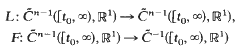
(the latter symbol denotes the space of locally summable functions).
As an application of the results obtained, theorems are proved for the asymptotic behaviour of the solutions of certain classes of functional-differential and integro-differential neutral-type equations.
Full- and partial-range eigenfunction expansions for Sturm-Liouville problems with indefinite weights*
-
- Journal:
- Proceedings of the Royal Society of Edinburgh. Section A: Mathematics / Volume 98 / Issue 1-2 / 1984
- Published online by Cambridge University Press:
- 14 November 2011, pp. 69-88
- Print publication:
- 1984
-
- Article
- Export citation
Abelian theorems for the distributional Mellin transform
-
- Journal:
- Proceedings of the Royal Society of Edinburgh. Section A: Mathematics / Volume 96 / Issue 3-4 / 1984
- Published online by Cambridge University Press:
- 14 November 2011, pp. 193-200
- Print publication:
- 1984
-
- Article
- Export citation
On positive definite differences of multilinear forms and their representation
-
- Journal:
- Proceedings of the Royal Society of Edinburgh. Section A: Mathematics / Volume 96 / Issue 1-2 / 1984
- Published online by Cambridge University Press:
- 14 November 2011, pp. 97-108
- Print publication:
- 1984
-
- Article
- Export citation
-
We study the evaluation of multilinear forms
 under arbitrary rearrangements of the entries of increasing n-tuples x(1), x(2),…, x(m), and we show that the difference of two such multilinear forms under certain circumstances can be written as a sum of obviously definite forms.
 under arbitrary rearrangements of the entries of increasing n-tuples
 On the topological structure of the set of generalized solutions of the catenary problem
-
- Journal:
- Proceedings of the Royal Society of Edinburgh. Section A: Mathematics / Volume 98 / Issue 3-4 / 1984
- Published online by Cambridge University Press:
- 14 November 2011, pp. 339-348
- Print publication:
- 1984
-
- Article
- Export citation
On an index law and a result of Buschman
-
- Journal:
- Proceedings of the Royal Society of Edinburgh. Section A: Mathematics / Volume 96 / Issue 3-4 / 1984
- Published online by Cambridge University Press:
- 14 November 2011, pp. 231-247
- Print publication:
- 1984
-
- Article
- Export citation
Multiplicity results for a nonlinear Dirichlet problem
-
- Journal:
- Proceedings of the Royal Society of Edinburgh. Section A: Mathematics / Volume 96 / Issue 3-4 / 1984
- Published online by Cambridge University Press:
- 14 November 2011, pp. 331-336
- Print publication:
- 1984
-
- Article
- Export citation
Uniqueness of positive solutions for a class of elliptic boundary value problems
-
- Journal:
- Proceedings of the Royal Society of Edinburgh. Section A: Mathematics / Volume 98 / Issue 3-4 / 1984
- Published online by Cambridge University Press:
- 14 November 2011, pp. 267-269
- Print publication:
- 1984
-
- Article
- Export citation
On the traction problem for linear elastostatics in exterior domains
-
- Journal:
- Proceedings of the Royal Society of Edinburgh. Section A: Mathematics / Volume 96 / Issue 1-2 / 1984
- Published online by Cambridge University Press:
- 14 November 2011, pp. 55-64
- Print publication:
- 1984
-
- Article
- Export citation
