Refine search
Actions for selected content:
26079 results in Abstract analysis
On hypersonic self-induced separation, hydraulic jumps and boundary layers with algebraic growth
- Part of
-
- Journal:
- Mathematika / Volume 30 / Issue 1 / June 1983
- Published online by Cambridge University Press:
- 26 February 2010, pp. 77-93
- Print publication:
- June 1983
-
- Article
- Export citation
An analytic inequality
- Part of
-
- Journal:
- Mathematika / Volume 30 / Issue 1 / June 1983
- Published online by Cambridge University Press:
- 26 February 2010, pp. 142-152
- Print publication:
- June 1983
-
- Article
- Export citation
Some metrical properties of continued fractions
-
- Journal:
- Mathematika / Volume 30 / Issue 1 / June 1983
- Published online by Cambridge University Press:
- 26 February 2010, pp. 117-132
- Print publication:
- June 1983
-
- Article
- Export citation
-
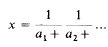
§1. Let E = E(A) be the set of real numbers x ε (0, 1) whose regular continued fraction expansion
contains only partial denominators ai from a given set A of positive integers. For finite A the (Hausdorff-) dimensional numbers dim E have been studied by I. J. Good ‘2’ and T. W. Cusick ‘1’. C. A. Rogers ‘8’ introduced a natural probability measure on E. He showed that excluding sets with measure between 0 and 1 (in the strict sense) from E does not reduce the dimensionality more than excluding sets of measure zero, and that the minimal (“essential”) dimensions ess dim E arising in this way is smaller than dim E, at least for A = {1,…, r} when r = 2 or r is sufficiently large.
On certain infinite products
-
- Journal:
- Mathematika / Volume 30 / Issue 1 / June 1983
- Published online by Cambridge University Press:
- 26 February 2010, pp. 4-10
- Print publication:
- June 1983
-
- Article
- Export citation
-
Let η(z) be the Dedekind eta function defined by
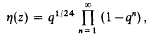
where q = exp(2πiz) and Im (z) > 0. Then it is famous that

On capitulation in certain Zl-extensions of number fields
-
- Journal:
- Mathematika / Volume 30 / Issue 1 / June 1983
- Published online by Cambridge University Press:
- 26 February 2010, pp. 58-60
- Print publication:
- June 1983
-
- Article
- Export citation
-
Let F be a number field, l a prime, and K a normal extension of F for which Gal(K/F) is topologically isomorphic to the additive group Zl. Then, corresponding to the subgroups ln Zl, there is a chain of fields F = F0 ⊂ F1 ⊂ F2 ⊂ … ⊂ K so that Gal (Fn/F) is cyclic of order ln. Let An be the l-Sylow subgroup of the ideal class group of Fn. By the now well-known theorem of Iwasawa, there are constants μ, λ and ν so that, for all sufficiently large n, |An| = len, where en = μln + λn + ν. Much work has been done investigating these constants, especially showing μ to be 0 for cyclotomic Zl-extensions of abelian fields F, [2], and computing λ and ν in special cases. In many cases, it has been shown that μ = λ = 0, and I know of no cases where μ or λ are positive when F is totally real (cf. Greenberg [3]). Here we investigate the maps in,m: An → Am induced by the inclusion of Fn in Fm for m ≥ n, with a view to determining their kernels. When μ = λ = 0, we prove that in, n+s(An) =
 for large enough n, and that, for large enough n, Ker in, n+s coincides with the kernel of the ls power map on An. I thank A. Brumer for helpful conversations on this matter.
 for large enough n, and that, for large enough n, Ker i
On the distribution of √p modulo one
-
- Journal:
- Mathematika / Volume 30 / Issue 1 / June 1983
- Published online by Cambridge University Press:
- 26 February 2010, pp. 104-116
- Print publication:
- June 1983
-
- Article
- Export citation
-
It was shown by Vinogradov (see Theorem 7, Chapter 4 of [18]) that, for ε > 0, there are infinitely many solutions in primes p of the inequality

where {x} denotes the fractional part of x and y = 0.1. The value of γ was improved to
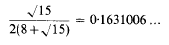
by Kaufman [9]. On the Riemann Hypothesis he showed that one can take γ =¼ The method used actually shows that, for any real β and any δ with 0 < 8 > 1, the number of primes p ≤ x satisfying
is
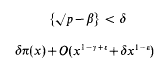
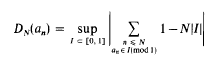
where π(x) denotes the number of primes not exceeding x. The sequence √p is, of course, a subsequence of the sequence n½ whose distribution modulo one has also been investigated (see Chapter 2, Section 3 of [10]: the argument for sequences nσ (0 < σ < 1) is entirely elementary). It is useful in this context to define the discrepancy (modulo one) of a sequence an by

The average order of magnitude of least primitive roots in algebraic number fields
-
- Journal:
- Mathematika / Volume 30 / Issue 1 / June 1983
- Published online by Cambridge University Press:
- 26 February 2010, pp. 11-25
- Print publication:
- June 1983
-
- Article
- Export citation
-
One of the oldest questions concerning primitive roots is that of the actual order df magnitude of the least positive primitive root m(p) to a large prime modulus p. During the last sixty years the interest of several mathematicians has been attracted by this problem. The history of the major results is too well known to need elaboration. The best known bound for m(p) is due to Wang [8] and Burgess [1] who independently obtained

On Kruskal's cascades and counting containments in a set of subsets
- Part of
-
- Journal:
- Mathematika / Volume 30 / Issue 1 / June 1983
- Published online by Cambridge University Press:
- 26 February 2010, pp. 133-141
- Print publication:
- June 1983
-
- Article
- Export citation
-
Let ℱ be a set of m subsets of X = {1,2,…, n}. We study the maximum number λ of containments Y ⊂ Z with Y, Z ∊ ℱ. Theorem 9.
 , if, and only if, ml/n → 1. When n is large and members of ℱ have cardinality k or k–1 we determine λ. For this we bound (ΔN)/N where ΔN is the shadow of Kruskal's k-cascade for the integer N. Roughly, if m ∼ N + ΔN, then λ ∼ kN with infinitely many cases of equality. A by-product is Theorem 7 of LYM posets.
 , if, and only if, m
Transcendental numbers arising from Drinfeld modules
-
- Journal:
- Mathematika / Volume 30 / Issue 1 / June 1983
- Published online by Cambridge University Press:
- 26 February 2010, pp. 61-66
- Print publication:
- June 1983
-
- Article
- Export citation
-
Let
 be a smooth projective, geometrically irreducible curve over a finite field
  . We fix a rational point ∞on , and consider the ring A of functions on regular away from ∞. We set k to be the function field of and k∞ its completion at ∞. After taking algebraic closure we obtain the field
  whose elements will be called “numbers”.
 be a smooth projective, geometrically irreducible curve over a finite field
  . We fix a rational point ∞on
  whose elements will be called “numbers”.
MTK volume 30 issue 1 Front matter
-
- Journal:
- Mathematika / Volume 30 / Issue 1 / June 1983
- Published online by Cambridge University Press:
- 26 February 2010, pp. f1-f2
- Print publication:
- June 1983
-
- Article
-
- You have access
- Export citation
On the general solution of a linear second order equation with variable coefficients
-
- Journal:
- Mathematika / Volume 30 / Issue 1 / June 1983
- Published online by Cambridge University Press:
- 26 February 2010, pp. 94-103
- Print publication:
- June 1983
-
- Article
- Export citation
On the densest packing of convex discs
-
- Journal:
- Mathematika / Volume 30 / Issue 1 / June 1983
- Published online by Cambridge University Press:
- 26 February 2010, pp. 1-3
- Print publication:
- June 1983
-
- Article
- Export citation
Contents
-
- Book:
- Ergodic Theory
- Published online:
- 05 June 2012
- Print publication:
- 12 May 1983, pp v-vii
-
- Chapter
- Export citation
5 - Entropy
-
- Book:
- Ergodic Theory
- Published online:
- 05 June 2012
- Print publication:
- 12 May 1983, pp 227-248
-
- Chapter
- Export citation
3 - More about almost everywhere convergence
-
- Book:
- Ergodic Theory
- Published online:
- 05 June 2012
- Print publication:
- 12 May 1983, pp 74-132
-
- Chapter
- Export citation
References
-
- Book:
- Ergodic Theory
- Published online:
- 05 June 2012
- Print publication:
- 12 May 1983, pp 302-321
-
- Chapter
- Export citation
Preface
-
- Book:
- Ergodic Theory
- Published online:
- 05 June 2012
- Print publication:
- 12 May 1983, pp ix-xii
-
- Chapter
- Export citation
Index
-
- Book:
- Ergodic Theory
- Published online:
- 05 June 2012
- Print publication:
- 12 May 1983, pp 322-329
-
- Chapter
- Export citation
1 - Introduction and preliminaries
-
- Book:
- Ergodic Theory
- Published online:
- 05 June 2012
- Print publication:
- 12 May 1983, pp 1-22
-
- Chapter
- Export citation
4 - More about recurrence
-
- Book:
- Ergodic Theory
- Published online:
- 05 June 2012
- Print publication:
- 12 May 1983, pp 133-226
-
- Chapter
- Export citation
