Refine search
Actions for selected content:
26079 results in Abstract analysis
On the traction problem for linear elastostatics in exterior domains
-
- Journal:
- Proceedings of the Royal Society of Edinburgh. Section A: Mathematics / Volume 96 / Issue 1-2 / 1984
- Published online by Cambridge University Press:
- 14 November 2011, pp. 55-64
- Print publication:
- 1984
-
- Article
- Export citation
A stable method for an inverse problem in acoustic scattering by an obstacle with an impedance boundary condition
-
- Journal:
- Proceedings of the Royal Society of Edinburgh. Section A: Mathematics / Volume 98 / Issue 3-4 / 1984
- Published online by Cambridge University Press:
- 14 November 2011, pp. 355-364
- Print publication:
- 1984
-
- Article
- Export citation
Generic space curves and secants
-
- Journal:
- Proceedings of the Royal Society of Edinburgh. Section A: Mathematics / Volume 98 / Issue 3-4 / 1984
- Published online by Cambridge University Press:
- 14 November 2011, pp. 281-289
- Print publication:
- 1984
-
- Article
- Export citation
Well-posedness, control and computation of a one-phase Stefan problem with Neumann condition*
-
- Journal:
- Proceedings of the Royal Society of Edinburgh. Section A: Mathematics / Volume 98 / Issue 1-2 / 1984
- Published online by Cambridge University Press:
- 14 November 2011, pp. 105-148
- Print publication:
- 1984
-
- Article
- Export citation
Comparison functions for a model problem related to nonlinear elasticity
-
- Journal:
- Proceedings of the Royal Society of Edinburgh. Section A: Mathematics / Volume 99 / Issue 1-2 / 1984
- Published online by Cambridge University Press:
- 14 November 2011, pp. 89-114
- Print publication:
- 1984
-
- Article
- Export citation
-
Comparison functions are constructed for the problem of minimizing

over maps u: D(⊆ℝ2)→ℝ2 with det≥0, subject to the constraint u= f on ∂D, D the unit disk. This is accomplished for maps / which are reparameterizations of ∂D or which are “graph-like” maps. Estimates involving half derivative boundary norms are obtained.
Asymptotics and deficiency indices for certain pairs of differential operators
-
- Journal:
- Proceedings of the Royal Society of Edinburgh. Section A: Mathematics / Volume 97 / 1984
- Published online by Cambridge University Press:
- 14 November 2011, pp. 43-58
- Print publication:
- 1984
-
- Article
- Export citation
The number of limit cycles of certain polynomial differential equations
-
- Journal:
- Proceedings of the Royal Society of Edinburgh. Section A: Mathematics / Volume 98 / Issue 3-4 / 1984
- Published online by Cambridge University Press:
- 14 November 2011, pp. 215-239
- Print publication:
- 1984
-
- Article
- Export citation
-
Two-dimensional differential systems

are considered, where P and Q are polynomials. The question of interest is the maximum possible numberof limit cycles of such systems in terms of the degree of P and Q. An algorithm is described for determining a so-called focal basis; this can be implemented on a computer. Estimates can then be obtained for the number of small-amplitude limit cycles. The technique is applied to certain cubic systems; a class of examples with exactly five small-amplitude limit cycles is constructed. Quadratic systems are also considered.
MTK volume 30 issue 2 Front matter
-
- Journal:
- Mathematika / Volume 30 / Issue 2 / December 1983
- Published online by Cambridge University Press:
- 26 February 2010, pp. f1-f10
- Print publication:
- December 1983
-
- Article
-
- You have access
- Export citation
The toroidal analogue to Eberhard's theorem
-
- Journal:
- Mathematika / Volume 30 / Issue 2 / December 1983
- Published online by Cambridge University Press:
- 26 February 2010, pp. 274-290
- Print publication:
- December 1983
-
- Article
- Export citation
-
In 1891 Victor Eberhard proved the following theorem concerning the number pk(P) of k-gonal facets of simple polytopes P, [4].
Eberhard's Theorem. For each k ≥ 3, k ≠ 6, let pk be a non-negative integer. Then there exists a simple 3-polytope P such that pk(P) = pk (k ≠ 6), if, and only if,

Convergence and summability factors in a sequence (II)
- Part of
-
- Journal:
- Mathematika / Volume 30 / Issue 2 / December 1983
- Published online by Cambridge University Press:
- 26 February 2010, pp. 255-273
- Print publication:
- December 1983
-
- Article
- Export citation
-
1.1. In an earlier paper [6] the author proved
Theorem A. If α ≥ 0, β ≥ 0 (α, β integers), p > –1, p–r > –1 then necessary and sufficient conditions for a sequence (εn) to be such that

are

and

If α ≥ 1 (α an integer) and (ii) holds, then (i)bis equivalent to

The graphs of exponential sums
-
- Journal:
- Mathematika / Volume 30 / Issue 2 / December 1983
- Published online by Cambridge University Press:
- 26 February 2010, pp. 153-163
- Print publication:
- December 1983
-
- Article
- Export citation
-
In [3], D. H. Lehmer has analysed the incomplete Gaussian sum
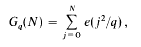
where N and q are positive integers with N < q and e(x) is an abbreviation for e2πix. The crucial observation is that, for almost all values of N, Gq(N) is in the vicinity of the point ¼(1 + i)q1/2. This leads to sharp estimates of the shape Gq(N) = O(q½).
MTK volume 30 issue 2 Back matter
-
- Journal:
- Mathematika / Volume 30 / Issue 2 / December 1983
- Published online by Cambridge University Press:
- 26 February 2010, p. b1
- Print publication:
- December 1983
-
- Article
-
- You have access
- Export citation
Aspherical manifolds with the Q-homology of a sphere
-
- Journal:
- Mathematika / Volume 30 / Issue 2 / December 1983
- Published online by Cambridge University Press:
- 26 February 2010, pp. 291-294
- Print publication:
- December 1983
-
- Article
- Export citation
On a free boundary problem for the equations of tidal motions
- Part of
-
- Journal:
- Mathematika / Volume 30 / Issue 2 / December 1983
- Published online by Cambridge University Press:
- 26 February 2010, pp. 222-254
- Print publication:
- December 1983
-
- Article
- Export citation
K-analytic sets
- Part of
-
- Journal:
- Mathematika / Volume 30 / Issue 2 / December 1983
- Published online by Cambridge University Press:
- 26 February 2010, pp. 189-221
- Print publication:
- December 1983
-
- Article
- Export citation
Small solutions of congruences
-
- Journal:
- Mathematika / Volume 30 / Issue 2 / December 1983
- Published online by Cambridge University Press:
- 26 February 2010, pp. 164-188
- Print publication:
- December 1983
-
- Article
- Export citation
-
Throughout the paper, let m be a natural number and let F(x1,…, xn) be a form of degree k ≥ 2 with integer coefficients, n ≥ 3. We are concerned with finding solutions of the congruence

for which x is a small non-zero integer vector. For example, in the case k = 2 it was shown by Schinzel, Schlickewei and Schmidt [11] that is a solution of (1) satisfying

provided that n is odd. This is best possible for n = 3, as we shall see later. Of course we can get an exponent (1/2) + (1/(2n – 2)) trivially for even n. I do not know how to improve on this. D. R. Heath-Brown (private communication) can improve the exponent in (2) to (l/2) + ε for n ≥ 4 and prime m > C1(ε).
MTK volume 30 issue 1 Back matter
-
- Journal:
- Mathematika / Volume 30 / Issue 1 / June 1983
- Published online by Cambridge University Press:
- 26 February 2010, p. b1
- Print publication:
- June 1983
-
- Article
-
- You have access
- Export citation
Generalized irregular primes
-
- Journal:
- Mathematika / Volume 30 / Issue 1 / June 1983
- Published online by Cambridge University Press:
- 26 February 2010, pp. 67-73
- Print publication:
- June 1983
-
- Article
- Export citation
A counterexample to elimination in systems of algebraic differential equations
- Part of
-
- Journal:
- Mathematika / Volume 30 / Issue 1 / June 1983
- Published online by Cambridge University Press:
- 26 February 2010, pp. 74-76
- Print publication:
- June 1983
-
- Article
- Export citation
Class groups of cyclic p-groups
-
- Journal:
- Mathematika / Volume 30 / Issue 1 / June 1983
- Published online by Cambridge University Press:
- 26 February 2010, pp. 26-57
- Print publication:
- June 1983
-
- Article
- Export citation
-
As usual, if π is a finite group and ℳ ⊆ ℚπ a maximal order containing , we set

This is well known to be a finite group, and independent of the choice of ℳ.
