Refine search
Actions for selected content:
26079 results in Abstract analysis
Linearization stability and Signorini Series for the traction problem in elastostatics
-
- Journal:
- Proceedings of the Royal Society of Edinburgh. Section A: Mathematics / Volume 95 / Issue 1-2 / 1983
- Published online by Cambridge University Press:
- 14 November 2011, pp. 171-180
- Print publication:
- 1983
-
- Article
- Export citation
On the compatibility of the natural order on a regular semigroup
-
- Journal:
- Proceedings of the Royal Society of Edinburgh. Section A: Mathematics / Volume 94 / Issue 1-2 / 1983
- Published online by Cambridge University Press:
- 14 November 2011, pp. 79-84
- Print publication:
- 1983
-
- Article
- Export citation
On a common abstraction of de Morgan algebras and Stone algebras
-
- Journal:
- Proceedings of the Royal Society of Edinburgh. Section A: Mathematics / Volume 94 / Issue 3-4 / 1983
- Published online by Cambridge University Press:
- 14 November 2011, pp. 301-308
- Print publication:
- 1983
-
- Article
- Export citation
The distribution of the values of a random power series in the unit disk
-
- Journal:
- Proceedings of the Royal Society of Edinburgh. Section A: Mathematics / Volume 94 / Issue 3-4 / 1983
- Published online by Cambridge University Press:
- 14 November 2011, pp. 251-263
- Print publication:
- 1983
-
- Article
- Export citation
-
This is a study of the family of power series
 where Σ αnZn has unit radius of convergence and the εn are independent random variables taking the values ±1 with equal probability. It is shown that if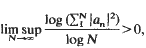
then almost all these power series take every complex value infinitely often in the unit disk.
 where Σ α
On a conjecture related to the number of solutions of a nonlinear Dirichlet problem
-
- Journal:
- Proceedings of the Royal Society of Edinburgh. Section A: Mathematics / Volume 95 / Issue 3-4 / 1983
- Published online by Cambridge University Press:
- 14 November 2011, pp. 275-283
- Print publication:
- 1983
-
- Article
- Export citation
Nonlinear eigenvalue problems for the whirling of heavy elastic strings, II: new methods of global bifurcation theory
-
- Journal:
- Proceedings of the Royal Society of Edinburgh. Section A: Mathematics / Volume 93 / Issue 3-4 / 1983
- Published online by Cambridge University Press:
- 14 November 2011, pp. 197-227
- Print publication:
- 1983
-
- Article
- Export citation
PRM volume 95 issue 3-4 Cover and Back matter
-
- Journal:
- Proceedings of the Royal Society of Edinburgh. Section A: Mathematics / Volume 95 / Issue 3-4 / 1983
- Published online by Cambridge University Press:
- 14 November 2011, pp. b1-b4
- Print publication:
- 1983
-
- Article
-
- You have access
- Export citation
On a class of evolution problems
-
- Journal:
- Proceedings of the Royal Society of Edinburgh. Section A: Mathematics / Volume 95 / Issue 3-4 / 1983
- Published online by Cambridge University Press:
- 14 November 2011, pp. 247-256
- Print publication:
- 1983
-
- Article
- Export citation
Index to Volume 94
-
- Journal:
- Proceedings of the Royal Society of Edinburgh. Section A: Mathematics / Volume 94 / Issue 3-4 / 1983
- Published online by Cambridge University Press:
- 14 November 2011, pp. i-ii
- Print publication:
- 1983
-
- Article
- Export citation
Quantitative maximum principles and strongly coupled gradient-like reaction-diffusion systems
-
- Journal:
- Proceedings of the Royal Society of Edinburgh. Section A: Mathematics / Volume 94 / Issue 3-4 / 1983
- Published online by Cambridge University Press:
- 14 November 2011, pp. 265-286
- Print publication:
- 1983
-
- Article
- Export citation
The square mean of Dirichlet series associated with cusp forms
-
- Journal:
- Mathematika / Volume 29 / Issue 2 / December 1982
- Published online by Cambridge University Press:
- 26 February 2010, pp. 278-295
- Print publication:
- December 1982
-
- Article
- Export citation
-
Let

be a cusp form of even integral weight k > 2 for the full modular group. Then the Dirichlet series

is absolutely convergent for σ > ½(k + 1). Hecke showed that LF is an entire function of s satisfying the functional equation

Further lattice packings in high dimensions
-
- Journal:
- Mathematika / Volume 29 / Issue 2 / December 1982
- Published online by Cambridge University Press:
- 26 February 2010, pp. 171-180
- Print publication:
- December 1982
-
- Article
- Export citation
-
Barnes and Sloane recently described a “general construction” for lattice packings of equal spheres in Euclidean space. In the present paper we simplify and further generalize their construction, and make it suitable for iteration. As a result we obtain lattice packings in ℝm with density Δ satisfying
 , as m → ∞ where
  is the smallest value of k for which the k-th iterated logarithm of m is less than 1. These appear to be the densest lattices that have been explicitly constructed in high-dimensional space. New records are also established in a number of lower dimensions, beginning in dimension 96.
 , as m → ∞ where
  is the smallest value of k for which the k-th iterated logarithm of m is less than 1. These appear to be the densest lattices that have been explicitly constructed in high-dimensional space. New records are also established in a number of lower dimensions, beginning in dimension 96.
Irrationality of lattices in finite characteristic
-
- Journal:
- Mathematika / Volume 29 / Issue 2 / December 1982
- Published online by Cambridge University Press:
- 26 February 2010, pp. 227-230
- Print publication:
- December 1982
-
- Article
- Export citation
-
Let q = pn, p a rational prime, and let
 be the finite field with q elements. The polynomial ring
  is considered as an analogue of the ring of rational integers ℤ. Completing the quotient field
  with respect to the normalized valuation at ∞, and then taking algebraic closure, we obtained the field k∞ whose elements will be called “numbers”.
 be the finite field with q elements. The polynomial ring
  is considered as an analogue of the ring of rational integers ℤ. Completing the quotient field
  with respect to the normalized valuation at ∞, and then taking algebraic closure, we obtained the field k
Further solutions of the Falkner–Skan equation for β = – 1 and γ = 0
- Part of
-
- Journal:
- Mathematika / Volume 29 / Issue 2 / December 1982
- Published online by Cambridge University Press:
- 26 February 2010, pp. 231-248
- Print publication:
- December 1982
-
- Article
- Export citation
-
We consider the Falkner–Skan equation
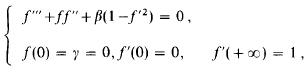
in the special case β = – 1. It is known that this equation may be integrated twice to get the Riccati equation

Packing and covering with convex discs
-
- Journal:
- Mathematika / Volume 29 / Issue 2 / December 1982
- Published online by Cambridge University Press:
- 26 February 2010, pp. 181-193
- Print publication:
- December 1982
-
- Article
- Export citation
Connectivity and freely rolling convex bodies
- Part of
-
- Journal:
- Mathematika / Volume 29 / Issue 2 / December 1982
- Published online by Cambridge University Press:
- 26 February 2010, pp. 249-259
- Print publication:
- December 1982
-
- Article
- Export citation
MTK volume 29 issue 2 Back matter
-
- Journal:
- Mathematika / Volume 29 / Issue 2 / December 1982
- Published online by Cambridge University Press:
- 26 February 2010, p. b1
- Print publication:
- December 1982
-
- Article
-
- You have access
- Export citation
On the Riemann zeta-function ζ(s)—Gaps between sign changes of S(t)
-
- Journal:
- Mathematika / Volume 29 / Issue 2 / December 1982
- Published online by Cambridge University Press:
- 26 February 2010, pp. 264-269
- Print publication:
- December 1982
-
- Article
- Export citation
-
Denote by N(t) the number of zeros β + iγ of ζ(s), s = σ + it, with 0 < β < 1 and 0 < γ < t. It is well known that
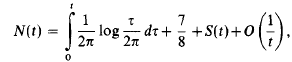
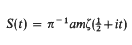
where
Power mean values of the Riemann zeta-function
-
- Journal:
- Mathematika / Volume 29 / Issue 2 / December 1982
- Published online by Cambridge University Press:
- 26 February 2010, pp. 202-212
- Print publication:
- December 1982
-
- Article
- Export citation
-
The classical mean value theorem for Dirichlet's polynomials states that

see H. L. Montgomery [7]. This formula is very useful in the theory of the Riemann zeta-function ζ(s). From the approximate functional equation

where | χ(½ + it)| = 1, u, v ≥ 1, 2πuv = t (see E. C. Titchmarsh [8]) it follows that χ(½ + it) can be well approximated by Dirichlet's polynomials of length N< t½.
MTK volume 29 issue 2 Front matter
-
- Journal:
- Mathematika / Volume 29 / Issue 2 / December 1982
- Published online by Cambridge University Press:
- 26 February 2010, pp. f1-f2
- Print publication:
- December 1982
-
- Article
-
- You have access
- Export citation
