Refine search
Actions for selected content:
26079 results in Abstract analysis
The recognition of certain Hausdorff like measures
- Part of
-
- Journal:
- Mathematika / Volume 29 / Issue 2 / December 1982
- Published online by Cambridge University Press:
- 26 February 2010, pp. 260-263
- Print publication:
- December 1982
-
- Article
- Export citation
-
For a metric space <Ω, ρ> and a ‘measure function’ h, the Hausdorff measure mh on Ω is denned by applying Method II to the premeasure defined by τ(E) = h(d(E)), E ⊆ Ω, where
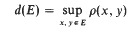
with d(Φ) = 0, is the diameter of E. The set function mh is then a metric outer measure. There are many variations on this definition producing measures also associated with the name Hausdorff. Here we are concerned with those measures which arise when there is a restriction on the sets E for which τ is defined. Such measures arise, for example, as net measures, Rogers [1]. Also we might find it useful to have τ defined only on disks, or only on squares, or only on rectangles with a given relation between vertical and horizontal sides.
Slices of L. Fejes Tóth's sausage conjecture
- Part of
-
- Journal:
- Mathematika / Volume 29 / Issue 2 / December 1982
- Published online by Cambridge University Press:
- 26 February 2010, pp. 194-201
- Print publication:
- December 1982
-
- Article
- Export citation
-
Let
 be k non-overlapping translates of the unit d-ball Bd in euclidean d-space Ed. Let Ck denote the convex hull of their centres and let Sk be a segment of length 2(k– 1). Furthermore, let Vd denote the d-volume. L. Fejes Tóth conjectured in [1], that, for d ≥ 5,
 be k non-overlapping translates of the unit d-ball B
On the Mertens conjecture for cusp forms
-
- Journal:
- Mathematika / Volume 29 / Issue 2 / December 1982
- Published online by Cambridge University Press:
- 26 February 2010, pp. 213-226
- Print publication:
- December 1982
-
- Article
- Export citation
-
Let f be a non-zero cusp form of weight k on SL(2, ℤ) with Fourier expansion
 We assume further that f is normalized (a(1) = 1) and that f is an eigenfunction of the Hecke operators. Define
 We assume further that f is normalized (a(1) = 1) and that f is an eigenfunction of the Hecke operators. Define
Exponential sums connected with Ramanujan's function τ(n)
-
- Journal:
- Mathematika / Volume 29 / Issue 2 / December 1982
- Published online by Cambridge University Press:
- 26 February 2010, pp. 270-277
- Print publication:
- December 1982
-
- Article
- Export citation
-
This paper contains estimates of several exponential sums involving Fourier coefficients of certain modular forms. Although the questions which we consider date back, in some cases, to the twenties, our motivation is modern. All of these sums are connected with one approach to the problem of calculating the norm of the Poincaré 0-operator. In this section we state our results (and their antecedents) and then describe their relevance to the θ-operator problem. For simplicity we state and prove all our results for the modular cusp form of weight six, the famous discriminant function

Local cohomology and modules of generalized fractions
- Part of
-
- Journal:
- Mathematika / Volume 29 / Issue 2 / December 1982
- Published online by Cambridge University Press:
- 26 February 2010, pp. 296-306
- Print publication:
- December 1982
-
- Article
- Export citation
-
The purpose of this paper is to provide additional evidence to support our view that the modules of generalized fractions introduced in [8] are worth further investigation: we show that, for a module M over a (commutative, Noetherian) local ring A (with identity) having maximal ideal m and dimension n, the n-th local cohomology module
 may be viewed as a module of generalized fractions of M with respect to a certain triangular subset of An + 1, and we use this work to formulate Hochster's ‘Monomial Conjecture’ [2, Conjecture 1]; in terms of modules of generalized fractions and to make a quick deduction of one of Hochster's results which supports that conjecture.
 may be viewed as a module of generalized fractions of M with respect to a certain triangular subset of A
IV - The initial and final behaviour of trajectories of Markov processes (RMS 26:4 (1971) 165–185)
-
- Book:
- Markov Processes and Related Problems of Analysis
- Published online:
- 18 March 2010
- Print publication:
- 23 September 1982, pp 123-144
-
- Chapter
- Export citation
V - Integral representation of excessive measures and excessive functions (RMS 27:1 (1972) 43–84
-
- Book:
- Markov Processes and Related Problems of Analysis
- Published online:
- 18 March 2010
- Print publication:
- 23 September 1982, pp 145-186
-
- Chapter
- Export citation
Contents
-
- Book:
- Markov Processes and Related Problems of Analysis
- Published online:
- 18 March 2010
- Print publication:
- 23 September 1982, pp v-v
-
- Chapter
- Export citation
Preface
-
- Book:
- Markov Processes and Related Problems of Analysis
- Published online:
- 18 March 2010
- Print publication:
- 23 September 1982, pp vi-viii
-
- Chapter
- Export citation
IX - Minimal excessive measures and functions (Trans. AMS 258 (1980) 217–244)
-
- Book:
- Markov Processes and Related Problems of Analysis
- Published online:
- 18 March 2010
- Print publication:
- 23 September 1982, pp 285-312
-
- Chapter
- Export citation
I - Markov processes and related problems of analysis (RMS 15:2 (1960) 1–21)
-
- Book:
- Markov Processes and Related Problems of Analysis
- Published online:
- 18 March 2010
- Print publication:
- 23 September 1982, pp 1-24
-
- Chapter
- Export citation
VI - Regular Markov processes (RMS 28:2 (1973) 33–64)
-
- Book:
- Markov Processes and Related Problems of Analysis
- Published online:
- 18 March 2010
- Print publication:
- 23 September 1982, pp 187-218
-
- Chapter
- Export citation
VII - Markov representations of stochastic systems (RMS 30:1 (1975) 65–104)
-
- Book:
- Markov Processes and Related Problems of Analysis
- Published online:
- 18 March 2010
- Print publication:
- 23 September 1982, pp 219-258
-
- Chapter
- Export citation
Frontmatter
-
- Book:
- Markov Processes and Related Problems of Analysis
- Published online:
- 18 March 2010
- Print publication:
- 23 September 1982, pp i-iv
-
- Chapter
- Export citation
III - Boundary theory of Markov processes (the discrete case) (RMS 24:2 (1969) 1–42)
-
- Book:
- Markov Processes and Related Problems of Analysis
- Published online:
- 18 March 2010
- Print publication:
- 23 September 1982, pp 79-122
-
- Chapter
- Export citation
VIII - Sufficient statistics and extreme points (Ann. Prob. 6 (1978) 705–730)
-
- Book:
- Markov Processes and Related Problems of Analysis
- Published online:
- 18 March 2010
- Print publication:
- 23 September 1982, pp 259-284
-
- Chapter
- Export citation
II - Martin boundaries and non-negative solutions of a boundary value problem with a directional derivative (RMS 19:5 (1964) 1–48)
-
- Book:
- Markov Processes and Related Problems of Analysis
- Published online:
- 18 March 2010
- Print publication:
- 23 September 1982, pp 25-78
-
- Chapter
- Export citation
Frontmatter
-
- Book:
- Classification Problems in Ergodic Theory
- Published online:
- 20 May 2010
- Print publication:
- 08 July 1982, pp i-iv
-
- Chapter
- Export citation
Index
-
- Book:
- Classification Problems in Ergodic Theory
- Published online:
- 20 May 2010
- Print publication:
- 08 July 1982, pp 100-101
-
- Chapter
- Export citation
Chapter V - Classifications of Topological Markov Chains
-
- Book:
- Classification Problems in Ergodic Theory
- Published online:
- 20 May 2010
- Print publication:
- 08 July 1982, pp 64-89
-
- Chapter
- Export citation
