Refine search
Actions for selected content:
26079 results in Abstract analysis
Optimal lower bounds for the spectrum of a second order linear differential equation with a p-integrable coefficient
-
- Journal:
- Proceedings of the Royal Society of Edinburgh. Section A: Mathematics / Volume 92 / Issue 1-2 / 1982
- Published online by Cambridge University Press:
- 14 November 2011, pp. 95-101
- Print publication:
- 1982
-
- Article
- Export citation
Counting singularities
-
- Journal:
- Proceedings of the Royal Society of Edinburgh. Section A: Mathematics / Volume 93 / Issue 1-2 / 1982
- Published online by Cambridge University Press:
- 14 November 2011, pp. 137-159
- Print publication:
- 1982
-
- Article
- Export citation
Enumeration of smooth labelled graphs
-
- Journal:
- Proceedings of the Royal Society of Edinburgh. Section A: Mathematics / Volume 91 / Issue 3-4 / 1982
- Published online by Cambridge University Press:
- 14 November 2011, pp. 205-212
- Print publication:
- 1982
-
- Article
- Export citation
-
An (n, q) graph is a graph on n labelled points and q lines without loops or multiple lines. We write ν(n, q) for the number of smooth (n, q) graphs, i.e. connected graphs without end points, and ν = V(Z, Y) = ∑n,q ν(n,q)ZnYq /n! for the exponential generating function of ν(n,q). We use the Riddell “core and mantle” method to find an explicit form for V (not, as usual with this method, only a functional equation). From this we deduce a partial differential equation satisfied by V. We interpret this equation in purely combinatorial terms. We write Vk = ∑ n ν(n, n + k)Xn/n! and find a recurrence formula for Vk for successive k. We use these and other results to find an asymptotic expansion for ν(n,q) as n→∞ when (q/n) −
 log n − log log n→ + ∞ and an asymptotic approximation to ν(n,n + k) when 0 < k = o
 and to log ν(n, n + k) when k < (1−ε).
 log n −
  and to log ν(n, n + k) when k <
 Generalised functions and their convolution
-
- Journal:
- Proceedings of the Royal Society of Edinburgh. Section A: Mathematics / Volume 91 / Issue 3-4 / 1982
- Published online by Cambridge University Press:
- 14 November 2011, pp. 213-233
- Print publication:
- 1982
-
- Article
- Export citation
Existence and non-existence results for semilinear elliptic problems in unbounded domains
-
- Journal:
- Proceedings of the Royal Society of Edinburgh. Section A: Mathematics / Volume 93 / Issue 1-2 / 1982
- Published online by Cambridge University Press:
- 14 November 2011, pp. 1-14
- Print publication:
- 1982
-
- Article
- Export citation
-
In this paper, we prove various existence and non-existence results for semilinear elliptic problems in unbounded domains. In particular we prove for general classes of unbounded domains that there exists no solution distinct from 0 of

for any smooth f satisfying f(0) = 0. This result is obtained by the use of new identities that solutions of semilinear elliptic equations satisfy.
The G-invariant implicit function theorem in infinite dimensions
-
- Journal:
- Proceedings of the Royal Society of Edinburgh. Section A: Mathematics / Volume 92 / Issue 1-2 / 1982
- Published online by Cambridge University Press:
- 14 November 2011, pp. 13-30
- Print publication:
- 1982
-
- Article
- Export citation
PRM volume 92 issue 1-2 Cover and Back matter
-
- Journal:
- Proceedings of the Royal Society of Edinburgh. Section A: Mathematics / Volume 92 / Issue 1-2 / 1982
- Published online by Cambridge University Press:
- 14 November 2011, pp. b1-b2
- Print publication:
- 1982
-
- Article
-
- You have access
- Export citation
The modular characters of the Higman-Sims simple group
-
- Journal:
- Proceedings of the Royal Society of Edinburgh. Section A: Mathematics / Volume 92 / Issue 3-4 / 1982
- Published online by Cambridge University Press:
- 14 November 2011, pp. 319-335
- Print publication:
- 1982
-
- Article
- Export citation
PRM volume 93 issue 1-2 Cover and Front matter
-
- Journal:
- Proceedings of the Royal Society of Edinburgh. Section A: Mathematics / Volume 93 / Issue 1-2 / 1982
- Published online by Cambridge University Press:
- 14 November 2011, pp. f1-f2
- Print publication:
- 1982
-
- Article
-
- You have access
- Export citation
Inequalities for the tail probabilities of weighted sums of independent random variables with applications to rates of convergence to zero
-
- Journal:
- Proceedings of the Royal Society of Edinburgh. Section A: Mathematics / Volume 93 / Issue 1-2 / 1982
- Published online by Cambridge University Press:
- 14 November 2011, pp. 111-121
- Print publication:
- 1982
-
- Article
- Export citation
-
We obtain inequalities for
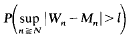 where Wn = anlX1 + … + annXn, the Xr being independent random variables and the Mn being certain truncated means. We then use these inequalities to study the rate at which this probability tends to zero as N→ ∞, noting that in the special case Wn = (X1 + … + Xn)/n, we obtain the estimate given by L. E. Baum and M. Katz which they show is, in a sense, best possible.
A desire to find an inequality which would lead to the result of Baum and Katz was, indeed, the impetus behind this paper.
 where W
Dissipative operators with finite dimensional damping
-
- Journal:
- Proceedings of the Royal Society of Edinburgh. Section A: Mathematics / Volume 91 / Issue 3-4 / 1982
- Published online by Cambridge University Press:
- 14 November 2011, pp. 243-263
- Print publication:
- 1982
-
- Article
- Export citation
Explicit solutions for a class of dual integral equations
-
- Journal:
- Proceedings of the Royal Society of Edinburgh. Section A: Mathematics / Volume 91 / Issue 3-4 / 1982
- Published online by Cambridge University Press:
- 14 November 2011, pp. 277-285
- Print publication:
- 1982
-
- Article
- Export citation
-
An explicit solution is derived for the dual integral equations
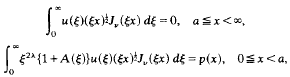
when A(ξ) takes the form

It is then shown how the basic technique can be adapted to derive explicit solutions for more general forms of A(ξ) such as
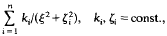
and
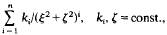
and linear combinations of such sums.
Some dual series equations with an application in the theory of elasticity
-
- Journal:
- Proceedings of the Royal Society of Edinburgh. Section A: Mathematics / Volume 92 / Issue 3-4 / 1982
- Published online by Cambridge University Press:
- 14 November 2011, pp. 241-251
- Print publication:
- 1982
-
- Article
- Export citation
Lifting homotopies through fixed points
-
- Journal:
- Proceedings of the Royal Society of Edinburgh. Section A: Mathematics / Volume 93 / Issue 1-2 / 1982
- Published online by Cambridge University Press:
- 14 November 2011, pp. 123-128
- Print publication:
- 1982
-
- Article
- Export citation
The independence of certain associative laws
-
- Journal:
- Proceedings of the Royal Society of Edinburgh. Section A: Mathematics / Volume 91 / Issue 3-4 / 1982
- Published online by Cambridge University Press:
- 14 November 2011, pp. 179-180
- Print publication:
- 1982
-
- Article
- Export citation
-
For n ≧ 3 the independence of the associative laws

for n-ary operations (…) is proved.
On the boundary value problems of electro- and magnetostatics
-
- Journal:
- Proceedings of the Royal Society of Edinburgh. Section A: Mathematics / Volume 92 / Issue 1-2 / 1982
- Published online by Cambridge University Press:
- 14 November 2011, pp. 165-174
- Print publication:
- 1982
-
- Article
- Export citation
Über die C2-Kompaktheit der Bahn von Lösungen semflinearer parabolischer Systeme
-
- Journal:
- Proceedings of the Royal Society of Edinburgh. Section A: Mathematics / Volume 93 / Issue 1-2 / 1982
- Published online by Cambridge University Press:
- 14 November 2011, pp. 99-103
- Print publication:
- 1982
-
- Article
- Export citation
-
The semilinear parabolic system ut + A(x, D)u = g(u) in (0, ∞) × Ω, Ω⊂ℝn bounded, u ∈ ℝN, with homogeneous boundary conditions B(x, D)u=0 on (0, ∞)×∂Ω is considered. The non-linearity g is assumed to be locally Lipschitz-continuous. It is shown that the orbit of a bounded regular solution u is relatively compact in
 .
.
 .
.PRM volume 92 issue 3-4 Cover and Front matter
-
- Journal:
- Proceedings of the Royal Society of Edinburgh. Section A: Mathematics / Volume 92 / Issue 3-4 / 1982
- Published online by Cambridge University Press:
- 14 November 2011, pp. f1-f2
- Print publication:
- 1982
-
- Article
-
- You have access
- Export citation
Mean-value theorems for Riemannian manifolds
-
- Journal:
- Proceedings of the Royal Society of Edinburgh. Section A: Mathematics / Volume 92 / Issue 3-4 / 1982
- Published online by Cambridge University Press:
- 14 November 2011, pp. 343-364
- Print publication:
- 1982
-
- Article
- Export citation
-
Let Mm (r, f) denote the mean-value of a real-valued integrable function f over a geodesic sphere with centre m and radius r in an n-dimensional Riemannian manifold M. We obtain an expansion of Mm (r, f) in powers of r, thereby generalizing Pizzetti's formula valid in euclidean space. From this expansion we prove that the property

for every harmonic function near m, characterizes Einstein spaces. We define super-Einstein spaces and prove that they are characterized by the property

A radical for near-rings
-
- Journal:
- Proceedings of the Royal Society of Edinburgh. Section A: Mathematics / Volume 93 / Issue 1-2 / 1982
- Published online by Cambridge University Press:
- 14 November 2011, pp. 105-110
- Print publication:
- 1982
-
- Article
- Export citation
