Refine search
Actions for selected content:
26079 results in Abstract analysis
On mean p-valent functions in an ellipse
-
- Journal:
- Proceedings of the Royal Society of Edinburgh. Section A: Mathematics / Volume 92 / Issue 1-2 / 1982
- Published online by Cambridge University Press:
- 14 November 2011, pp. 1-11
- Print publication:
- 1982
-
- Article
- Export citation
On the exponential behaviour of eigenfunctions and the essential spectrum of differential operators
-
- Journal:
- Proceedings of the Royal Society of Edinburgh. Section A: Mathematics / Volume 92 / Issue 3-4 / 1982
- Published online by Cambridge University Press:
- 14 November 2011, pp. 271-300
- Print publication:
- 1982
-
- Article
- Export citation
-
The paper deals with the differential equation

on [ 0, ∞) Where λ>0 and the coefficients qm are complex-valued with qn continuous and non-zero, w is positive and continuous and qm
 for m = 0, 1,…, n − 1. In the first part of the paper the exponential behaviour of any solution of (*) is given in terms of a function ρ(λ) which is roughly the distance of λ from the essential spectrum of a closed, densely denned linear operator T generated by T+ in L2(0, ∞ w). Next, estimates are obtained for the solutions in terms of the coefficients in (*). When the latter results are compared with the estimates established previously in terms of ρ(λ), bounds for ρ(λ) are obtained. From the general result there are two kinds of consequences. In the first, criteria for ρ(λ) = 0 for all All λ > 0 are obtained; this means that [0, ∞) lies in the essential spectrum of T in appropriate circumstances. The second type of consequence concerns bounds of the form ρ(λ) = O(λr) for λ → ∞ and r<1.
 for m = 0, 1,…, n − 1. In the first part of the paper the exponential behaviour of any solution of (*) is given in terms of a function ρ(λ) which is roughly the distance of λ from the essential spectrum of a closed, densely denned linear operator T generated by T
Existence, uniqueness and asymptotic expansion of the solution of a multipoint boundary-value problem with parameters for a singularly-perturbed system of integro-differential equations
-
- Journal:
- Proceedings of the Royal Society of Edinburgh. Section A: Mathematics / Volume 92 / Issue 1-2 / 1982
- Published online by Cambridge University Press:
- 14 November 2011, pp. 103-112
- Print publication:
- 1982
-
- Article
- Export citation
Gradient estimates for degenerate diffusion equations II†
-
- Journal:
- Proceedings of the Royal Society of Edinburgh. Section A: Mathematics / Volume 91 / Issue 3-4 / 1982
- Published online by Cambridge University Press:
- 14 November 2011, pp. 335-346
- Print publication:
- 1982
-
- Article
- Export citation
Cesàro means and recurrence in dynamic thermoelasticity
-
- Journal:
- Mathematika / Volume 28 / Issue 2 / December 1981
- Published online by Cambridge University Press:
- 26 February 2010, pp. 211-230
- Print publication:
- December 1981
-
- Article
- Export citation
Minimal width and diameter of lattice-point-free convex bodies
-
- Journal:
- Mathematika / Volume 28 / Issue 2 / December 1981
- Published online by Cambridge University Press:
- 26 February 2010, pp. 255-264
- Print publication:
- December 1981
-
- Article
- Export citation
-
Let K be a convex body (compact convex set with interior points) in d-dimensional euclidean space Ed, let D(K) denote its diameter, Δ(K) its minimal width, and
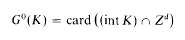
the number of lattice points (points of Ed with integer coordinates) in the interior of K. If G0(K) = 0, we call K lattice-point-free; in what follows, K will always be a lattice-point-free convex body.
Lifting properties and uniform regularity of lebesgue measures on topological spaces
- Part of
-
- Journal:
- Mathematika / Volume 28 / Issue 2 / December 1981
- Published online by Cambridge University Press:
- 26 February 2010, pp. 198-205
- Print publication:
- December 1981
-
- Article
- Export citation
Convex bodies which tile space by translation: Acknowledgement of priority
-
- Journal:
- Mathematika / Volume 28 / Issue 2 / December 1981
- Published online by Cambridge University Press:
- 26 February 2010, p. 191
- Print publication:
- December 1981
-
- Article
- Export citation
An algebraic approach to the growth of class numbers of binary quadratic lattices
-
- Journal:
- Mathematika / Volume 28 / Issue 2 / December 1981
- Published online by Cambridge University Press:
- 26 February 2010, pp. 160-168
- Print publication:
- December 1981
-
- Article
- Export citation
The distribution of rational points on varieties defined over a finite field
-
- Journal:
- Mathematika / Volume 28 / Issue 2 / December 1981
- Published online by Cambridge University Press:
- 26 February 2010, pp. 153-159
- Print publication:
- December 1981
-
- Article
- Export citation
-
Let h1(x1, …, xn), …, hs(x1, …, xn) be polynomials with integer coefficients. We give conditions on these polynomials which guarantee the existence, for all sufficiently large primes p, of small solutions to the system of congruences

Previous investigations of this problem include those of Mordell [10], Chalk and Williams [5], and Smith [14]. Smith's main result, which encompasses the other results, can be stated as follows.
Spaces of largest Hausdorff dimension
- Part of
-
- Journal:
- Mathematika / Volume 28 / Issue 2 / December 1981
- Published online by Cambridge University Press:
- 26 February 2010, pp. 206-210
- Print publication:
- December 1981
-
- Article
- Export citation
Pure Gauss sums over finite fields
-
- Journal:
- Mathematika / Volume 28 / Issue 2 / December 1981
- Published online by Cambridge University Press:
- 26 February 2010, pp. 239-248
- Print publication:
- December 1981
-
- Article
- Export citation
On the status of the uncoupled approximation within quasistatic thermoelasticity
-
- Journal:
- Mathematika / Volume 28 / Issue 2 / December 1981
- Published online by Cambridge University Press:
- 26 February 2010, pp. 286-294
- Print publication:
- December 1981
-
- Article
- Export citation
-
We consider a body which occupies the open, bounded, regular region B, whose boundary is ∂B and whose closure is
 . We denote by da the element of surface area, by dυ the element of volume, and by n the outward unit normal. We suppose the behaviour of the body to be described by the equations of the quasi-static theory of homogeneous and isotropic thermoelasticity. These equations, which are obtained from the equations of the dynamical theory (see, for example, Carlson [1], Chadwick [2] or Boley and Weiner [3]) by omitting the inertial term pű from the right-hand side of the equation of motion (4), are:




 . We denote by da the element of surface area, by dυ the element of volume, and by n the outward unit normal. We suppose the behaviour of the body to be described by the equations of the quasi-static theory of homogeneous and isotropic thermoelasticity. These equations, which are obtained from the equations of the dynamical theory (see, for example, Carlson [1], Chadwick [2] or Boley and Weiner [3]) by omitting the inertial term pű from the right-hand side of the equation of motion (4), are:
Regular positive ternary quadratic forms
-
- Journal:
- Mathematika / Volume 28 / Issue 2 / December 1981
- Published online by Cambridge University Press:
- 26 February 2010, pp. 231-238
- Print publication:
- December 1981
-
- Article
- Export citation
The dissipative quasigeostrophic equations
- Part of
-
- Journal:
- Mathematika / Volume 28 / Issue 2 / December 1981
- Published online by Cambridge University Press:
- 26 February 2010, pp. 265-285
- Print publication:
- December 1981
-
- Article
- Export citation
The slimmest arrangements of hyperplanes: II. Basepointed geometric lattices and Euclidean arrangements
-
- Journal:
- Mathematika / Volume 28 / Issue 2 / December 1981
- Published online by Cambridge University Press:
- 26 February 2010, pp. 169-190
- Print publication:
- December 1981
-
- Article
- Export citation
MTK volume 28 issue 1 Front matter
-
- Journal:
- Mathematika / Volume 28 / Issue 2 / December 1981
- Published online by Cambridge University Press:
- 26 February 2010, pp. f1-f2
- Print publication:
- December 1981
-
- Article
-
- You have access
- Export citation
Ovaloids whose curvatures are powers of support functions
- Part of
-
- Journal:
- Mathematika / Volume 28 / Issue 2 / December 1981
- Published online by Cambridge University Press:
- 26 February 2010, pp. 192-197
- Print publication:
- December 1981
-
- Article
- Export citation
-
Let Mn be a smooth, compact and strictly convex, embedded hypersurface of Rn + 1 (n ≥ 1), an ovaloid for short. By “strictly convex” we mean that the Gauss-Kronecker curvature
 where ki are the principal curvatures with respect to the inner unit normal field, is everywhere positive. It is well knpwn [5, p. 41] that, for such a hypersurface, the spherical-image mapping is a diffeomorphism onto the unit hypersphere. Furthermore, Mn is the boundary of an open bounded convex body, which we shall call the interior of Mn.
 where k
Trigonometric sums over primes I
-
- Journal:
- Mathematika / Volume 28 / Issue 2 / December 1981
- Published online by Cambridge University Press:
- 26 February 2010, pp. 249-254
- Print publication:
- December 1981
-
- Article
- Export citation
On ext(G2)
- Part of
-
- Journal:
- Mathematika / Volume 28 / Issue 1 / June 1981
- Published online by Cambridge University Press:
- 26 February 2010, pp. 79-85
- Print publication:
- June 1981
-
- Article
- Export citation
