Refine search
Actions for selected content:
26079 results in Abstract analysis
The transformation of concentric circles into concentric rectangles
- Part of
-
- Journal:
- Mathematika / Volume 28 / Issue 1 / June 1981
- Published online by Cambridge University Press:
- 26 February 2010, pp. 141-152
- Print publication:
- June 1981
-
- Article
- Export citation
On ordered set systems and some conjectures related to the erdös–ko–rado theorem and turán's theorem
- Part of
-
- Journal:
- Mathematika / Volume 28 / Issue 1 / June 1981
- Published online by Cambridge University Press:
- 26 February 2010, pp. 54-66
- Print publication:
- June 1981
-
- Article
- Export citation
-
In [10] the following generalization of the Erdös–Ko–Rado [6] theorem was proved:
If 1 ≤ h ≤ m/2 and
 are r sets of h-subsets of {1,…, m} such that
then
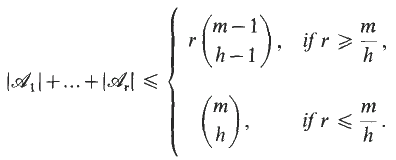
 are r sets of h-subsets of {1,…, m} such that
An acknowledgement of priority
-
- Journal:
- Mathematika / Volume 28 / Issue 1 / June 1981
- Published online by Cambridge University Press:
- 26 February 2010, p. 87
- Print publication:
- June 1981
-
- Article
- Export citation
Corrigendum
-
- Journal:
- Mathematika / Volume 28 / Issue 1 / June 1981
- Published online by Cambridge University Press:
- 26 February 2010, p. 86
- Print publication:
- June 1981
-
- Article
-
- You have access
- Export citation
Energy decay in a problem of linear thermoelasticity
-
- Journal:
- Mathematika / Volume 28 / Issue 1 / June 1981
- Published online by Cambridge University Press:
- 26 February 2010, pp. 102-115
- Print publication:
- June 1981
-
- Article
- Export citation
The necessity of sigma-finiteness in the radon–nikodym theorem
- Part of
-
- Journal:
- Mathematika / Volume 28 / Issue 1 / June 1981
- Published online by Cambridge University Press:
- 26 February 2010, pp. 99-101
- Print publication:
- June 1981
-
- Article
- Export citation
MTK volume 28 issue 1 Front matter
-
- Journal:
- Mathematika / Volume 28 / Issue 1 / June 1981
- Published online by Cambridge University Press:
- 26 February 2010, pp. f1-f2
- Print publication:
- June 1981
-
- Article
-
- You have access
- Export citation
Consequences of the kahn–priddy theorem in homotopy and geometry
- Part of
-
- Journal:
- Mathematika / Volume 28 / Issue 1 / June 1981
- Published online by Cambridge University Press:
- 26 February 2010, pp. 72-78
- Print publication:
- June 1981
-
- Article
- Export citation
-
Much recent attention has been given to geometric representation of elements of the stable homotopy groups of spheres, π*s A particular example concerns non-singular bilinear maps ℝm+1 × ℝn+1 → ℝm+n+1−p; on restriction and normalisation these become biskew maps Sm × Sn ℝ Sm+n-p;. Now the Hopf construction ℋ applied to any map f: Sm × Sn → Sm+n-p yields

An integral mean inequality for starlike functions
- Part of
-
- Journal:
- Mathematika / Volume 28 / Issue 1 / June 1981
- Published online by Cambridge University Press:
- 26 February 2010, pp. 88-98
- Print publication:
- June 1981
-
- Article
- Export citation
-
A function
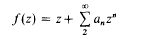
analytic and univalent in U = {z: |z| < 1} is said to be starlike there, if f(U) is f starshaped with respect to the origin, that is, if w ε f(U) implies tw ε f(U) for 0 ≤t ≤ 1. We denote by S* the class of all such functions. The Koebe function; k(z) = z(l – z)-2, z ε U, maps U onto the complex plane minus a slit along the I negative real axis from - ¼ to ∞, and thus belongs to the class S*. Recently Leung [4] has shown that, if

then, for f ε S*,

for every p > 0.
Patterns on the 2-Sphere
-
- Journal:
- Mathematika / Volume 28 / Issue 1 / June 1981
- Published online by Cambridge University Press:
- 26 February 2010, pp. 1-35
- Print publication:
- June 1981
-
- Article
- Export citation
Encoding orders and trees in binary relations
- Part of
-
- Journal:
- Mathematika / Volume 28 / Issue 1 / June 1981
- Published online by Cambridge University Press:
- 26 February 2010, pp. 67-71
- Print publication:
- June 1981
-
- Article
- Export citation
Real classification of complex conics
- Part of
-
- Journal:
- Mathematika / Volume 28 / Issue 1 / June 1981
- Published online by Cambridge University Press:
- 26 February 2010, pp. 36-53
- Print publication:
- June 1981
-
- Article
- Export citation
Uniform asymptotic solutions of the orr–sommerfeld equation
- Part of
-
- Journal:
- Mathematika / Volume 28 / Issue 1 / June 1981
- Published online by Cambridge University Press:
- 26 February 2010, pp. 116-140
- Print publication:
- June 1981
-
- Article
- Export citation
16 - Continuity
-
- Book:
- The Foundations of Topological Analysis: A Straightforward Introduction
- Published online:
- 26 January 2010
- Print publication:
- 07 May 1981, pp 39-46
-
- Chapter
- Export citation
Index
-
- Book:
- The Foundations of Topological Analysis: A Straightforward Introduction
- Published online:
- 26 January 2010
- Print publication:
- 07 May 1981, pp 247-249
-
- Chapter
- Export citation
Contents
-
- Book:
- The Foundations of Topological Analysis: A Straightforward Introduction
- Published online:
- 26 January 2010
- Print publication:
- 07 May 1981, pp v-ix
-
- Chapter
- Export citation
24 - Points at infinity
-
- Book:
- The Foundations of Topological Analysis: A Straightforward Introduction
- Published online:
- 26 January 2010
- Print publication:
- 07 May 1981, pp 149-168
-
- Chapter
- Export citation
17 - Connected sets
-
- Book:
- The Foundations of Topological Analysis: A Straightforward Introduction
- Published online:
- 26 January 2010
- Print publication:
- 07 May 1981, pp 47-59
-
- Chapter
- Export citation
19 - Compact sets (I)
-
- Book:
- The Foundations of Topological Analysis: A Straightforward Introduction
- Published online:
- 26 January 2010
- Print publication:
- 07 May 1981, pp 66-76
-
- Chapter
- Export citation
27 - Completeness
-
- Book:
- The Foundations of Topological Analysis: A Straightforward Introduction
- Published online:
- 26 January 2010
- Print publication:
- 07 May 1981, pp 190-200
-
- Chapter
- Export citation
