Refine search
Actions for selected content:
26079 results in Abstract analysis
Hankel operators with PC symbols and the space H∞ + PC
-
- Journal:
- Proceedings of the Royal Society of Edinburgh. Section A: Mathematics / Volume 89 / Issue 1-2 / 1981
- Published online by Cambridge University Press:
- 14 November 2011, pp. 17-24
- Print publication:
- 1981
-
- Article
- Export citation
-
We obtain an explicit formula for the essential norm of a Hankel operator with its symbol in the space PC, which is the closure in L∞
 of the space of piecewise continuous functions on the unit circle
  . It follows from this formula that functions in PC can be approximated as closely by functions in C, the continuous functions on the circle, as by functions in the much larger space H∞ + C. This is an example of the way in which properties of the Hardy spaces can be derived from properties of Hankel operators.
 of the space of piecewise continuous functions on the unit circle
  . It follows from this formula that functions in PC can be approximated as closely by functions in C, the continuous functions on the circle, as by functions in the much larger space H
On the Vitali–Hahn–Saks theorem
-
- Journal:
- Proceedings of the Royal Society of Edinburgh. Section A: Mathematics / Volume 90 / Issue 1-2 / 1981
- Published online by Cambridge University Press:
- 14 November 2011, pp. 163-173
- Print publication:
- 1981
-
- Article
- Export citation
On the swirling flow between rotating coaxial disks, asymptotic behaviour, II
-
- Journal:
- Proceedings of the Royal Society of Edinburgh. Section A: Mathematics / Volume 90 / Issue 3-4 / 1981
- Published online by Cambridge University Press:
- 14 November 2011, pp. 317-346
- Print publication:
- 1981
-
- Article
- Export citation
-
Consider solutions 〈H(x, ε), G(x, ε)〉 of the von Kármán equations for the swirling flow between two rotating coaxial disks

and

We assume that |H(x, ε)| + |Hʹ(x, ε)| + |G(x, ε)|≦B. This work considers shapes and asymptotic behaviour as ε→0+. We consider the type of limit functions 〈H(x), G(x)〉 that are permissible. In particular, if 〈H(x, ε), G(x, ε)〉 also satisfy the boundary conditions H(0, ε)=H(1, ε)=0, Hʹ(0, ε)=Hʹ(1, ε)=0 then H(x) has no simple zeros. That is, there does not exist a point Z ε [0, 1] such that H(x)=0, Hʹ(z)≠0. Moreover, the case of “cells” which oscillate is studied in detail.
PRM volume 88 issue 3-4 Cover and Front matter
-
- Journal:
- Proceedings of the Royal Society of Edinburgh. Section A: Mathematics / Volume 88 / Issue 3-4 / 1981
- Published online by Cambridge University Press:
- 14 November 2011, pp. f1-f4
- Print publication:
- 1981
-
- Article
-
- You have access
- Export citation
Non-linear mixed boundary value problems for elliptic partial differential equations
-
- Journal:
- Proceedings of the Royal Society of Edinburgh. Section A: Mathematics / Volume 90 / Issue 3-4 / 1981
- Published online by Cambridge University Press:
- 14 November 2011, pp. 347-359
- Print publication:
- 1981
-
- Article
- Export citation
On oscillations in a compressible laminar boundary layer
-
- Journal:
- Proceedings of the Royal Society of Edinburgh. Section A: Mathematics / Volume 91 / Issue 1-2 / 1981
- Published online by Cambridge University Press:
- 14 November 2011, pp. 1-13
- Print publication:
- 1981
-
- Article
- Export citation
The principle of limiting absorption for Laplacians on two-point homogeneous spaces
-
- Journal:
- Proceedings of the Royal Society of Edinburgh. Section A: Mathematics / Volume 87 / Issue 3-4 / 1981
- Published online by Cambridge University Press:
- 14 November 2011, pp. 319-329
- Print publication:
- 1981
-
- Article
- Export citation
Limit-point (LP) criteria for real symmetric differential expressions of order 2n†
-
- Journal:
- Proceedings of the Royal Society of Edinburgh. Section A: Mathematics / Volume 88 / Issue 3-4 / 1981
- Published online by Cambridge University Press:
- 14 November 2011, pp. 203-217
- Print publication:
- 1981
-
- Article
- Export citation
-
An interval-type LP criterion for
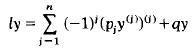
is derived in which “positive” coefficients play a prominent role. When pn = 1 and all the other pi are zero this reduces to a result of Ismagilov (1962). Successive specializations are obtained with the growth of the pi constrained by monomials in x. Previous LP criteria of Everitt (1968) and Hinton (1972, 1974) are shown to be special cases.
On the Lax-Phillips scattering theory
-
- Journal:
- Proceedings of the Royal Society of Edinburgh. Section A: Mathematics / Volume 87 / Issue 3-4 / 1981
- Published online by Cambridge University Press:
- 14 November 2011, pp. 219-230
- Print publication:
- 1981
-
- Article
- Export citation
Some integrodifferential inequalities in n-independent variables†
-
- Journal:
- Proceedings of the Royal Society of Edinburgh. Section A: Mathematics / Volume 89 / Issue 3-4 / 1981
- Published online by Cambridge University Press:
- 14 November 2011, pp. 347-353
- Print publication:
- 1981
-
- Article
- Export citation
Dual solutions in mixed convection
-
- Journal:
- Proceedings of the Royal Society of Edinburgh. Section A: Mathematics / Volume 87 / Issue 3-4 / 1981
- Published online by Cambridge University Press:
- 14 November 2011, pp. 349-358
- Print publication:
- 1981
-
- Article
- Export citation
Semi-discrete Galerkin approximation method applied to initial boundary value problems for Maxwell's equations in anisotropic, inhomogeneous media
-
- Journal:
- Proceedings of the Royal Society of Edinburgh. Section A: Mathematics / Volume 89 / Issue 1-2 / 1981
- Published online by Cambridge University Press:
- 14 November 2011, pp. 125-133
- Print publication:
- 1981
-
- Article
- Export citation
Solution periodique d'une équation d'évolution
-
- Journal:
- Proceedings of the Royal Society of Edinburgh. Section A: Mathematics / Volume 89 / Issue 3-4 / 1981
- Published online by Cambridge University Press:
- 14 November 2011, pp. 175-180
- Print publication:
- 1981
-
- Article
- Export citation
Asymptotic theory and deficiency indices for differential equations of odd order
-
- Journal:
- Proceedings of the Royal Society of Edinburgh. Section A: Mathematics / Volume 90 / Issue 3-4 / 1981
- Published online by Cambridge University Press:
- 14 November 2011, pp. 263-279
- Print publication:
- 1981
-
- Article
- Export citation
Estimate of the number of eigenvalues for an operator of Schrödinger type
-
- Journal:
- Proceedings of the Royal Society of Edinburgh. Section A: Mathematics / Volume 89 / Issue 3-4 / 1981
- Published online by Cambridge University Press:
- 14 November 2011, pp. 355-361
- Print publication:
- 1981
-
- Article
- Export citation
-
We obtain an asymptotic estimate for the number of eigenvalues less than λ of an operator of Schrödinger type

defined on an unbounded domain.

Smoothing effect and asymptotic behaviour for the solutions of a nonlinear time dependent system
-
- Journal:
- Proceedings of the Royal Society of Edinburgh. Section A: Mathematics / Volume 87 / Issue 3-4 / 1981
- Published online by Cambridge University Press:
- 14 November 2011, pp. 289-303
- Print publication:
- 1981
-
- Article
- Export citation
Bounds for the point spectra of separated Dirac operators
-
- Journal:
- Proceedings of the Royal Society of Edinburgh. Section A: Mathematics / Volume 88 / Issue 1-2 / 1981
- Published online by Cambridge University Press:
- 14 November 2011, pp. 1-15
- Print publication:
- 1981
-
- Article
- Export citation
-
In this paper real numbers A1, A2 are obtained which are such that for λ > A1 or λ < A2 there are no non-trivial solutions of the equation

which are in L2(a,∞) for some a>0. Precise values for A1 and A2 are obtained in certain cases.
The assimilation of a strong, two-dimensional laminar jet into an aligned uniform stream
-
- Journal:
- Proceedings of the Royal Society of Edinburgh. Section A: Mathematics / Volume 90 / Issue 1-2 / 1981
- Published online by Cambridge University Press:
- 14 November 2011, pp. 13-23
- Print publication:
- 1981
-
- Article
- Export citation
Groups of units of zero ternary quadratic forms
-
- Journal:
- Proceedings of the Royal Society of Edinburgh. Section A: Mathematics / Volume 88 / Issue 1-2 / 1981
- Published online by Cambridge University Press:
- 14 November 2011, pp. 141-157
- Print publication:
- 1981
-
- Article
- Export citation
Existence of conjugate points for second and fourth order differential equations
-
- Journal:
- Proceedings of the Royal Society of Edinburgh. Section A: Mathematics / Volume 89 / Issue 3-4 / 1981
- Published online by Cambridge University Press:
- 14 November 2011, pp. 281-291
- Print publication:
- 1981
-
- Article
- Export citation
