Refine search
Actions for selected content:
26079 results in Abstract analysis
Norm inequalities of product form in weighted Lp spaces
-
- Journal:
- Proceedings of the Royal Society of Edinburgh. Section A: Mathematics / Volume 89 / Issue 3-4 / 1981
- Published online by Cambridge University Press:
- 14 November 2011, pp. 293-307
- Print publication:
- 1981
-
- Article
- Export citation
-
The classical inequality ‖y′‖2≦K‖y‖ ‖y″‖ and its higher order analogues are extended from the Lp spaces to the weighted
 spaces, for appropriate w.
 spaces, for appropriate w.
PRM volume 90 issue 1-2 Cover and Back matter
-
- Journal:
- Proceedings of the Royal Society of Edinburgh. Section A: Mathematics / Volume 90 / Issue 1-2 / 1981
- Published online by Cambridge University Press:
- 14 November 2011, pp. b1-b2
- Print publication:
- 1981
-
- Article
-
- You have access
- Export citation
Subgroups of SL2ℤ generated by elementary matrices
-
- Journal:
- Proceedings of the Royal Society of Edinburgh. Section A: Mathematics / Volume 88 / Issue 1-2 / 1981
- Published online by Cambridge University Press:
- 14 November 2011, pp. 43-47
- Print publication:
- 1981
-
- Article
- Export citation
Generalized systems of linear differential equations
-
- Journal:
- Proceedings of the Royal Society of Edinburgh. Section A: Mathematics / Volume 89 / Issue 1-2 / 1981
- Published online by Cambridge University Press:
- 14 November 2011, pp. 1-14
- Print publication:
- 1981
-
- Article
- Export citation
Stability theory for quasi-linear wave equations with linear damping
-
- Journal:
- Proceedings of the Royal Society of Edinburgh. Section A: Mathematics / Volume 88 / Issue 1-2 / 1981
- Published online by Cambridge University Press:
- 14 November 2011, pp. 25-41
- Print publication:
- 1981
-
- Article
- Export citation
Index to Volume 90
-
- Journal:
- Proceedings of the Royal Society of Edinburgh. Section A: Mathematics / Volume 90 / Issue 3-4 / 1981
- Published online by Cambridge University Press:
- 14 November 2011, pp. v-vi
- Print publication:
- 1981
-
- Article
- Export citation
PRM volume 89 issue 1-2 Cover and Front matter
-
- Journal:
- Proceedings of the Royal Society of Edinburgh. Section A: Mathematics / Volume 89 / Issue 1-2 / 1981
- Published online by Cambridge University Press:
- 14 November 2011, pp. f1-f2
- Print publication:
- 1981
-
- Article
-
- You have access
- Export citation
On inequalities for powers of linear operators and for quadratic forms
-
- Journal:
- Proceedings of the Royal Society of Edinburgh. Section A: Mathematics / Volume 89 / Issue 1-2 / 1981
- Published online by Cambridge University Press:
- 14 November 2011, pp. 25-50
- Print publication:
- 1981
-
- Article
- Export citation
-
Let H be a Hilbert space in which a symmetric operator S with a dense domain Ds is given and let S have a finite deficiency index (r, s). This paper contains a necessary and sufficient condition for validity of the following inequalities of Kolmogorov type

and a method for calculating the best possible constants Cn,m(S).
Moreover, let φ be a symmetric bilinear functional with a dense domain Dφ such that Ds ⊂ Dφ and φ(f, g) = (Sf, g) for all f ∈ Ds, g ∈ Dφ. A necessary and sufficient condition for validity of the inequality

as well as a method for calculating the best possible constant K are obtained. Then an analogous approach is worked out in order to obtain the best possible additive inequalities of the form

The paper is concluded by establishing the best possible constants in the inequalities

where T is an arbitrary dissipative operator. The theorems are extensions of the results of Ju. I. Ljubič, W. N. Everitt, and T. Kato.
An elliptic boundary-value problem with a discontinuous nonlinearity
-
- Journal:
- Proceedings of the Royal Society of Edinburgh. Section A: Mathematics / Volume 91 / Issue 1-2 / 1981
- Published online by Cambridge University Press:
- 14 November 2011, pp. 161-174
- Print publication:
- 1981
-
- Article
- Export citation
-
We study the boundary-value problem, for (λ/k,ψ),
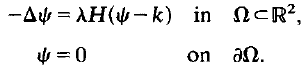
Here ∆ denotes the Laplacian, H is the Heaviside step function and one of A or k is a given positive constant. We define

and usually omit the subscript. Throughout we are interested in solutions with ψ>0 in Ω and hence with λ/=0.
In the special case Ω = B(0, R), denoting the explicit exact solutions by ℑe, the following statements are true, (a) The set Aψ, issimply-connected, (b) Along ℑe, the diameter of Aψ tendsto zero when the area of Aψ, tends to zero.
For doubly-symmetrised solutions in domains Ω such as rectangles, it is shown that the statements (a) and (b) above remain true.
PRM volume 88 issue 1-2 Cover and Back matter
-
- Journal:
- Proceedings of the Royal Society of Edinburgh. Section A: Mathematics / Volume 88 / Issue 1-2 / 1981
- Published online by Cambridge University Press:
- 14 November 2011, pp. b1-b2
- Print publication:
- 1981
-
- Article
-
- You have access
- Export citation
On uniform boundedness properties in exhausting additive set function spaces
-
- Journal:
- Proceedings of the Royal Society of Edinburgh. Section A: Mathematics / Volume 90 / Issue 1-2 / 1981
- Published online by Cambridge University Press:
- 14 November 2011, pp. 175-184
- Print publication:
- 1981
-
- Article
- Export citation
The uniform exponential stability of a class of linear differential–difference equations in a Hilbert space
-
- Journal:
- Proceedings of the Royal Society of Edinburgh. Section A: Mathematics / Volume 89 / Issue 3-4 / 1981
- Published online by Cambridge University Press:
- 14 November 2011, pp. 201-215
- Print publication:
- 1981
-
- Article
- Export citation
Linear initial value problems with a singular perturbation of hyperbolic type
-
- Journal:
- Proceedings of the Royal Society of Edinburgh. Section A: Mathematics / Volume 87 / Issue 3-4 / 1981
- Published online by Cambridge University Press:
- 14 November 2011, pp. 167-187
- Print publication:
- 1981
-
- Article
- Export citation
A note on linear hyperbolic evolution equations
-
- Journal:
- Proceedings of the Royal Society of Edinburgh. Section A: Mathematics / Volume 87 / Issue 3-4 / 1981
- Published online by Cambridge University Press:
- 14 November 2011, pp. 305-318
- Print publication:
- 1981
-
- Article
- Export citation
A differentiability property and its application to the spectral theory of differential operators
-
- Journal:
- Proceedings of the Royal Society of Edinburgh. Section A: Mathematics / Volume 88 / Issue 1-2 / 1981
- Published online by Cambridge University Press:
- 14 November 2011, pp. 49-74
- Print publication:
- 1981
-
- Article
- Export citation
On the existence of weak solutions for quasilinear parabolic initial-boundary value problems
-
- Journal:
- Proceedings of the Royal Society of Edinburgh. Section A: Mathematics / Volume 89 / Issue 3-4 / 1981
- Published online by Cambridge University Press:
- 14 November 2011, pp. 217-237
- Print publication:
- 1981
-
- Article
- Export citation
-
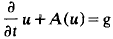
Structure conditions on a strongly nonlinear operator A(u) are given, under whichthe initial-Dirichlet-boundary value problem for
 has weak solutions.
 has weak solutions.
Quasi-adequate semigroups
-
- Journal:
- Proceedings of the Royal Society of Edinburgh. Section A: Mathematics / Volume 91 / Issue 1-2 / 1981
- Published online by Cambridge University Press:
- 14 November 2011, pp. 91-99
- Print publication:
- 1981
-
- Article
- Export citation
Approximation properties of sets with bounded complements
-
- Journal:
- Proceedings of the Royal Society of Edinburgh. Section A: Mathematics / Volume 89 / Issue 1-2 / 1981
- Published online by Cambridge University Press:
- 14 November 2011, pp. 75-86
- Print publication:
- 1981
-
- Article
- Export citation
Global regularity and formation of singularities of solutions to first order quasilinear hyperbolic systems
-
- Journal:
- Proceedings of the Royal Society of Edinburgh. Section A: Mathematics / Volume 87 / Issue 3-4 / 1981
- Published online by Cambridge University Press:
- 14 November 2011, pp. 255-261
- Print publication:
- 1981
-
- Article
- Export citation
Necessary and sufficient conditions for asymptotic decay of oscillations in delayed functional equations†
-
- Journal:
- Proceedings of the Royal Society of Edinburgh. Section A: Mathematics / Volume 91 / Issue 1-2 / 1981
- Published online by Cambridge University Press:
- 14 November 2011, pp. 135-145
- Print publication:
- 1981
-
- Article
- Export citation
-
This paper studies the equation

where the differential operator Ln is defined by

and a necessary and sufficient condition that all oscillatory solutions of the above equation converge to zero asymptotically is presented. The results obtained extend and improve previous ones of Kusano and Onose, and Singh, even in the usual case where

where N is an integer with l≦N≦n–1.
