Refine search
Actions for selected content:
26079 results in Abstract analysis
Stable methods for solving the inverse scattering problem for a cylinder
-
- Journal:
- Proceedings of the Royal Society of Edinburgh. Section A: Mathematics / Volume 89 / Issue 3-4 / 1981
- Published online by Cambridge University Press:
- 14 November 2011, pp. 181-188
- Print publication:
- 1981
-
- Article
- Export citation
Positive solutions of superlinear boundary value problems
-
- Journal:
- Proceedings of the Royal Society of Edinburgh. Section A: Mathematics / Volume 88 / Issue 1-2 / 1981
- Published online by Cambridge University Press:
- 14 November 2011, pp. 17-24
- Print publication:
- 1981
-
- Article
- Export citation
-
Using a fixed point theorem on operators expanding a cone in a Banach space we prove the existence of positive solutions of superlinear boundary value problems

At the same time we get bounds (or even inclusions) of positive solutions.
Vortices, Liouville's equation and the Bergman kernel function
-
- Journal:
- Mathematika / Volume 27 / Issue 2 / December 1980
- Published online by Cambridge University Press:
- 26 February 2010, pp. 321-334
- Print publication:
- December 1980
-
- Article
- Export citation
The inefficiency of certain periodic processes in linear thermoelasticity
- Part of
-
- Journal:
- Mathematika / Volume 27 / Issue 2 / December 1980
- Published online by Cambridge University Press:
- 26 February 2010, pp. 189-196
- Print publication:
- December 1980
-
- Article
- Export citation
-
Consider a uniform body whose behaviour is described by the linear field equations of quasi-static, coupled thermoelasticity†:




On the convolution of Hecke L-functions
-
- Journal:
- Mathematika / Volume 27 / Issue 2 / December 1980
- Published online by Cambridge University Press:
- 26 February 2010, pp. 312-320
- Print publication:
- December 1980
-
- Article
- Export citation
-
§1. Let k be an algebraic number field of finite degree over the field Q of rational numbers and Ki be an extension of k of degree (Ki:k) = ni, i = 1,2. We choose a Hecke Grössencharakter Xi in Ki and consider the L-function

associated with Xi see [1, 2]. It is known to be a meromorphic function on the whole complex plane. We are interested here in the properties of the convolution of functions LK1, LK2 over k defined by

where
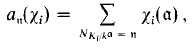
and a (and n) run over integral ideals of Ki (and k), whose norm NKi/k a is equal to n. The function (2) is sometimes called the “scalar product of the Hecke L-functions” «3—11». The object of the paper is the following theorem.
On the Mertens conjecture for cusp forms, Corrigendum
-
- Journal:
- Mathematika / Volume 27 / Issue 2 / December 1980
- Published online by Cambridge University Press:
- 26 February 2010, p. 261
- Print publication:
- December 1980
-
- Article
- Export citation
-
In my recent paper [1], the corollary on p. 241 is not correct. It should be
Corollary. There is a sequence S, tending to infinity, such that for each t in S we have
 where γ is any zero of
 where γ is any zero of
Measures on totally ordered spaces
-
- Journal:
- Mathematika / Volume 27 / Issue 2 / December 1980
- Published online by Cambridge University Press:
- 26 February 2010, pp. 225-235
- Print publication:
- December 1980
-
- Article
- Export citation
Index to volume 27
-
- Journal:
- Mathematika / Volume 27 / Issue 2 / December 1980
- Published online by Cambridge University Press:
- 26 February 2010, p. 335
- Print publication:
- December 1980
-
- Article
- Export citation
The decay of the energy in a viscoelastic body
-
- Journal:
- Mathematika / Volume 27 / Issue 2 / December 1980
- Published online by Cambridge University Press:
- 26 February 2010, pp. 268-286
- Print publication:
- December 1980
-
- Article
- Export citation
-
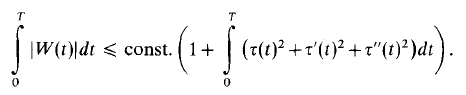
Consider a homogeneous linear viscoelastic filament, one of whose ends is held fixed, while the other is subjected to a given traction τ(t) (t ≤ 0). I shall prove first that the total energy E(t), which is the sum of the kinetic and free energies, its derivative E′(t), and the rate of working W(t) satisfy

and
On irregularities of distribution
-
- Journal:
- Mathematika / Volume 27 / Issue 2 / December 1980
- Published online by Cambridge University Press:
- 26 February 2010, pp. 153-170
- Print publication:
- December 1980
-
- Article
- Export citation
-
Let U0 = [(0, 1); and U1 = (0,1)]. Suppose we have a distribution
 of N points in
  , where, for k ≥ 1, is the unit cube consisting of the points y = (y1, … , yk+1) with 0 ≤ yi < 1 (i = 1 , … , k + 1). For X = (x1 ,…, xk + 1) in
  , let B(x) denote the box consisting of all y such that 0 ≤ yi < xi (i = 1 ,…, k + 1), and let
  denote the number of points of which lie in B(x).
 of N points in
  , where, for k ≥ 1,
  , let B(x) denote the box consisting of all y such that 0 ≤ y
 denote the number of points of
 On a theorem of Bombieri–Vinogradov type
-
- Journal:
- Mathematika / Volume 27 / Issue 2 / December 1980
- Published online by Cambridge University Press:
- 26 February 2010, pp. 135-152
- Print publication:
- December 1980
-
- Article
- Export citation
-
The celebrated theorem of Bombieri and A. I. Vinogradov states that

for any ε > 0 and A ε 0, the implied constant in the symbol «ε depending at most on ε and A (see [1] and [14]). The original proofs of Bombieri and Vinogradov were greatly simplified by P. X. Gallagher [4]. An elegant proof has been given recently by R. C. Vaughan [13]. For other references see H. L. Montgomery [10] and H. -E. Richert [12]. Estimates of type (1) are required in various applications of sieve methods. Having this in mind distinct generalizations have been investigated (see for example [15] and [2]). Y. Motohashi established a general theorem which, roughly speaking, says that if (1) holds for two arithmetic functions then it also holds for their Dirichlet convolution; for precise assumptions and statement see [11]. So far, all methods depend on the large sieve inequality (see [10])

which sets the limit x1/2 for the modulus q in (1) and in its generalizations.
On the unsolvability of some Diophantine equations of a modified Fermat type
-
- Journal:
- Mathematika / Volume 27 / Issue 2 / December 1980
- Published online by Cambridge University Press:
- 26 February 2010, pp. 179-187
- Print publication:
- December 1980
-
- Article
- Export citation
-
In an earlier paper [11] we have discussed the diophantine equation

and the more general equation

when l is an odd prime > 3, c a natural number (or more generally a rational number) satisfying several conditions, n also a natural number and x, y, z, non-zero rational integers. Other investigators have obtained quite a number of results concerning particularly the case n = 1. Obviously, without an essential restriction, we may assume that the natural number c contains no divisor a1n (since such a divisor can be absorbed in the power of z) and furthermore that x, y, z in (1) are relatively prime in pairs.
The simplified quasigeostrophic equations: Existence and uniqueness of strong solutions
-
- Journal:
- Mathematika / Volume 27 / Issue 2 / December 1980
- Published online by Cambridge University Press:
- 26 February 2010, pp. 287-311
- Print publication:
- December 1980
-
- Article
- Export citation
MTK volume 27 issue 2 Front matter
-
- Journal:
- Mathematika / Volume 27 / Issue 2 / December 1980
- Published online by Cambridge University Press:
- 26 February 2010, pp. f1-f2
- Print publication:
- December 1980
-
- Article
-
- You have access
- Export citation
Countable partitions of product spaces
-
- Journal:
- Mathematika / Volume 27 / Issue 2 / December 1980
- Published online by Cambridge University Press:
- 26 February 2010, pp. 213-224
- Print publication:
- December 1980
-
- Article
- Export citation
Borel isomorphisms at the first level: Corrigenda et addenda
-
- Journal:
- Mathematika / Volume 27 / Issue 2 / December 1980
- Published online by Cambridge University Press:
- 26 February 2010, pp. 236-260
- Print publication:
- December 1980
-
- Article
- Export citation
-
In recent work [2] we have investigated Borel isomorphisms at the first level, i.e. mappings that together with their inverses map Fσ-sets to Fσ-sets. We are grateful to Dr. F. Topsøe for writing to point out errors in the proofs of our Theorems 2.1, 2.2 and 2.3. The errors escaped our attention because we only wrote out the first step of a complicated inductive argument and carelessly and falsely claimed that the general step of the induction was similar to the first. To be more specific, in the proof of Theorem 2.1, although we do have
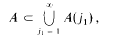
we do not, in general, have
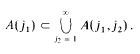
Fortunately the proofs can be corrected.
Continued fractions and Fourier transforms
-
- Journal:
- Mathematika / Volume 27 / Issue 2 / December 1980
- Published online by Cambridge University Press:
- 26 February 2010, pp. 262-267
- Print publication:
- December 1980
-
- Article
- Export citation
-
Let FN be the set of real numbers x whose continued fraction expansion x = [a0; a1, a2,…, an,…] contains only elements ai = 1,2,…, N. Here N ≥ 2. Considerable effort, [1,3], has centred on metrical properties of FN and certain measures carried by FN. A classification of sets of measure zero, as venerable as the dimensional theory, depends on Fourier-Stieltjes transforms: a closed set E of real numbers is called an M0-set, if E carries a probability measure λ whose transform
 vanishes at infinity. Aside from the Riemann-Lebesgue Lemma, no purely metrical property of E can ensure that E is an M0-set. For the sets FN, however, metrical properties can be used to construct the measure λ.
 vanishes at infinity. Aside from the Riemann-Lebesgue Lemma, no purely metrical property of E can ensure that E is an M
Some remarks on fibrations of monoids and their classifying spaces
- Part of
-
- Journal:
- Mathematika / Volume 27 / Issue 2 / December 1980
- Published online by Cambridge University Press:
- 26 February 2010, pp. 197-212
- Print publication:
- December 1980
-
- Article
- Export citation
On the number of square-full integers between successive squares
-
- Journal:
- Mathematika / Volume 27 / Issue 2 / December 1980
- Published online by Cambridge University Press:
- 26 February 2010, pp. 171-178
- Print publication:
- December 1980
-
- Article
- Export citation
Determination of a binary quadratic form by its values at integer points: Acknowledgement
-
- Journal:
- Mathematika / Volume 27 / Issue 2 / December 1980
- Published online by Cambridge University Press:
- 26 February 2010, p. 188
- Print publication:
- December 1980
-
- Article
- Export citation
