Refine search
Actions for selected content:
26079 results in Abstract analysis
A semilinear elliptic eigenvalue problem, II. The plasma problem
-
- Journal:
- Proceedings of the Royal Society of Edinburgh. Section A: Mathematics / Volume 87 / Issue 1-2 / 1980
- Published online by Cambridge University Press:
- 14 November 2011, pp. 83-109
- Print publication:
- 1980
-
- Article
- Export citation
-
This paper continues the study of the boundary value problem, for (λ, ψ)
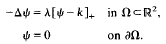
Here δ denotes the Laplacian, k is a given positive constant, and λ1 will denote the first eigenvalue for the Dirichlet problem for −δ on Ω. For λ ≦ λ1, the only solutions are those with ψ = 0. Throughout we will be interested in solutions (λ, ψ) with λ > λ1 and with ψ > 0 in Ω.
In the special case Ω = B(0, R) there is a branch ℱe, of explicit exact solutions which bifurcate from infinity at λ = λ1 and for which the following conclusions are valid, (a) The set Aψ,

is simply-connected, (b) Along ℱe, ψm → k, ‖ψ‖1 → 0 and the diameter of Aψ tends to zero as λ → ∞, where

Here it is shown that the above conclusions hold for other choices of Ω, and in particular, for Ω = (−a, a)×(−b, b). (Existence is settled in Part I, and elsewhere.)
The results of numerical and asymptotic calculations when Ω = (−a, a)×(−b, b) are given to illustrate both the above, and some limitations in the conclusions of our analysis.
Another positivity result for determinantal operators
-
- Journal:
- Proceedings of the Royal Society of Edinburgh. Section A: Mathematics / Volume 86 / Issue 3-4 / 1980
- Published online by Cambridge University Press:
- 14 November 2011, pp. 333-337
- Print publication:
- 1980
-
- Article
- Export citation
Singular eigenvalue problems with eigenvalue parameter contained in the boundary conditions
-
- Journal:
- Proceedings of the Royal Society of Edinburgh. Section A: Mathematics / Volume 87 / Issue 1-2 / 1980
- Published online by Cambridge University Press:
- 14 November 2011, pp. 1-34
- Print publication:
- 1980
-
- Article
- Export citation
On the variation of Teichmüller's metric
-
- Journal:
- Proceedings of the Royal Society of Edinburgh. Section A: Mathematics / Volume 85 / Issue 1-2 / 1980
- Published online by Cambridge University Press:
- 14 November 2011, pp. 143-152
- Print publication:
- 1980
-
- Article
- Export citation
Reflection of singularities of solutions to the wave equation and the leading singularity of the scattering kernel†
-
- Journal:
- Proceedings of the Royal Society of Edinburgh. Section A: Mathematics / Volume 86 / Issue 3-4 / 1980
- Published online by Cambridge University Press:
- 14 November 2011, pp. 235-242
- Print publication:
- 1980
-
- Article
- Export citation
Rearrangement inequalities†
-
- Journal:
- Proceedings of the Royal Society of Edinburgh. Section A: Mathematics / Volume 86 / Issue 3-4 / 1980
- Published online by Cambridge University Press:
- 14 November 2011, pp. 339-345
- Print publication:
- 1980
-
- Article
- Export citation
Limit-point criteria for systems of differential equations
-
- Journal:
- Proceedings of the Royal Society of Edinburgh. Section A: Mathematics / Volume 85 / Issue 3-4 / 1980
- Published online by Cambridge University Press:
- 14 November 2011, pp. 233-245
- Print publication:
- 1980
-
- Article
- Export citation
On the existence of bifurcating solutions in the presence of symmetries
-
- Journal:
- Proceedings of the Royal Society of Edinburgh. Section A: Mathematics / Volume 85 / Issue 3-4 / 1980
- Published online by Cambridge University Press:
- 14 November 2011, pp. 321-336
- Print publication:
- 1980
-
- Article
- Export citation
PRM volume 86 issue 1-2 Cover and Front matter
-
- Journal:
- Proceedings of the Royal Society of Edinburgh. Section A: Mathematics / Volume 86 / Issue 1-2 / 1980
- Published online by Cambridge University Press:
- 14 November 2011, pp. f1-f2
- Print publication:
- 1980
-
- Article
-
- You have access
- Export citation
Proof of a conjecture of Offord
-
- Journal:
- Proceedings of the Royal Society of Edinburgh. Section A: Mathematics / Volume 86 / Issue 1-2 / 1980
- Published online by Cambridge University Press:
- 14 November 2011, pp. 103-106
- Print publication:
- 1980
-
- Article
- Export citation
-
If z1, z2 … zn are complex numbers satisfying |zi−zj|≧1 for all i, j then the number of the 2n sums
 where ει = ±1, which lie in any circle of radius r cannot exceed αr2n/n3/2 where αr depends only on r.
 where ε
Gewöhnliche lineare Differentialgleichungen n−ter Ordnung mit Distributionskoeffizienten
-
- Journal:
- Proceedings of the Royal Society of Edinburgh. Section A: Mathematics / Volume 85 / Issue 3-4 / 1980
- Published online by Cambridge University Press:
- 14 November 2011, pp. 291-298
- Print publication:
- 1980
-
- Article
- Export citation
PRM volume 85 issue 1-2 Cover and Back matter
-
- Journal:
- Proceedings of the Royal Society of Edinburgh. Section A: Mathematics / Volume 85 / Issue 1-2 / 1980
- Published online by Cambridge University Press:
- 14 November 2011, pp. b1-b2
- Print publication:
- 1980
-
- Article
-
- You have access
- Export citation
PRM volume 87 issue 1-2 Cover and Front matter
-
- Journal:
- Proceedings of the Royal Society of Edinburgh. Section A: Mathematics / Volume 87 / Issue 1-2 / 1980
- Published online by Cambridge University Press:
- 14 November 2011, pp. f1-f2
- Print publication:
- 1980
-
- Article
-
- You have access
- Export citation
PRM volume 86 issue 1-2 Cover and Back matter
-
- Journal:
- Proceedings of the Royal Society of Edinburgh. Section A: Mathematics / Volume 86 / Issue 1-2 / 1980
- Published online by Cambridge University Press:
- 14 November 2011, pp. b1-b2
- Print publication:
- 1980
-
- Article
-
- You have access
- Export citation
PRM volume 85 issue 1-2 Cover and Front matter
-
- Journal:
- Proceedings of the Royal Society of Edinburgh. Section A: Mathematics / Volume 85 / Issue 1-2 / 1980
- Published online by Cambridge University Press:
- 14 November 2011, pp. f1-f2
- Print publication:
- 1980
-
- Article
-
- You have access
- Export citation
Monotone continuity of the spectral resolution and the eigenvalues
-
- Journal:
- Proceedings of the Royal Society of Edinburgh. Section A: Mathematics / Volume 85 / Issue 1-2 / 1980
- Published online by Cambridge University Press:
- 14 November 2011, pp. 131-136
- Print publication:
- 1980
-
- Article
- Export citation
Some ergodic theorems
-
- Journal:
- Proceedings of the Royal Society of Edinburgh. Section A: Mathematics / Volume 85 / Issue 1-2 / 1980
- Published online by Cambridge University Press:
- 14 November 2011, pp. 111-118
- Print publication:
- 1980
-
- Article
- Export citation
A comparison theorem for the first nodal line of the solutions of quasilinear hyperbolic equations with non-increasing initial values
-
- Journal:
- Proceedings of the Royal Society of Edinburgh. Section A: Mathematics / Volume 86 / Issue 1-2 / 1980
- Published online by Cambridge University Press:
- 14 November 2011, pp. 139-151
- Print publication:
- 1980
-
- Article
- Export citation
-
The oscillatory behaviour of quasilinear hyperbolic equations of the form
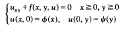
is studied using a Sturmian-type comparison theorem. We assume that
 for some function
  ψ′(x)≦0 and ψ′(x≦0.) The existence of the first nodal line of u is then inferred from the existence of that of the solution ν of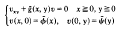
with
 .Some results of Pagan are improved using this approach and a problem posed by him is also studied.
 for some function
  ψ′(x)≦0 and ψ′(x≦0.) The existence of the first nodal line of u is then inferred from the existence of that of the solution ν of
 .Some results of Pagan are improved using this approach and a problem posed by him is also studied.
Periodic solutions of a nonlinear wave equation
-
- Journal:
- Proceedings of the Royal Society of Edinburgh. Section A: Mathematics / Volume 85 / Issue 3-4 / 1980
- Published online by Cambridge University Press:
- 14 November 2011, pp. 313-320
- Print publication:
- 1980
-
- Article
- Export citation
-
We provide a sufficient and “almost” necessary condition for the existence of a periodic solution of the equation

where F is nondecreasing in u and has a small linear growth as |u|→∞.

The direct and inverse scattering problems for an arbitrary cylinder: Dirichlet boundary conditions†
-
- Journal:
- Proceedings of the Royal Society of Edinburgh. Section A: Mathematics / Volume 86 / Issue 1-2 / 1980
- Published online by Cambridge University Press:
- 14 November 2011, pp. 29-42
- Print publication:
- 1980
-
- Article
- Export citation
