Refine search
Actions for selected content:
26079 results in Abstract analysis
PRM volume 86 issue 3-4 Cover and Front matter
-
- Journal:
- Proceedings of the Royal Society of Edinburgh. Section A: Mathematics / Volume 86 / Issue 3-4 / 1980
- Published online by Cambridge University Press:
- 14 November 2011, pp. f1-f4
- Print publication:
- 1980
-
- Article
-
- You have access
- Export citation
PRM volume 85 issue 3-4 Cover and Front matter
-
- Journal:
- Proceedings of the Royal Society of Edinburgh. Section A: Mathematics / Volume 85 / Issue 3-4 / 1980
- Published online by Cambridge University Press:
- 14 November 2011, pp. f1-f4
- Print publication:
- 1980
-
- Article
-
- You have access
- Export citation
An extension of the method of the hypercircle to linear operator problems with unilateral constraints
-
- Journal:
- Proceedings of the Royal Society of Edinburgh. Section A: Mathematics / Volume 85 / Issue 3-4 / 1980
- Published online by Cambridge University Press:
- 14 November 2011, pp. 173-193
- Print publication:
- 1980
-
- Article
- Export citation
PRM volume 85 issue 3-4 Cover and Back matter
-
- Journal:
- Proceedings of the Royal Society of Edinburgh. Section A: Mathematics / Volume 85 / Issue 3-4 / 1980
- Published online by Cambridge University Press:
- 14 November 2011, pp. b1-b2
- Print publication:
- 1980
-
- Article
-
- You have access
- Export citation
The measure of the s-skeleton of a convex body
-
- Journal:
- Mathematika / Volume 26 / Issue 2 / December 1979
- Published online by Cambridge University Press:
- 26 February 2010, pp. 290-301
- Print publication:
- December 1979
-
- Article
- Export citation
-
When K is a convex body in d-dimensional euclidean space E and 0 ≤ s ≤ d, the s-skeleton of K, denoted skel(s)K, consists of those points of K which are not centres of (s + l)-dimensional balls contained in K. The s-skeleton is thus the union of the extreme faces of K having dimension at most s. The s-skeleton is a
 -set [see 6] and it is therefore measurable with respect to the s-dimensional Hausdorff measure ℋ(s) [see 7]; here we normalize ℋ(s) so that it assigns unit measure to the s-dimensional unit cube.
 -set [see 6] and it is therefore measurable with respect to the s-dimensional Hausdorff measure ℋ
Nearly parallel vectors
-
- Journal:
- Mathematika / Volume 26 / Issue 2 / December 1979
- Published online by Cambridge University Press:
- 26 February 2010, pp. 258-268
- Print publication:
- December 1979
-
- Article
- Export citation
On a problem of Barban and Vehov, Corrigendum
-
- Journal:
- Mathematika / Volume 26 / Issue 2 / December 1979
- Published online by Cambridge University Press:
- 26 February 2010, p. 306
- Print publication:
- December 1979
-
- Article
-
- You have access
- Export citation
-
Unfortunately the contours used in the proof of Lemma 3 of my recent paper «this volume pp. 62–71» have not all been specified in the appropriate way. The contours used at the foot of page 66 should be
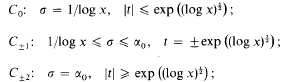
and middle contour used near the middle of page 67 should be

Denumerable compact metric spaces admit isometry-invariant finitely additive measures
-
- Journal:
- Mathematika / Volume 26 / Issue 2 / December 1979
- Published online by Cambridge University Press:
- 26 February 2010, pp. 184-186
- Print publication:
- December 1979
-
- Article
- Export citation
Instability of flow through pipes of general cross-section, Part 1
- Part of
-
- Journal:
- Mathematika / Volume 26 / Issue 2 / December 1979
- Published online by Cambridge University Press:
- 26 February 2010, pp. 187-210
- Print publication:
- December 1979
-
- Article
- Export citation
On the Mertens conjecture for cusp forms
-
- Journal:
- Mathematika / Volume 26 / Issue 2 / December 1979
- Published online by Cambridge University Press:
- 26 February 2010, pp. 236-249
- Print publication:
- December 1979
-
- Article
- Export citation
-
Before stating the main theorem, we would like to recall the basic properties of the “zeta-functions” attached to cusp forms on SL (2, ℤ). Let k be an even integer ≥ 12 and f a cusp form of weight k on SL (2, ℤ) with q-expansion
 We shall assume that c1 = 1, and that f is an eigenfunction of the Hecke operators. Define φ(s) as the Dirichlet series
  The series and the product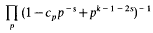
over the primes are equal and absolutely convergent for Re (S) > ½(k + 1).
 We shall assume that c
 The series and the product
Mass transport induced by standing interfacial waves
- Part of
-
- Journal:
- Mathematika / Volume 26 / Issue 2 / December 1979
- Published online by Cambridge University Press:
- 26 February 2010, pp. 224-235
- Print publication:
- December 1979
-
- Article
- Export citation
A decomposition theorem in tensor products of Archimedean vector lattices
- Part of
-
- Journal:
- Mathematika / Volume 26 / Issue 2 / December 1979
- Published online by Cambridge University Press:
- 26 February 2010, pp. 302-305
- Print publication:
- December 1979
-
- Article
- Export citation
Index to volume 26
-
- Journal:
- Mathematika / Volume 26 / Issue 2 / December 1979
- Published online by Cambridge University Press:
- 26 February 2010, p. 307
- Print publication:
- December 1979
-
- Article
- Export citation
Borel isomorphisms at the first level, II
- Part of
-
- Journal:
- Mathematika / Volume 26 / Issue 2 / December 1979
- Published online by Cambridge University Press:
- 26 February 2010, pp. 157-179
- Print publication:
- December 1979
-
- Article
- Export citation
Packing planes in ℝ3
- Part of
-
- Journal:
- Mathematika / Volume 26 / Issue 2 / December 1979
- Published online by Cambridge University Press:
- 26 February 2010, pp. 180-183
- Print publication:
- December 1979
-
- Article
- Export citation
Symmetrization and currents
- Part of
-
- Journal:
- Mathematika / Volume 26 / Issue 2 / December 1979
- Published online by Cambridge University Press:
- 26 February 2010, pp. 269-289
- Print publication:
- December 1979
-
- Article
- Export citation
Instability of flow through pipes of general cross-section, Part 2
- Part of
-
- Journal:
- Mathematika / Volume 26 / Issue 2 / December 1979
- Published online by Cambridge University Press:
- 26 February 2010, pp. 211-223
- Print publication:
- December 1979
-
- Article
- Export citation
MTK volume 26 issue 2 Front matter
-
- Journal:
- Mathematika / Volume 26 / Issue 2 / December 1979
- Published online by Cambridge University Press:
- 26 February 2010, pp. f1-f2
- Print publication:
- December 1979
-
- Article
-
- You have access
- Export citation
Buchstab's sifting weights
-
- Journal:
- Mathematika / Volume 26 / Issue 2 / December 1979
- Published online by Cambridge University Press:
- 26 February 2010, pp. 250-257
- Print publication:
- December 1979
-
- Article
- Export citation
-
Let
 be a finite sequence of positive integers. If we want to show that contains primes, or at least almost-primes (i.e. numbers with few prime factors), sieve methods give better results if weights of a certain kind are attached to the elements of .
 be a finite sequence of positive integers. If we want to show that
 Determination of a binary quadratic form by its values at integer points
-
- Journal:
- Mathematika / Volume 26 / Issue 1 / June 1979
- Published online by Cambridge University Press:
- 26 February 2010, pp. 72-75
- Print publication:
- June 1979
-
- Article
- Export citation
