Refine search
Actions for selected content:
26079 results in Abstract analysis
On a problem of Barban and Vehov
-
- Journal:
- Mathematika / Volume 26 / Issue 1 / June 1979
- Published online by Cambridge University Press:
- 26 February 2010, pp. 62-71
- Print publication:
- June 1979
-
- Article
- Export citation
-
Barban and Vehov posed in [1] the problem of minimizing the quadratic form
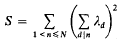
under the conditions
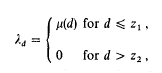
where 1 ≤ z1 < z2 and μ(n) is the Möbius function. They also commented on the connections of this problem with zero-density estimates of L-functions near the lines δ = 1 and ½, and with Linnik's prime number theorem. This program was carried out some years later by other authors, in the first place by Selberg [10], and later by Motohashi ([7]–[9]), Graham [2] and the present author ([4], [5]).
A distal property of groups and the growth of connected locally compact groups
- Part of
-
- Journal:
- Mathematika / Volume 26 / Issue 1 / June 1979
- Published online by Cambridge University Press:
- 26 February 2010, pp. 94-98
- Print publication:
- June 1979
-
- Article
- Export citation
Packing smooth curves in Rq
- Part of
-
- Journal:
- Mathematika / Volume 26 / Issue 1 / June 1979
- Published online by Cambridge University Press:
- 26 February 2010, pp. 1-12
- Print publication:
- June 1979
-
- Article
- Export citation
Universal fixed messages and the Rivest-Shamir-Adleman cryptosystem
-
- Journal:
- Mathematika / Volume 26 / Issue 1 / June 1979
- Published online by Cambridge University Press:
- 26 February 2010, pp. 44-52
- Print publication:
- June 1979
-
- Article
- Export citation
MTK volume 26 issue 1 Front matter
-
- Journal:
- Mathematika / Volume 26 / Issue 1 / June 1979
- Published online by Cambridge University Press:
- 26 February 2010, pp. f1-f2
- Print publication:
- June 1979
-
- Article
-
- You have access
- Export citation
On CS-closed sets
-
- Journal:
- Mathematika / Volume 26 / Issue 1 / June 1979
- Published online by Cambridge University Press:
- 26 February 2010, pp. 30-32
- Print publication:
- June 1979
-
- Article
- Export citation
Borel isomorphisms at the first level—I
- Part of
-
- Journal:
- Mathematika / Volume 26 / Issue 1 / June 1979
- Published online by Cambridge University Press:
- 26 February 2010, pp. 125-156
- Print publication:
- June 1979
-
- Article
- Export citation
Inner contact measures
- Part of
-
- Journal:
- Mathematika / Volume 26 / Issue 1 / June 1979
- Published online by Cambridge University Press:
- 26 February 2010, pp. 106-112
- Print publication:
- June 1979
-
- Article
- Export citation
Lusin's theorem for measure preserving homeomorphisms
-
- Journal:
- Mathematika / Volume 26 / Issue 1 / June 1979
- Published online by Cambridge University Press:
- 26 February 2010, pp. 33-43
- Print publication:
- June 1979
-
- Article
- Export citation
Stable, fragile and absolutely symmetric quadratic forms
-
- Journal:
- Mathematika / Volume 26 / Issue 1 / June 1979
- Published online by Cambridge University Press:
- 26 February 2010, pp. 76-79
- Print publication:
- June 1979
-
- Article
- Export citation
The ambiguous class group and the genius group of certain non-normal extensions
-
- Journal:
- Mathematika / Volume 26 / Issue 1 / June 1979
- Published online by Cambridge University Press:
- 26 February 2010, pp. 113-124
- Print publication:
- June 1979
-
- Article
- Export citation
Category algebras of complete metric spaces
- Part of
-
- Journal:
- Mathematika / Volume 26 / Issue 1 / June 1979
- Published online by Cambridge University Press:
- 26 February 2010, pp. 13-17
- Print publication:
- June 1979
-
- Article
- Export citation
-
We show that a complete metric space X has an essentially unique “nice” zero-dimensional dense Gδ subset, and derive from this a complete algebraic description of the “category algebra” (of Borel modulo first category sets)
 of X.
of X.
 of X.
of X.An approach to the zero-divisor question for group rings
-
- Journal:
- Mathematika / Volume 26 / Issue 1 / June 1979
- Published online by Cambridge University Press:
- 26 February 2010, pp. 88-93
- Print publication:
- June 1979
-
- Article
- Export citation
The distribution of integral and prime-integral values of systems of full-norm polynomials and affine-decomposable polynomials
-
- Journal:
- Mathematika / Volume 26 / Issue 1 / June 1979
- Published online by Cambridge University Press:
- 26 February 2010, pp. 80-87
- Print publication:
- June 1979
-
- Article
- Export citation
-
Let K be any finite (possibly trivial) extension of ℚ, the field of rational numbers. Let
 denote the ring of integers of K, and let M ⊆ be a full module in K thus a free ℤ-module of rank [K : ℚ] contained in ; ℤ denoting the ring of rational integers. Regarding as an abelian group, the index (: M) is finite. Suppose that m1, …, mk is a ℤ-basis for M and let a ∊ Then the polynomial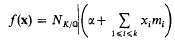
(the xi; being indeterminates) will be called a full-norm polynomial; here NK/ℚ denotes the norm mapping from K to ℚ. Apart from constant factors, such a polynomial f(x) is necessarily irreducible in ℤ[x].
 denote the ring of integers of K, and let M ⊆
Ellipsoids defined by Banach ideal norms
- Part of
-
- Journal:
- Mathematika / Volume 26 / Issue 1 / June 1979
- Published online by Cambridge University Press:
- 26 February 2010, pp. 18-29
- Print publication:
- June 1979
-
- Article
- Export citation
An embedding for groups with length functions
- Part of
-
- Journal:
- Mathematika / Volume 26 / Issue 1 / June 1979
- Published online by Cambridge University Press:
- 26 February 2010, pp. 99-102
- Print publication:
- June 1979
-
- Article
- Export citation
Covering systems of congruences, a negative result
-
- Journal:
- Mathematika / Volume 26 / Issue 1 / June 1979
- Published online by Cambridge University Press:
- 26 February 2010, pp. 53-61
- Print publication:
- June 1979
-
- Article
- Export citation
-
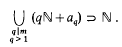
Suppose that we have a system of congruences ai (mod ni) 1 < n1 < … < ni < … < nk such that every integer is congruent to at least one ai (mod ni), then we say that it is a covering system of congruences. If ni | m, 1 ≤ i ≤ k, we say that m is a covering number. We shall use the symbol ℕ to denote the natural numbers together with zero, then m is a covering number if, for each q there is an aq such that
Outer automorphisms and non-trivial Picard groups
-
- Journal:
- Mathematika / Volume 26 / Issue 1 / June 1979
- Published online by Cambridge University Press:
- 26 February 2010, pp. 103-105
- Print publication:
- June 1979
-
- Article
- Export citation
Preface
-
- Book:
- Uniform Algebras and Jensen Measures
- Published online:
- 18 March 2010
- Print publication:
- 01 March 1979, pp vii-viii
-
- Chapter
- Export citation
3 - The Algebra R(K)
-
- Book:
- Uniform Algebras and Jensen Measures
- Published online:
- 18 March 2010
- Print publication:
- 01 March 1979, pp 34-45
-
- Chapter
- Export citation
