Refine search
Actions for selected content:
26079 results in Abstract analysis
Entire solutions of Δpu = f(r, u)
-
- Journal:
- Proceedings of the Royal Society of Edinburgh. Section A: Mathematics / Volume 82 / Issue 3-4 / 1979
- Published online by Cambridge University Press:
- 14 November 2011, pp. 189-192
- Print publication:
- 1979
-
- Article
- Export citation
On a non-regular parametric integral
-
- Journal:
- Proceedings of the Royal Society of Edinburgh. Section A: Mathematics / Volume 83 / Issue 3-4 / 1979
- Published online by Cambridge University Press:
- 14 November 2011, pp. 185-188
- Print publication:
- 1979
-
- Article
- Export citation
-
Suppose that f(t, λ) is, for fixed t in an open interval (a, b), a regular (or analytic or holomorphic) function of λ, when λ lies in a domain D of the complex plane. We assume that f is integrable with respect to t for fixed λ ∈ D, and consider the parametric integral

By hypothesis F(λ) exists for λ ∈ D and Professor W. N. Everitt has asked whether F(λ) is necessarily regular as a function of λ.
Hyponormal and essentially normal operators†
-
- Journal:
- Proceedings of the Royal Society of Edinburgh. Section A: Mathematics / Volume 83 / Issue 1-2 / 1979
- Published online by Cambridge University Press:
- 14 November 2011, pp. 123-132
- Print publication:
- 1979
-
- Article
- Export citation
Regularität in der nichtlinearen Spektraltheorie
-
- Journal:
- Proceedings of the Royal Society of Edinburgh. Section A: Mathematics / Volume 83 / Issue 1-2 / 1979
- Published online by Cambridge University Press:
- 14 November 2011, pp. 81-91
- Print publication:
- 1979
-
- Article
- Export citation
Near-rings of mappings*
-
- Journal:
- Proceedings of the Royal Society of Edinburgh. Section A: Mathematics / Volume 83 / Issue 3-4 / 1979
- Published online by Cambridge University Press:
- 14 November 2011, pp. 213-223
- Print publication:
- 1979
-
- Article
- Export citation
The last of the Fibonacci groups
-
- Journal:
- Proceedings of the Royal Society of Edinburgh. Section A: Mathematics / Volume 83 / Issue 3-4 / 1979
- Published online by Cambridge University Press:
- 14 November 2011, pp. 199-203
- Print publication:
- 1979
-
- Article
- Export citation
Comportement à l'infini pour certains systèmes dissipatifs non linéaires
-
- Journal:
- Proceedings of the Royal Society of Edinburgh. Section A: Mathematics / Volume 84 / Issue 3-4 / 1979
- Published online by Cambridge University Press:
- 14 November 2011, pp. 213-234
- Print publication:
- 1979
-
- Article
- Export citation
-
In the Hilbert space framework, we give some results concerning the behaviour when t goes to infinity for solutions of equations of the form:

A is assumed to be a maximal monotone operator and F(t) is a periodic function.
When F = 0, under a compactness assumption for trajectories of (1), we give the complete description of the asymptotic behaviour, e.g. every trajectory is asymptotic to an almost-periodic solution of (1). When F ≠ cst, the compactness hypothesis being too restrictive, we concentrate our efforts on the case of the equation:

with Dirichlet boundary condition) and get weak convergence to particular solutions of the equation when β is either univalued or strictly monotone. The methods used in these cases seem of general interest for hyperbolic equations of dissipative type with periodic forcing term.
On diffracted wave fronts
-
- Journal:
- Proceedings of the Royal Society of Edinburgh. Section A: Mathematics / Volume 84 / Issue 1-2 / 1979
- Published online by Cambridge University Press:
- 14 November 2011, pp. 35-54
- Print publication:
- 1979
-
- Article
- Export citation
The Rothe method for the wave equation in several space dimensions
-
- Journal:
- Proceedings of the Royal Society of Edinburgh. Section A: Mathematics / Volume 84 / Issue 1-2 / 1979
- Published online by Cambridge University Press:
- 14 November 2011, pp. 1-18
- Print publication:
- 1979
-
- Article
- Export citation
The point-continuous spectrum of second-order, ordinary differential operators
-
- Journal:
- Proceedings of the Royal Society of Edinburgh. Section A: Mathematics / Volume 84 / Issue 3-4 / 1979
- Published online by Cambridge University Press:
- 14 November 2011, pp. 197-211
- Print publication:
- 1979
-
- Article
- Export citation
Compactness of bounded trajectories of dynamical systems in infinite dimensional spaces†
-
- Journal:
- Proceedings of the Royal Society of Edinburgh. Section A: Mathematics / Volume 84 / Issue 1-2 / 1979
- Published online by Cambridge University Press:
- 14 November 2011, pp. 19-33
- Print publication:
- 1979
-
- Article
- Export citation
-
The following theorem is proved: Let S(t), t≧0 be a dynamical system in an infinite dimensional Banach space X such that S(t) = S1(t)+S2(t) for t≧0, where (1)
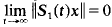 uniformly in bounded sets of x in X, and (2) S2(t) is compact for t sufficiently large. Then, if the orbit {S(t)x: t ≧0} of x ∈ X is bounded in X, it is precompact in X. Applications are made to an age dependent population model, a non-linear functional differential equation on an infinite interval, and a non-linear Volterra integrodifferential equation.
 uniformly in bounded sets of x in X, and (2) S
Positive solutions of a non-linear eigenvalue problem with discontinuous non-linearity†
-
- Journal:
- Proceedings of the Royal Society of Edinburgh. Section A: Mathematics / Volume 83 / Issue 1-2 / 1979
- Published online by Cambridge University Press:
- 14 November 2011, pp. 133-145
- Print publication:
- 1979
-
- Article
- Export citation
On regularized distance and related functions
-
- Journal:
- Proceedings of the Royal Society of Edinburgh. Section A: Mathematics / Volume 83 / Issue 1-2 / 1979
- Published online by Cambridge University Press:
- 14 November 2011, pp. 115-122
- Print publication:
- 1979
-
- Article
- Export citation
On the possibility of defining the Chapman–Kolmogorov semi-group on L∞
-
- Journal:
- Proceedings of the Royal Society of Edinburgh. Section A: Mathematics / Volume 83 / Issue 3-4 / 1979
- Published online by Cambridge University Press:
- 14 November 2011, pp. 327-331
- Print publication:
- 1979
-
- Article
- Export citation
Anti-isomorphisms of completely 0-simple semigroups
-
- Journal:
- Proceedings of the Royal Society of Edinburgh. Section A: Mathematics / Volume 83 / Issue 1-2 / 1979
- Published online by Cambridge University Press:
- 14 November 2011, pp. 55-62
- Print publication:
- 1979
-
- Article
- Export citation
On optimal mild solutions of non-homogeneous differential equations in Banach spaces†
-
- Journal:
- Proceedings of the Royal Society of Edinburgh. Section A: Mathematics / Volume 84 / Issue 3-4 / 1979
- Published online by Cambridge University Press:
- 14 November 2011, pp. 273-277
- Print publication:
- 1979
-
- Article
- Export citation
Contents
-
- Journal:
- Proceedings of the Royal Society of Edinburgh. Section A: Mathematics / Volume 84 / Issue 3-4 / 1979
- Published online by Cambridge University Press:
- 14 November 2011, pp. v-vi
- Print publication:
- 1979
-
- Article
- Export citation
Some comments on a singular elliptic problem associated with a rectangle*
-
- Journal:
- Proceedings of the Royal Society of Edinburgh. Section A: Mathematics / Volume 83 / Issue 3-4 / 1979
- Published online by Cambridge University Press:
- 14 November 2011, pp. 283-296
- Print publication:
- 1979
-
- Article
- Export citation
Multiplicity and bifurcation of periodic solutions in ordinary differential equations
-
- Journal:
- Proceedings of the Royal Society of Edinburgh. Section A: Mathematics / Volume 82 / Issue 3-4 / 1979
- Published online by Cambridge University Press:
- 14 November 2011, pp. 225-232
- Print publication:
- 1979
-
- Article
- Export citation
-
One considers the linear differential systems
 where
where  is a (not necessarily diagonal) matrix and one relates the computation of a general multiplicity defined from this system to the corresponding multiplicity of some eigenvalues of . Then applying these conclusions, one gives simple conditions ensuring the existence of odd or even periodic solutions for systems having the form
  .
.
 where
where  is a (not necessarily diagonal) matrix and one relates the computation of a general multiplicity defined from this system to the corresponding multiplicity of some eigenvalues of
  .
.Index
-
- Journal:
- Proceedings of the Royal Society of Edinburgh. Section A: Mathematics / Volume 83 / Issue 3-4 / 1979
- Published online by Cambridge University Press:
- 14 November 2011, pp. 365-367
- Print publication:
- 1979
-
- Article
- Export citation
