Refine search
Actions for selected content:
26079 results in Abstract analysis
5 - Subharmonicity with Respect to a Uniform Algebra
-
- Book:
- Uniform Algebras and Jensen Measures
- Published online:
- 18 March 2010
- Print publication:
- 01 March 1979, pp 54-82
-
- Chapter
- Export citation
Contents
-
- Book:
- Uniform Algebras and Jensen Measures
- Published online:
- 18 March 2010
- Print publication:
- 01 March 1979, pp v-vi
-
- Chapter
- Export citation
6 - Algebras of Analytic Functions
-
- Book:
- Uniform Algebras and Jensen Measures
- Published online:
- 18 March 2010
- Print publication:
- 01 March 1979, pp 83-106
-
- Chapter
- Export citation
2 - Classes of Representing Measures
-
- Book:
- Uniform Algebras and Jensen Measures
- Published online:
- 18 March 2010
- Print publication:
- 01 March 1979, pp 22-33
-
- Chapter
- Export citation
9 - Moduli of Functions in H2 (σ)
-
- Book:
- Uniform Algebras and Jensen Measures
- Published online:
- 18 March 2010
- Print publication:
- 01 March 1979, pp 146-155
-
- Chapter
- Export citation
1 - Choquet Theory
-
- Book:
- Uniform Algebras and Jensen Measures
- Published online:
- 18 March 2010
- Print publication:
- 01 March 1979, pp 1-21
-
- Chapter
- Export citation
7 - The Conjugation Opération for Representing Measures
-
- Book:
- Uniform Algebras and Jensen Measures
- Published online:
- 18 March 2010
- Print publication:
- 01 March 1979, pp 107-128
-
- Chapter
- Export citation
Frontmatter
-
- Book:
- Uniform Algebras and Jensen Measures
- Published online:
- 18 March 2010
- Print publication:
- 01 March 1979, pp i-iv
-
- Chapter
- Export citation
List of Notation
-
- Book:
- Uniform Algebras and Jensen Measures
- Published online:
- 18 March 2010
- Print publication:
- 01 March 1979, pp 156-157
-
- Chapter
- Export citation
4 - The Corona Problem for Riemann Surfaces
-
- Book:
- Uniform Algebras and Jensen Measures
- Published online:
- 18 March 2010
- Print publication:
- 01 March 1979, pp 46-53
-
- Chapter
- Export citation
8 - The Conjugation Operation for Jensen Measures
-
- Book:
- Uniform Algebras and Jensen Measures
- Published online:
- 18 March 2010
- Print publication:
- 01 March 1979, pp 129-145
-
- Chapter
- Export citation
Index
-
- Book:
- Uniform Algebras and Jensen Measures
- Published online:
- 18 March 2010
- Print publication:
- 01 March 1979, pp 158-162
-
- Chapter
- Export citation
Boundary value problems for linear systems†
-
- Journal:
- Proceedings of the Royal Society of Edinburgh. Section A: Mathematics / Volume 83 / Issue 3-4 / 1979
- Published online by Cambridge University Press:
- 14 November 2011, pp. 297-302
- Print publication:
- 1979
-
- Article
- Export citation
-
Suppose H and K are Hilbert spaces and H′0, H′ are closed subspaces of H so that H′0 ⊂ H′. Denote by P the orthogonal projection of H onto H′0, denote by g an element of k and by C a bounded linear transformation from H to K so that CC* = I, the identity on K. Denote CPC* by M. Given w in H′ one has the problem of finding u in H′ so that

There are given conditions on M (or certain operators related to M) which imply convergence of a certain iteratively generated sequence to a solution to this problem. The equation Cu = g represents an inhomogeneous system of linear differential equations (ordinary, partial or functional) and the condition P(u − w) = u − w is an abstract representation of inhomogeneous boundary conditions for u.
Acoustic radiation of long wavelength*
-
- Journal:
- Proceedings of the Royal Society of Edinburgh. Section A: Mathematics / Volume 83 / Issue 3-4 / 1979
- Published online by Cambridge University Press:
- 14 November 2011, pp. 245-254
- Print publication:
- 1979
-
- Article
- Export citation
Index
-
- Journal:
- Proceedings of the Royal Society of Edinburgh. Section A: Mathematics / Volume 84 / Issue 3-4 / 1979
- Published online by Cambridge University Press:
- 14 November 2011, pp. 365-366
- Print publication:
- 1979
-
- Article
- Export citation
The Poincaré–Bendixson theorem for certain differential equations of higher order
-
- Journal:
- Proceedings of the Royal Society of Edinburgh. Section A: Mathematics / Volume 83 / Issue 1-2 / 1979
- Published online by Cambridge University Press:
- 14 November 2011, pp. 63-79
- Print publication:
- 1979
-
- Article
- Export citation
Composite rational functions which are powers*
-
- Journal:
- Proceedings of the Royal Society of Edinburgh. Section A: Mathematics / Volume 83 / Issue 1-2 / 1979
- Published online by Cambridge University Press:
- 14 November 2011, pp. 11-16
- Print publication:
- 1979
-
- Article
- Export citation
Two series inequalities*
-
- Journal:
- Proceedings of the Royal Society of Edinburgh. Section A: Mathematics / Volume 83 / Issue 1-2 / 1979
- Published online by Cambridge University Press:
- 14 November 2011, pp. 109-114
- Print publication:
- 1979
-
- Article
- Export citation
-
In 1932, Hardy and Littlewood proved the inequalities
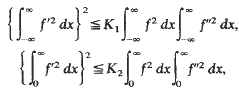
The best possible values of the constants K1 and K2 being 1 and 4 respectively. The object of this paper is to prove analogous results for infinite series in which the derivative of the real function f is replaced by the finite difference

of a sequence {an} of real numbers.
A generalisation of the inverse spectral theorem of Levitan and Gasymov
-
- Journal:
- Proceedings of the Royal Society of Edinburgh. Section A: Mathematics / Volume 84 / Issue 3-4 / 1979
- Published online by Cambridge University Press:
- 14 November 2011, pp. 185-196
- Print publication:
- 1979
-
- Article
- Export citation
-
In the Inverse Spectral Theorem in the form given by Levitan and Gasymov, necessary and sufficient conditions are given for a non-decreasing function, p(ℷ), to be the spectral function of a Sturm–Liouville problem. In these conditions, p(ℷ) is compared with the spectral function for the particular Strum–Liouville problem
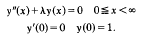
If the method of Levitan and Gasymov's proof is slightly adapted, the necessary and sufficient conditions can be stated in a more general form in which p(ℷ) is compared with the spectral function for any problem of the form

where hO is real and qo(x) locally integrable.
A second order Dirichlet differential expression that is not bounded below
-
- Journal:
- Proceedings of the Royal Society of Edinburgh. Section A: Mathematics / Volume 83 / Issue 1-2 / 1979
- Published online by Cambridge University Press:
- 14 November 2011, pp. 39-43
- Print publication:
- 1979
-
- Article
- Export citation
