Refine search
Actions for selected content:
26079 results in Abstract analysis
PRM volume 82 issue 3-4 Cover and Front matter
-
- Journal:
- Proceedings of the Royal Society of Edinburgh. Section A: Mathematics / Volume 82 / Issue 3-4 / 1979
- Published online by Cambridge University Press:
- 14 November 2011, pp. f1-f2
- Print publication:
- 1979
-
- Article
-
- You have access
- Export citation
On a class of interpolation series
-
- Journal:
- Proceedings of the Royal Society of Edinburgh. Section A: Mathematics / Volume 84 / Issue 3-4 / 1979
- Published online by Cambridge University Press:
- 14 November 2011, pp. 283-307
- Print publication:
- 1979
-
- Article
- Export citation
-
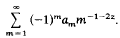
This paper deals with a class of interpolation series of the form

called R-series. It is equiconvergent with the Dirichlet series
If the nth Legendre polynomial for the interval (0,1) is denoted by (−1)nLn(t), then the bilinear formula
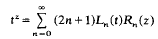
serves as generating function for the Rn(z). It also leads in easy steps to R-series expansions for rational functions.
Lagrange [7] has shown that a function holomorphic and of finite rate of growth in a right half-plane can be expanded in an R-series whose abscissa of convergence is limited by the rate of growth of f(z). The converse problem is attacked in Theorem 2 below where it is shown that

Nodal cubic surfaces*
-
- Journal:
- Proceedings of the Royal Society of Edinburgh. Section A: Mathematics / Volume 83 / Issue 3-4 / 1979
- Published online by Cambridge University Press:
- 14 November 2011, pp. 333-346
- Print publication:
- 1979
-
- Article
- Export citation
The inverse scattering problem for a cylinder†
-
- Journal:
- Proceedings of the Royal Society of Edinburgh. Section A: Mathematics / Volume 84 / Issue 1-2 / 1979
- Published online by Cambridge University Press:
- 14 November 2011, pp. 135-143
- Print publication:
- 1979
-
- Article
- Export citation
Energy stability for the flow between rotating, coaxial disks
-
- Journal:
- Proceedings of the Royal Society of Edinburgh. Section A: Mathematics / Volume 83 / Issue 3-4 / 1979
- Published online by Cambridge University Press:
- 14 November 2011, pp. 255-261
- Print publication:
- 1979
-
- Article
- Export citation
The stability problem for transformations of the circle
-
- Journal:
- Proceedings of the Royal Society of Edinburgh. Section A: Mathematics / Volume 84 / Issue 3-4 / 1979
- Published online by Cambridge University Press:
- 14 November 2011, pp. 279-281
- Print publication:
- 1979
-
- Article
- Export citation
PRM volume 84 issue 3-4 Cover and Front matter
-
- Journal:
- Proceedings of the Royal Society of Edinburgh. Section A: Mathematics / Volume 84 / Issue 3-4 / 1979
- Published online by Cambridge University Press:
- 14 November 2011, pp. f1-f2
- Print publication:
- 1979
-
- Article
-
- You have access
- Export citation
PRM volume 83 issue 1-2 Cover and Front matter
-
- Journal:
- Proceedings of the Royal Society of Edinburgh. Section A: Mathematics / Volume 83 / Issue 1-2 / 1979
- Published online by Cambridge University Press:
- 14 November 2011, pp. f1-f2
- Print publication:
- 1979
-
- Article
-
- You have access
- Export citation
The essential self-adjointness of differential operators with positive coefficients
-
- Journal:
- Proceedings of the Royal Society of Edinburgh. Section A: Mathematics / Volume 82 / Issue 3-4 / 1979
- Published online by Cambridge University Press:
- 14 November 2011, pp. 345-360
- Print publication:
- 1979
-
- Article
- Export citation
-
We consider the formally self-adjoint 2mth-order elliptic differential operator in ℝn given by
 where lt is an operator of order t, and pt ≧0 for t ≧1 and establish conditions under which the operator on
  is essentially self-adjoint in L2. A feature is that the major conditions (including the positivity of the coefficients) have to be imposed only in an increasing sequence of annular regions surrounding the origin.
 where l
 is essentially self-adjoint in L
On certain fourth-order integral inequalities
-
- Journal:
- Proceedings of the Royal Society of Edinburgh. Section A: Mathematics / Volume 83 / Issue 3-4 / 1979
- Published online by Cambridge University Press:
- 14 November 2011, pp. 205-211
- Print publication:
- 1979
-
- Article
- Export citation
-
The integral inequalities with which this paper is concerned are

and

where K(μ) and K1(μ) are positive numbers which depend on μ.
It is shown that each of these inequalities is valid only when μ = 0. Results relating to the corresponding inequalities on the extended interval (−∞, ∞) are also given.
Effects of a sharp pressure rise on a compressible laminar boundary layer, when the Prandtl number is σ = 0.72*
-
- Journal:
- Proceedings of the Royal Society of Edinburgh. Section A: Mathematics / Volume 84 / Issue 1-2 / 1979
- Published online by Cambridge University Press:
- 14 November 2011, pp. 153-171
- Print publication:
- 1979
-
- Article
- Export citation
-
Following an earlier paper (Curle 1978) we consider a compressible laminar boundary layer with uniform pressure when the distance x along the wall satisfies x < x0 and a prescribed large adverse pressure gradient when x > x0. The viscosity and absolute temperature are again taken to be proportional, but the Prandtl number is no longer assumed to be unity. After applying the Illingworth-Stewartson transformation, the transformed external velocity u1(x) is chosen so that
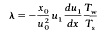
is large and constant, where Ts is the stagnation temperature, Tw is the (constant) Wall temperature and u0 is the upstream value of u1(x).
The flow reacts to this sharp pressure rise mainly in a thin inner sublayer, so inner and outer asymptotic expansions are derived and matched for functions F and S which determine the stream function and the temperature.
The skin friction, heat transfer, displacement thickness and momentum thickness are determined as functions of
 , andinvolve two parameters B1, B2, which depend upon the Mach number and the walltemperature. Detailed numerical calculations are presented here for σ = 0.72. In particular, it is seen that the heat transfer rate varies roughly like σ⅓ except near to separation, where it varies like σ¼.
 , andinvolve two parameters B
A simpler proof of two inequalities of Brodlie and Everitt
-
- Journal:
- Proceedings of the Royal Society of Edinburgh. Section A: Mathematics / Volume 84 / Issue 3-4 / 1979
- Published online by Cambridge University Press:
- 14 November 2011, pp. 259-261
- Print publication:
- 1979
-
- Article
- Export citation
-
In 1975 K. W. Brodie and W. N. Everitt dealt with integral inequalities of the form

in the two cases T = ℝ, T = ℝ+, and obtained the best possible constants KT(μ) for all μ ε ℝ. The proof was not elementary, but an elementary proof was given in 1977 by E. T. Copson. This note shows how Copson's method can be greatly simplified so as to obtain the results in a more straightforward manner.
Cohen elements in Banach algebras*†
-
- Journal:
- Proceedings of the Royal Society of Edinburgh. Section A: Mathematics / Volume 84 / Issue 1-2 / 1979
- Published online by Cambridge University Press:
- 14 November 2011, pp. 55-70
- Print publication:
- 1979
-
- Article
- Export citation
-
The definition of Cohen elements in a commutative Banach algebra
 with a countable bounded approximate identity given by Esterle is modified slightly to be more analogous to the invertible elements in a unital Banach algebra. With the modified definition the n1-Cohen factorization results that were proved by Esterle are shown tohold in the semigroup of Cohen elements. If is the algebra of continuous complex valued functions vanishing at infinity on a σ-compact locally compact Hausdorff space X, then the Cohen elements in are identified and a natural quotient of a subsemigroup of Cohen elements is shown to be a group, isomorphic to the abstract index group of C(X∪{∞}).
 with a countable bounded approximate identity given by Esterle is modified slightly to be more analogous to the invertible elements in a unital Banach algebra. With the modified definition the n
Conics related by a pentagram: a problem of J. E. Reeve
-
- Journal:
- Proceedings of the Royal Society of Edinburgh. Section A: Mathematics / Volume 84 / Issue 1-2 / 1979
- Published online by Cambridge University Press:
- 14 November 2011, pp. 109-115
- Print publication:
- 1979
-
- Article
- Export citation
On the divergence in rth mean of a class of eigenfunction expansions
-
- Journal:
- Proceedings of the Royal Society of Edinburgh. Section A: Mathematics / Volume 84 / Issue 3-4 / 1979
- Published online by Cambridge University Press:
- 14 November 2011, pp. 347-363
- Print publication:
- 1979
-
- Article
- Export citation
PRM volume 83 issue 1-2 Cover and Back matter
-
- Journal:
- Proceedings of the Royal Society of Edinburgh. Section A: Mathematics / Volume 83 / Issue 1-2 / 1979
- Published online by Cambridge University Press:
- 14 November 2011, pp. b1-b2
- Print publication:
- 1979
-
- Article
-
- You have access
- Export citation
On the hypertranscendence of meromorphic solutions of certain functional equations†
-
- Journal:
- Proceedings of the Royal Society of Edinburgh. Section A: Mathematics / Volume 83 / Issue 1-2 / 1979
- Published online by Cambridge University Press:
- 14 November 2011, pp. 45-54
- Print publication:
- 1979
-
- Article
- Export citation
PRM volume 82 issue 3-4 Cover and Back matter
-
- Journal:
- Proceedings of the Royal Society of Edinburgh. Section A: Mathematics / Volume 82 / Issue 3-4 / 1979
- Published online by Cambridge University Press:
- 14 November 2011, pp. b1-b6
- Print publication:
- 1979
-
- Article
-
- You have access
- Export citation
Nonlinear parabolic problems in unbounded domains
-
- Journal:
- Proceedings of the Royal Society of Edinburgh. Section A: Mathematics / Volume 82 / Issue 3-4 / 1979
- Published online by Cambridge University Press:
- 14 November 2011, pp. 201-209
- Print publication:
- 1979
-
- Article
- Export citation
Stability regions for multi-parameter systems of periodic second order ordinary differential equations*
-
- Journal:
- Proceedings of the Royal Society of Edinburgh. Section A: Mathematics / Volume 84 / Issue 3-4 / 1979
- Published online by Cambridge University Press:
- 14 November 2011, pp. 249-257
- Print publication:
- 1979
-
- Article
- Export citation
-
This paper studies the stability regions associated with the multi-parameter system

where the functions qr(xr), ars(xr) are periodic and the system is subjected to periodic or semi-periodic boundary conditions.
