Refine search
Actions for selected content:
26079 results in Abstract analysis
Skeleta and sections of convex bodies
- Part of
-
- Journal:
- Mathematika / Volume 27 / Issue 1 / June 1980
- Published online by Cambridge University Press:
- 26 February 2010, pp. 97-103
- Print publication:
- June 1980
-
- Article
- Export citation
-
The purpose of this paper is to prove two integralgeometric formulae for convex bodies. Our results are expressed in terms of integrals with respect to the rigid-motion-invariant measure μd, r on the space ℰ(d, r) of all r-dimensional affine flats in d-dimensional Euclidean space Ed. Rolf Schneider, in an unpublished note [6], has shown that for a convex polytope P in Ed and 1 ≤ r ≤ d – 1 one has

where ηr(P) is the sum of the contents of the r-dimensional faces of P, ηo(Ed–r ∩ P) is the number of vertices of the (d – r)-dimensional section Ed–r ∩ P, and α(r) is the content of the r-dimensional unit ball.
A graph and its complement with specified properties V: The self-complement index
- Part of
-
- Journal:
- Mathematika / Volume 27 / Issue 1 / June 1980
- Published online by Cambridge University Press:
- 26 February 2010, pp. 64-68
- Print publication:
- June 1980
-
- Article
- Export citation
Popular values of Euler's function
-
- Journal:
- Mathematika / Volume 27 / Issue 1 / June 1980
- Published online by Cambridge University Press:
- 26 February 2010, pp. 84-89
- Print publication:
- June 1980
-
- Article
- Export citation
On the chromatic number of binary matroids
- Part of
-
- Journal:
- Mathematika / Volume 27 / Issue 1 / June 1980
- Published online by Cambridge University Press:
- 26 February 2010, pp. 1-9
- Print publication:
- June 1980
-
- Article
- Export citation
The d – 2 Skeletons of polytopal approximations to a convex body in Ed
- Part of
-
- Journal:
- Mathematika / Volume 27 / Issue 1 / June 1980
- Published online by Cambridge University Press:
- 26 February 2010, pp. 122-133
- Print publication:
- June 1980
-
- Article
- Export citation
-
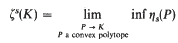
Let K be a convex body in Ed and let skelsK denote the s-skeleton of K. Let ηs(K) denote the Hausdorff s-measure of skelsK and
L-Series for genera at s = 1
-
- Journal:
- Mathematika / Volume 27 / Issue 1 / June 1980
- Published online by Cambridge University Press:
- 26 February 2010, pp. 10-16
- Print publication:
- June 1980
-
- Article
- Export citation
-
It has been conjectured that, if p ≡ 1 (mod 4) is prime, and if d < 0 is a square-free discriminant with
 then
then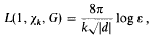
Where
 belongs to the field
  is the fundamental unit of Q(√k),
 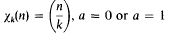 depending on whether there are an even number or an odd number of classes per genus in Q(√d), and Ω is the genus field of Q(√d). Here
  the summation being over a complete set of inequivalent forms in the genus G, and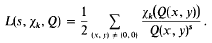
In this paper it will be shown that this conjecture is true when d is the product of two odd discriminants. An example when d is the product of three prime discriminants is discussed.
 then
then
 belongs to the field
  is the fundamental unit of Q(√k),
  depending on whether there are an even number or an odd number of classes per genus in Q(√d), and Ω is the genus field of Q(√d). Here
  the summation being over a complete set of inequivalent forms in the genus G, and
Small fractional parts of quadratic forms in many variables
-
- Journal:
- Mathematika / Volume 27 / Issue 1 / June 1980
- Published online by Cambridge University Press:
- 26 February 2010, pp. 25-29
- Print publication:
- June 1980
-
- Article
- Export citation
-
Let

be a real quadratic form in n variables x1,…, xn and let ‖θ‖ denote the distance from θ to the nearest integer. Danicic [3] proved that if N > 1 and ξ > 0 then there exist integers x1,…, xn, not all zero, satisfying

where C depends on n and ξ only.
MTK volume 27 issue 1 Front matter
-
- Journal:
- Mathematika / Volume 27 / Issue 1 / June 1980
- Published online by Cambridge University Press:
- 26 February 2010, pp. f1-f2
- Print publication:
- June 1980
-
- Article
-
- You have access
- Export citation
Shadow-boundaries and cuts of convex polytopes
-
- Journal:
- Mathematika / Volume 27 / Issue 1 / June 1980
- Published online by Cambridge University Press:
- 26 February 2010, pp. 58-63
- Print publication:
- June 1980
-
- Article
- Export citation
-
Let P be a (convex) d-polytope in the Euclidean space Ed and p a point of Ed not contained in P or in a supporting hyperplane of a facet of P (we use the terminology of Grunbaum [2]). The part of the boundary of P which is “visible” from p, i.e. the union of those facets whose supporting hyperplanes separate p and P, form a (d – l)-ball, whose boundary is a (d – 2)-sphere S (all balls, spheres and manifolds to be considered are piecewise-linear). The boundary-complex ℬ(P) induces a subdivision
 of S, which we call a (sharp) shadow-boundary ofP. is combinatorially isomorphic to the boundary complex of a poly tope which is a central projection of P from the point p on a hyperplane.
 of S, which we call a (sharp) shadow-boundary ofP.
 Locally minimal Epstein zeta functions
-
- Journal:
- Mathematika / Volume 27 / Issue 1 / June 1980
- Published online by Cambridge University Press:
- 26 February 2010, pp. 17-24
- Print publication:
- June 1980
-
- Article
- Export citation
Small solutions of quadratic and quartic congruences
-
- Journal:
- Mathematika / Volume 27 / Issue 1 / June 1980
- Published online by Cambridge University Press:
- 26 February 2010, pp. 30-45
- Print publication:
- June 1980
-
- Article
- Export citation
-
The present investigation was suggested by a theorem of A. Schinzel, H. P. Schlickewei and W. M. Schmidt [6]: let Q(x) = Q(x1,…, xs) be a quadratic form with integer coefficients. Then for each natural number m there are integers x1,…, xs satisfying

and having

Rarefaction indices
- Part of
-
- Journal:
- Mathematika / Volume 27 / Issue 1 / June 1980
- Published online by Cambridge University Press:
- 26 February 2010, pp. 46-57
- Print publication:
- June 1980
-
- Article
- Export citation
On the slow viscous rolling of a sphere in contact with a permeable surface
-
- Journal:
- Mathematika / Volume 27 / Issue 1 / June 1980
- Published online by Cambridge University Press:
- 26 February 2010, pp. 104-112
- Print publication:
- June 1980
-
- Article
- Export citation
Convex bodies which tile space by translation
-
- Journal:
- Mathematika / Volume 27 / Issue 1 / June 1980
- Published online by Cambridge University Press:
- 26 February 2010, pp. 113-121
- Print publication:
- June 1980
-
- Article
- Export citation
Sections of Sets of zero Lebesgue measure
- Part of
-
- Journal:
- Mathematika / Volume 27 / Issue 1 / June 1980
- Published online by Cambridge University Press:
- 26 February 2010, pp. 90-96
- Print publication:
- June 1980
-
- Article
- Export citation
Proof of D. J. Newman's coprime mapping conjecture
-
- Journal:
- Mathematika / Volume 27 / Issue 1 / June 1980
- Published online by Cambridge University Press:
- 26 February 2010, pp. 69-83
- Print publication:
- June 1980
-
- Article
- Export citation
1 - Differentiation of functions of one real variable
-
- Book:
- Differential Analysis
- Published online:
- 07 October 2011
- Print publication:
- 14 February 1980, pp 3-68
-
- Chapter
- Export citation
Notes
-
- Book:
- Differential Analysis
- Published online:
- 07 October 2011
- Print publication:
- 14 February 1980, pp 332-338
-
- Chapter
- Export citation
Bibliography
-
- Book:
- Differential Analysis
- Published online:
- 07 October 2011
- Print publication:
- 14 February 1980, pp 339-350
-
- Chapter
- Export citation
4 - The Gâteaux and Hadamard variations and differentials
-
- Book:
- Differential Analysis
- Published online:
- 07 October 2011
- Print publication:
- 14 February 1980, pp 251-312
-
- Chapter
- Export citation
