Refine search
Actions for selected content:
26079 results in Abstract analysis
An eigenfunction expansion associated with a two-parameter system of differential equations. I
-
- Journal:
- Proceedings of the Royal Society of Edinburgh. Section A: Mathematics / Volume 89 / Issue 1-2 / 1981
- Published online by Cambridge University Press:
- 14 November 2011, pp. 143-155
- Print publication:
- 1981
-
- Article
- Export citation
On the convergence of the method of finite differences applied to the solution of the initial value problem for functional-differential neutral type equations
-
- Journal:
- Proceedings of the Royal Society of Edinburgh. Section A: Mathematics / Volume 89 / Issue 3-4 / 1981
- Published online by Cambridge University Press:
- 14 November 2011, pp. 259-265
- Print publication:
- 1981
-
- Article
- Export citation
Order arguments on the dimension of vector lattices
-
- Journal:
- Proceedings of the Royal Society of Edinburgh. Section A: Mathematics / Volume 89 / Issue 1-2 / 1981
- Published online by Cambridge University Press:
- 14 November 2011, pp. 51-53
- Print publication:
- 1981
-
- Article
- Export citation
Orthogonal polynomials satisfying fourth order differential equations
-
- Journal:
- Proceedings of the Royal Society of Edinburgh. Section A: Mathematics / Volume 87 / Issue 3-4 / 1981
- Published online by Cambridge University Press:
- 14 November 2011, pp. 271-288
- Print publication:
- 1981
-
- Article
- Export citation
A class of bisimple, idempotent-generated congruence-free semigroups
-
- Journal:
- Proceedings of the Royal Society of Edinburgh. Section A: Mathematics / Volume 88 / Issue 1-2 / 1981
- Published online by Cambridge University Press:
- 14 November 2011, pp. 169-184
- Print publication:
- 1981
-
- Article
- Export citation
-
Let X be a set with infinite regular cardinality m. Within the full transformation semigroup ℑ(X) a subsemigroup Sm is described which is bisimple and idempotent-generated. Its minimum non-trivial homomorphic image
 has both these properties and is also congruence-free. The semigroup contains an isomorphic copy of every semigroup having order less than m.
 has both these properties and is also congruence-free. The semigroup
 Oscillation criteria for third order hyperbolic characteristic initial value problems
-
- Journal:
- Proceedings of the Royal Society of Edinburgh. Section A: Mathematics / Volume 88 / Issue 1-2 / 1981
- Published online by Cambridge University Press:
- 14 November 2011, pp. 135-140
- Print publication:
- 1981
-
- Article
- Export citation
A priori bounds for a class of nonlinear elliptic equations and applications to physical problems
-
- Journal:
- Proceedings of the Royal Society of Edinburgh. Section A: Mathematics / Volume 88 / Issue 1-2 / 1981
- Published online by Cambridge University Press:
- 14 November 2011, pp. 75-81
- Print publication:
- 1981
-
- Article
- Export citation
The spectrum of multiparameter problems in Hilbert space
-
- Journal:
- Proceedings of the Royal Society of Edinburgh. Section A: Mathematics / Volume 91 / Issue 1-2 / 1981
- Published online by Cambridge University Press:
- 14 November 2011, pp. 31-42
- Print publication:
- 1981
-
- Article
- Export citation
Naturally ordered regular semigroups with a greatest idempotent
-
- Journal:
- Proceedings of the Royal Society of Edinburgh. Section A: Mathematics / Volume 91 / Issue 1-2 / 1981
- Published online by Cambridge University Press:
- 14 November 2011, pp. 107-122
- Print publication:
- 1981
-
- Article
- Export citation
PRM volume 87 issue 3-4 Cover and Back matter
-
- Journal:
- Proceedings of the Royal Society of Edinburgh. Section A: Mathematics / Volume 87 / Issue 3-4 / 1981
- Published online by Cambridge University Press:
- 14 November 2011, pp. b1-b2
- Print publication:
- 1981
-
- Article
-
- You have access
- Export citation
Existence and uniqueness for two-point boundary value problems
-
- Journal:
- Proceedings of the Royal Society of Edinburgh. Section A: Mathematics / Volume 88 / Issue 3-4 / 1981
- Published online by Cambridge University Press:
- 14 November 2011, pp. 219-234
- Print publication:
- 1981
-
- Article
- Export citation
PRM volume 88 issue 3-4 Cover and Back matter
-
- Journal:
- Proceedings of the Royal Society of Edinburgh. Section A: Mathematics / Volume 88 / Issue 3-4 / 1981
- Published online by Cambridge University Press:
- 14 November 2011, pp. b1-b2
- Print publication:
- 1981
-
- Article
-
- You have access
- Export citation
Hermite–Birkhoff interpolation by Hermite–Birkhoff splines
-
- Journal:
- Proceedings of the Royal Society of Edinburgh. Section A: Mathematics / Volume 88 / Issue 3-4 / 1981
- Published online by Cambridge University Press:
- 14 November 2011, pp. 195-201
- Print publication:
- 1981
-
- Article
- Export citation
A directed set of Sturm–Liouville operators
-
- Journal:
- Proceedings of the Royal Society of Edinburgh. Section A: Mathematics / Volume 90 / Issue 1-2 / 1981
- Published online by Cambridge University Press:
- 14 November 2011, pp. 125-145
- Print publication:
- 1981
-
- Article
- Export citation
On polynomial interpolation at the points of a geometric progression
-
- Journal:
- Proceedings of the Royal Society of Edinburgh. Section A: Mathematics / Volume 90 / Issue 3-4 / 1981
- Published online by Cambridge University Press:
- 14 November 2011, pp. 195-207
- Print publication:
- 1981
-
- Article
- Export citation
The number of positive solutions of a non-linear problem with discontinuous non-linearity
-
- Journal:
- Proceedings of the Royal Society of Edinburgh. Section A: Mathematics / Volume 90 / Issue 3-4 / 1981
- Published online by Cambridge University Press:
- 14 November 2011, pp. 281-291
- Print publication:
- 1981
-
- Article
- Export citation
-
For the non-linear problem
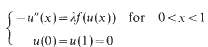
where f is a discontinuous function at 1, we show that the number of non-trivial positive solutions, for a given real number λ≧0, is related to the graph of a continuous function g. Then, by studying the function g it is possible in some special cases to give, for any λ≧0, the minimal or exact number of non-trivial positive solutions.
PRM volume 90 issue 3-4 Cover and Back matter
-
- Journal:
- Proceedings of the Royal Society of Edinburgh. Section A: Mathematics / Volume 90 / Issue 3-4 / 1981
- Published online by Cambridge University Press:
- 14 November 2011, pp. b1-b4
- Print publication:
- 1981
-
- Article
-
- You have access
- Export citation
PRM volume 91 issue 1-2 Cover and Front matter
-
- Journal:
- Proceedings of the Royal Society of Edinburgh. Section A: Mathematics / Volume 91 / Issue 1-2 / 1981
- Published online by Cambridge University Press:
- 14 November 2011, pp. f1-f2
- Print publication:
- 1981
-
- Article
-
- You have access
- Export citation
Non-existence of eigenvalues of Dirac operators
-
- Journal:
- Proceedings of the Royal Society of Edinburgh. Section A: Mathematics / Volume 89 / Issue 3-4 / 1981
- Published online by Cambridge University Press:
- 14 November 2011, pp. 309-317
- Print publication:
- 1981
-
- Article
- Export citation
-
Absence of non-trivial square integrable solutions of the Dirac equation

for values of λ in half-rays is proved under local conditions on q, curl b, and the radial derivative of q. The Coulomb potential is admitted. Another result does not contain any growth condition on the radial derivative of q. It states that there are no solutions of integrable square other than the trivial solution if λ ε ℝ\ [−1, 1] and

A limit-point criterion for 2n-th order symmetric differential expressions
-
- Journal:
- Proceedings of the Royal Society of Edinburgh. Section A: Mathematics / Volume 90 / Issue 1-2 / 1981
- Published online by Cambridge University Press:
- 14 November 2011, pp. 1-12
- Print publication:
- 1981
-
- Article
- Export citation
