Refine search
Actions for selected content:
26079 results in Abstract analysis
5 - Restrictions on the growth of ∥at∥
-
- Book:
- Continuous Semigroups in Banach Algebras
- Published online:
- 22 March 2010
- Print publication:
- 17 June 1982, pp 70-90
-
- Chapter
- Export citation
MTK volume 29 issue 1 Front matter
-
- Journal:
- Mathematika / Volume 29 / Issue 1 / June 1982
- Published online by Cambridge University Press:
- 26 February 2010, pp. f1-f2
- Print publication:
- June 1982
-
- Article
-
- You have access
- Export citation
Totally ordered measure spaces and their Lp algebras
- Part of
-
- Journal:
- Mathematika / Volume 29 / Issue 1 / June 1982
- Published online by Cambridge University Press:
- 26 February 2010, pp. 42-54
- Print publication:
- June 1982
-
- Article
- Export citation
-
This paper is concerned with two aspects of the theory of measures on compact totally ordered spaces (the topology is to be the order topology). In Section 2, we clarify a recent construction of Sapounakis [11, 12] and, in so doing, we are able to say a little more about it. It should be added here that Sapounakis had other ends in view. To be precise, let I be the closed unit interval [0, 1] and let λ be Lebesgue measure on I. We shall construct another totally ordered set Ĩ which is compact in its order topology, a continuous increasing surjection τ : Ĩ → I with the property that card τ−1(t) = 2 for all t ∈ ]0,1[ (these brackets denote the open interval), and a measure
 on Ĩ such that τ() = λ. Then the following theorem holds.
 on Ĩ such that τ(
On the representation of even integers as sums of two almost-primes in algebraic number fields
-
- Journal:
- Mathematika / Volume 29 / Issue 1 / June 1982
- Published online by Cambridge University Press:
- 26 February 2010, pp. 93-108
- Print publication:
- June 1982
-
- Article
- Export citation
A measure invariant under group endomorphisms
- Part of
-
- Journal:
- Mathematika / Volume 29 / Issue 1 / June 1982
- Published online by Cambridge University Press:
- 26 February 2010, pp. 116-118
- Print publication:
- June 1982
-
- Article
- Export citation
On the presentation of stratified sets and singular varieties
- Part of
-
- Journal:
- Mathematika / Volume 29 / Issue 1 / June 1982
- Published online by Cambridge University Press:
- 26 February 2010, pp. 135-170
- Print publication:
- June 1982
-
- Article
- Export citation
Covering and packing properties of bounded sequences of convex sets
-
- Journal:
- Mathematika / Volume 29 / Issue 1 / June 1982
- Published online by Cambridge University Press:
- 26 February 2010, pp. 18-31
- Print publication:
- June 1982
-
- Article
- Export citation
Mean values of superharmonic functions on half-spaces
-
- Journal:
- Mathematika / Volume 29 / Issue 1 / June 1982
- Published online by Cambridge University Press:
- 26 February 2010, pp. 55-57
- Print publication:
- June 1982
-
- Article
- Export citation
-
Hyperplane mean values of non-negative subharmonic functions have been studied in many papers, of which [2] and [3] are examples. Recently, Armitage [1] began a study of hyperplane means of non-negative superharmonic functions. One of his results [1, Theorem 2] shows that, if w is a positive superharmonic function on

and n/(n + 1) p < 1, then

as t → ∞, while another [1, Theorem 1] shows that, if 0 < p ≤ n/(n + l), then the integral in (1) is always infinite. However, he did not present a complete analogue of the result of Flett and Brawn [2, 3], which states that, if Ф: [0, ∞ [ → [0, ∞ [ is a non-decreasing convex function such that Ф(u)/u → 0 as u → 0 +, and w is a nonnegative subharmonic function on Rn × ]0, ∞ [, then under certain conditions on the size of w, the integral mean
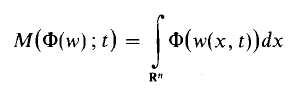
tends to zero as t → ∞. In this note we present an analogue for superharmonic functions of the above result, in which the mean M(Ф(w); t) is shown to tend to infinity with t, provided that Ф(u)/u → ∞ as u → 0 +, and which therefore generalizes (1). It might be expected that, in dealing with the superharmonic case, the function Ф would have to be concave, so that Ф(w) would also be superharmonic. It turns out that this condition is unnecessary.
A parity problem from sieve theory
-
- Journal:
- Mathematika / Volume 29 / Issue 1 / June 1982
- Published online by Cambridge University Press:
- 26 February 2010, pp. 1-6
- Print publication:
- June 1982
-
- Article
- Export citation
Sets of finite sets satisfying union conditions
-
- Journal:
- Mathematika / Volume 29 / Issue 1 / June 1982
- Published online by Cambridge University Press:
- 26 February 2010, pp. 128-134
- Print publication:
- June 1982
-
- Article
- Export citation
Hausdorff dimension and the exceptional set of projections
- Part of
-
- Journal:
- Mathematika / Volume 29 / Issue 1 / June 1982
- Published online by Cambridge University Press:
- 26 February 2010, pp. 109-115
- Print publication:
- June 1982
-
- Article
- Export citation
Cubic Diophantine inequalities
-
- Journal:
- Mathematika / Volume 29 / Issue 1 / June 1982
- Published online by Cambridge University Press:
- 26 February 2010, pp. 83-92
- Print publication:
- June 1982
-
- Article
- Export citation
-
Let λ1, …, λ8 be any non-zero real numbers not all of the same sign and not all in rational ratios. According to a theorem of Davenport and Roth [3], given a real number κ, the inequality

has infinitely many solutions in positive integers for any ε > 0. Recently Liu, Ng and Tsang [5] gave a refinement of this result: for any δ > 0, the inequality

has infinitely many solutions in positive integers. In the present note we obtain a better exponent.
Boundary measures of solutions of partial differential equations
- Part of
-
- Journal:
- Mathematika / Volume 29 / Issue 1 / June 1982
- Published online by Cambridge University Press:
- 26 February 2010, pp. 67-82
- Print publication:
- June 1982
-
- Article
- Export citation
Modules of generalized fractions
- Part of
-
- Journal:
- Mathematika / Volume 29 / Issue 1 / June 1982
- Published online by Cambridge University Press:
- 26 February 2010, pp. 32-41
- Print publication:
- June 1982
-
- Article
- Export citation
-
The construction, for a module M over a commutative ring A (with identity) and a multiplicatively closed subset S of A, of the module of fractions S-1M is, of course, one of the most basic ideas in commutative algebra. The purpose of this note is to present a generalization which constructs, for a positive integer n and what is called a triangular subset U of An = A × A × … × A (n factors), a module U-n M of generalized fractions, a typical element of which has the form
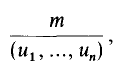
where m∈ M and (u1, … un)∈U.
Squarefree numbers on short intervals
-
- Journal:
- Mathematika / Volume 29 / Issue 1 / June 1982
- Published online by Cambridge University Press:
- 26 February 2010, pp. 7-17
- Print publication:
- June 1982
-
- Article
- Export citation
-
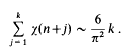
It is a familiar fact that the sequence of K-free numbers, i.e. those having no K-th power divisor greater than 1, has asymptotic density 1/ζ(K). Let χ(K) denote the characteristic function of this sequence, χ(2) = χ. Roth [5] proved that, if k/(n3/13(log n)4/13) → ∞, then
Low-Reynolds-number flow between converging spheres
- Part of
-
- Journal:
- Mathematika / Volume 29 / Issue 1 / June 1982
- Published online by Cambridge University Press:
- 26 February 2010, pp. 58-66
- Print publication:
- June 1982
-
- Article
- Export citation
Simplicial faces and sections of a convex polytope
-
- Journal:
- Mathematika / Volume 29 / Issue 1 / June 1982
- Published online by Cambridge University Press:
- 26 February 2010, pp. 119-127
- Print publication:
- June 1982
-
- Article
- Export citation
The periodic quasigeostrophic equations: existence and uniqueness of strong solutions
-
- Journal:
- Proceedings of the Royal Society of Edinburgh. Section A: Mathematics / Volume 91 / Issue 3-4 / 1982
- Published online by Cambridge University Press:
- 14 November 2011, pp. 185-203
- Print publication:
- 1982
-
- Article
- Export citation
An analogue of Maschke's theorem for certain representations of A6 over GF(2)
-
- Journal:
- Proceedings of the Royal Society of Edinburgh. Section A: Mathematics / Volume 91 / Issue 3-4 / 1982
- Published online by Cambridge University Press:
- 14 November 2011, pp. 175-177
- Print publication:
- 1982
-
- Article
- Export citation
Monotone techniques and some existence-uniqueness theorems for two point boundary value problems
-
- Journal:
- Proceedings of the Royal Society of Edinburgh. Section A: Mathematics / Volume 91 / Issue 3-4 / 1982
- Published online by Cambridge University Press:
- 14 November 2011, pp. 265-275
- Print publication:
- 1982
-
- Article
- Export citation
-
In this paper we study the existence and uniqueness of the two point boundary value problems −(p(x)u′(x))′ = f(x, u(x), u′(x)), xε(0, 1), u′(0)−cu(0) = 0 = u′(1) + du(1), where ∂f/∂u is bounded. above by the least eigenvalue of associated linear problems and ∂f/∂u is bounded. By using monotone techniques to investigate the equivalent problem −(p(x)u′(x))′ + r(x)u(x) = f(x, u(x), u′(x)) + r(x)u(x) where r ε C[0, 1] we show that

gives the optimal bounds for ∂f/∂u and ∂f/u′ when c and d are nonnegative constants.
