Refine search
Actions for selected content:
26078 results in Abstract analysis
A nonlinear singularly perturbed Volterra integrodifferential equation of nonconvolution type
-
- Journal:
- Proceedings of the Royal Society of Edinburgh. Section A: Mathematics / Volume 80 / Issue 3-4 / 1978
- Published online by Cambridge University Press:
- 14 November 2011, pp. 235-247
- Print publication:
- 1978
-
- Article
- Export citation
-
We consider the nonconvolution initial value problem

where μ is a small positive parameter, b(t, s) is a given real kernel, and F, g are given real functions. For the convolution case b(t,s) = a(t − s). Lodge, McLeod, and Nohel recently established many qualitative properties of the solution of (+); we extend their results to the general nonconvolution problem. In particular, conditions are given that ensure that the solution of (+) decreases to a limiting value α(μ) > 1 as t → ∞.
Fragmented rings
-
- Journal:
- Proceedings of the Royal Society of Edinburgh. Section A: Mathematics / Volume 78 / Issue 3-4 / 1978
- Published online by Cambridge University Press:
- 14 November 2011, pp. 273-283
- Print publication:
- 1978
-
- Article
- Export citation
On the structure of morphism near-rings*
-
- Journal:
- Proceedings of the Royal Society of Edinburgh. Section A: Mathematics / Volume 81 / Issue 3-4 / 1978
- Published online by Cambridge University Press:
- 14 November 2011, pp. 287-298
- Print publication:
- 1978
-
- Article
- Export citation
A nonlinear singularly perturbed Volterra integrodifferential equation occurring in polymer rheology
-
- Journal:
- Proceedings of the Royal Society of Edinburgh. Section A: Mathematics / Volume 80 / Issue 1-2 / 1978
- Published online by Cambridge University Press:
- 14 November 2011, pp. 99-137
- Print publication:
- 1978
-
- Article
- Export citation
-
We study the initial value problem for the nonlinear Volterra integrodifferential equation
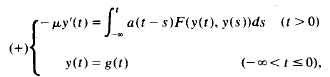
where μ > 0 is a small parameter, a is a given real kernel, and F, g are given real functions; (+) models the elongation ratio of a homogeneous filament of a certain polyethylene which is stretched on the time interval (— ∞ 0], then released and allowed to undergo elastic recovery for t > 0. Under assumptions which include physically interesting cases of the given functions a, F, g, we discuss qualitative properties of the solution of (+) and of the corresponding reduced problem when μ = 0, and the relation between them as μ → 0+, both for t near zero (where a boundary layer occurs) and for large t. In particular, we show that in general the filament does not recover its original length, and that the Newtonian term —μy′ in (+) has little effect on the ultimate recovery but significant effect during the early part of the recovery.
Eigenfunction expansions associated with a two-parameter system of differential equations
-
- Journal:
- Proceedings of the Royal Society of Edinburgh. Section A: Mathematics / Volume 81 / Issue 1-2 / 1978
- Published online by Cambridge University Press:
- 14 November 2011, pp. 79-93
- Print publication:
- 1978
-
- Article
- Export citation
The interlacing of eigenvalues for periodic multi-parameter problems*
-
- Journal:
- Proceedings of the Royal Society of Edinburgh. Section A: Mathematics / Volume 80 / Issue 3-4 / 1978
- Published online by Cambridge University Press:
- 14 November 2011, pp. 357-362
- Print publication:
- 1978
-
- Article
- Export citation
-
This paper studies a linked system of second order ordinary differential equations

where xx ∈ [ar, br] and the coefficients qrars are continuous, real valued and periodic of period (br − ar), 1 ≤ r,s ≤ k. We assume the definiteness condition det{ars(xr)} > 0 and 2k possible multiparameter eigenvalue problems are then formulated according as periodic or semi-periodic boundary conditions are imposed on each of the equations of (*). The main result describes the interlacing of the 2k possible sets of eigentuples thus extending to the multiparameter case the well known theorem concerning 1-parameter periodic equation.
Non-linear Sturm-Liouville problems with no secondary bifurcation†
-
- Journal:
- Proceedings of the Royal Society of Edinburgh. Section A: Mathematics / Volume 80 / Issue 3-4 / 1978
- Published online by Cambridge University Press:
- 14 November 2011, pp. 347-356
- Print publication:
- 1978
-
- Article
- Export citation
-
The paper is concerned with giving sufficient conditions that in the non-linear boundary-value problem

there should be no secondary bifurcation, i.e. that, given a branch of solutions (u, λ) bifurcating from the trivial solution, there should be no further bifurcation on that branch. Sufficient conditions on G are given which include, for example, Kolodner's problem of the motion of a heavy rotating string.
The treatment of a Neumann boundary value problem for force-free fields by an integral equation method*†
-
- Journal:
- Proceedings of the Royal Society of Edinburgh. Section A: Mathematics / Volume 82 / Issue 1-2 / 1978
- Published online by Cambridge University Press:
- 14 November 2011, pp. 71-86
- Print publication:
- 1978
-
- Article
- Export citation
Baer semigroup coordinatizations of modular lattices*
-
- Journal:
- Proceedings of the Royal Society of Edinburgh. Section A: Mathematics / Volume 81 / Issue 1-2 / 1978
- Published online by Cambridge University Press:
- 14 November 2011, pp. 49-56
- Print publication:
- 1978
-
- Article
- Export citation
-
In the coordinatization of lattices by Baer semigroups, two notable gaps that remain to be filled concern the coordinatization of modular and distributive lattices. In this paper we present coordinatizations of modular lattices. In a subsequent paper we shall deal with the distributive case. Here we show that a bounded lattice L is modular if and only if L can be coordinatized by a Baer semigroup S such that if eS, fS ∊ R(S) then there exist idempotents ē,
 ∊ S such that ēS = eS, S = fS and e¯, commute; equivalently, if and only if L can be coordinatized by a Baer semigroup S such that if eS, fS ∊ R(S) with e idempotent then there is an idempotent such that S = fS and e = ee.
 ∊ S such that ēS = eS,
 Monotone techniques and semilinear elliptic boundary value problems*
-
- Journal:
- Proceedings of the Royal Society of Edinburgh. Section A: Mathematics / Volume 80 / Issue 1-2 / 1978
- Published online by Cambridge University Press:
- 14 November 2011, pp. 139-149
- Print publication:
- 1978
-
- Article
- Export citation
-
This paper considers semilinear elliptic boundary value problems of the form

where the partial derivative ∂f/∂u is bounded above by the least eigenvalue of the linear elliptic operator L. Existence and uniqueness of solutions is proved by using monotone operator theory and sub and supersolution techniques.
On the Holley-Preston inequalities
-
- Journal:
- Proceedings of the Royal Society of Edinburgh. Section A: Mathematics / Volume 78 / Issue 3-4 / 1978
- Published online by Cambridge University Press:
- 14 November 2011, pp. 265-272
- Print publication:
- 1978
-
- Article
- Export citation
PRM volume 78 issue 3-4 Cover and Front matter
-
- Journal:
- Proceedings of the Royal Society of Edinburgh. Section A: Mathematics / Volume 78 / Issue 3-4 / 1978
- Published online by Cambridge University Press:
- 14 November 2011, pp. f1-f2
- Print publication:
- 1978
-
- Article
-
- You have access
- Export citation
On Schrödinger's factorization method for Sturm-Liouville operators
-
- Journal:
- Proceedings of the Royal Society of Edinburgh. Section A: Mathematics / Volume 80 / Issue 1-2 / 1978
- Published online by Cambridge University Press:
- 14 November 2011, pp. 67-84
- Print publication:
- 1978
-
- Article
- Export citation
-
We consider the Friedrichs extension A of a minimal Sturm-Liouville operator L0 and show that A admits a Schrödinger factorization, i.e. that one can find first order differential operators Bk with
 where the μk are suitable numbers which optimally chosen are just the lower eigenvalues of A (if any exist). With the help of this theorem we derive for the special case L0u = −u″ + q(x)u with q(x) → 0 (|x| → ∞) the inequality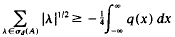
σd(A) being the discrete spectrum of A. This inequality is seen to be sharp to some extent.
 where the μ
On the definition of the absolute temperature—a reconciliation of the classical method with that of Carathéodory
-
- Journal:
- Proceedings of the Royal Society of Edinburgh. Section A: Mathematics / Volume 82 / Issue 1-2 / 1978
- Published online by Cambridge University Press:
- 14 November 2011, pp. 87-94
- Print publication:
- 1978
-
- Article
- Export citation
PRM volume 80 issue 3-4 Cover and Front matter
-
- Journal:
- Proceedings of the Royal Society of Edinburgh. Section A: Mathematics / Volume 80 / Issue 3-4 / 1978
- Published online by Cambridge University Press:
- 14 November 2011, pp. f1-f2
- Print publication:
- 1978
-
- Article
-
- You have access
- Export citation
Periodic solutions of ordinary differential equations with one-sided growth restrictions
-
- Journal:
- Proceedings of the Royal Society of Edinburgh. Section A: Mathematics / Volume 82 / Issue 1-2 / 1978
- Published online by Cambridge University Press:
- 14 November 2011, pp. 95-106
- Print publication:
- 1978
-
- Article
- Export citation
PRM volume 79 issue 3-4 Cover and Back matter
-
- Journal:
- Proceedings of the Royal Society of Edinburgh. Section A: Mathematics / Volume 79 / Issue 3-4 / 1978
- Published online by Cambridge University Press:
- 14 November 2011, pp. b1-b5
- Print publication:
- 1978
-
- Article
-
- You have access
- Export citation
Existence and stability of solutions for semi-linear parabolic systems, and applications to some diffusion reaction equations
-
- Journal:
- Proceedings of the Royal Society of Edinburgh. Section A: Mathematics / Volume 81 / Issue 1-2 / 1978
- Published online by Cambridge University Press:
- 14 November 2011, pp. 35-47
- Print publication:
- 1978
-
- Article
- Export citation
The condition of gram matrices and related problems
-
- Journal:
- Proceedings of the Royal Society of Edinburgh. Section A: Mathematics / Volume 80 / Issue 1-2 / 1978
- Published online by Cambridge University Press:
- 14 November 2011, pp. 45-56
- Print publication:
- 1978
-
- Article
- Export citation
Perturbational analysis of dual trigonometric series associated with boundary conditions of first and third kind
-
- Journal:
- Proceedings of the Royal Society of Edinburgh. Section A: Mathematics / Volume 78 / Issue 3-4 / 1978
- Published online by Cambridge University Press:
- 14 November 2011, pp. 291-298
- Print publication:
- 1978
-
- Article
- Export citation
