Refine search
Actions for selected content:
26078 results in Abstract analysis
MTK volume 24 issue 2 Front matter
-
- Journal:
- Mathematika / Volume 24 / Issue 2 / December 1977
- Published online by Cambridge University Press:
- 26 February 2010, pp. f1-f2
- Print publication:
- December 1977
-
- Article
-
- You have access
- Export citation
Continuants with bounded digits
-
- Journal:
- Mathematika / Volume 24 / Issue 2 / December 1977
- Published online by Cambridge University Press:
- 26 February 2010, pp. 166-172
- Print publication:
- December 1977
-
- Article
- Export citation
-
We let K(a1a2, ak) denote the continuant formed from the positive integers a1 …, ak; that is,

Of course, K(a1, …, an) is the denominator of the continued fraction

We use the convention that K (empty set) = 1.
Contact forms on 1-connected 5-manifolds
- Part of
-
- Journal:
- Mathematika / Volume 24 / Issue 2 / December 1977
- Published online by Cambridge University Press:
- 26 February 2010, pp. 237-240
- Print publication:
- December 1977
-
- Article
- Export citation
Index to volume 24
-
- Journal:
- Mathematika / Volume 24 / Issue 2 / December 1977
- Published online by Cambridge University Press:
- 26 February 2010, p. 270
- Print publication:
- December 1977
-
- Article
- Export citation
The mean value of the derivative of the Dedekind zeta-function of a real quadratic field
-
- Journal:
- Mathematika / Volume 24 / Issue 2 / December 1977
- Published online by Cambridge University Press:
- 26 February 2010, pp. 226-236
- Print publication:
- December 1977
-
- Article
- Export citation
-
Denote by ζk′(S), the derivative of the Dedekind zeta-function associated with the real quadratic field K. Then it is known that

where ζ(S) is the Riemann zeta-function, and L(s, x) is the Dirichlet L-series associated with the Legendre symbol X. Moreover, we have the functional equation
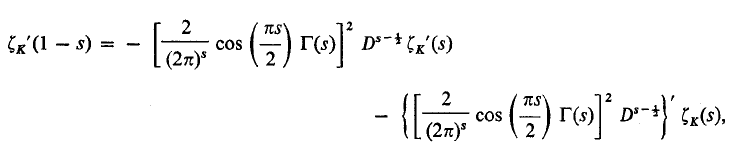
where D is the discriminant of K.
A C∞ curve of spectral non-synthesis
-
- Journal:
- Mathematika / Volume 24 / Issue 2 / December 1977
- Published online by Cambridge University Press:
- 26 February 2010, pp. 189-192
- Print publication:
- December 1977
-
- Article
- Export citation
-
The Fourier transform f of a function
 is defind by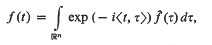
t ∊ ℝn. A(ℝn) is the isometric image of L1(ℝn) under the Fourier transformation. We extend the Fourier transformation to a mapping of ℒ(ℝn) to itself and denote by A′(ℝn) the isometric image of L∞(ℝn).
 is defind by
An asymptotic expansion for the Wedderburn–Etherington sequence
- Part of
-
- Journal:
- Mathematika / Volume 24 / Issue 2 / December 1977
- Published online by Cambridge University Press:
- 26 February 2010, pp. 262-265
- Print publication:
- December 1977
-
- Article
- Export citation
A lower bound for the L1-norm of certain exponential sums
-
- Journal:
- Mathematika / Volume 24 / Issue 2 / December 1977
- Published online by Cambridge University Press:
- 26 February 2010, pp. 182-188
- Print publication:
- December 1977
-
- Article
- Export citation
-
Littlewood [5, Problem 4.19, originally 4] conjectured that there is an absolute constant C > 0 such that, for every sequence of distinct integers n1, n2, n3, …, if

then
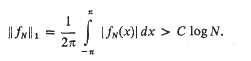
Cohen [2] showed

for some absolute constant C, with b = 1/8. Davenport [3] gave a more explicit version of Cohen's proof and improved the estimate to b = 1/4. Pichorides [6] added another refinement to obtain b = ½, and has, more recently, obtained ‖fN‖1>C(log N)1/2. This seems to be the best estimate so far without restriction on the sequences. We shall show that the methods of Davenport and Pichorides may be extended to obtain better results for certain classes of sequences. Specifically, we prove the following theorems.
Centrally symmetric convex sets and mixed volumes
- Part of
-
- Journal:
- Mathematika / Volume 24 / Issue 2 / December 1977
- Published online by Cambridge University Press:
- 26 February 2010, pp. 193-198
- Print publication:
- December 1977
-
- Article
- Export citation
-
Let
 denote the class of all compact convex sets in Euclidean n-dimensional space En, and let y be the collection of those members of k which are centrally symmetric. The topology in is that induced by the Hausdorff metric.
 denote the class of all compact convex sets in Euclidean n-dimensional space E
Theorems of Novikov type
- Part of
-
- Journal:
- Mathematika / Volume 24 / Issue 1 / June 1977
- Published online by Cambridge University Press:
- 26 February 2010, pp. 97-114
- Print publication:
- June 1977
-
- Article
- Export citation
-
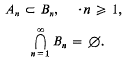
Novikov [7] or [5, Th. 2, p. 510] proves that: if{An} is a sequence of analytic sets in a complete separable metric space and

then there is a sequence {Bn} of Borel sets with

Projective representations of the infinite orthogonal group
- Part of
-
- Journal:
- Mathematika / Volume 24 / Issue 1 / June 1977
- Published online by Cambridge University Press:
- 26 February 2010, pp. 115-121
- Print publication:
- June 1977
-
- Article
- Export citation
-
Let ℝ∞ be the direct limit of the Euclidean spaces ℝn. Now the orthogonal group O(∞) acts on ℝn and the direct limit O(∞) of the groups O(∞) acts on ℝ∞. The infinite pin group Pin(∞) is an extension of ℤ2 by O(∞) and admits the following presentation: the generators are the unit vectors xf in ℝ∞ and the relations are


A set in L containing regularizing families for ultrafilters
-
- Journal:
- Mathematika / Volume 24 / Issue 1 / June 1977
- Published online by Cambridge University Press:
- 26 February 2010, pp. 50-51
- Print publication:
- June 1977
-
- Article
- Export citation
-
Let K be a successor cardinal. Call an
 regularizing family (for short, a regularizing family) if Card ℱ = k and
  for each
  with Card
  . In [7], Prikry proved, assuming V = L, that if
  is an ultrafilter on K which is uniform (Card X = K, each
  ) then is regular (some
  forms a regularizing family).†
 regularizing family (for short, a regularizing family) if Card ℱ = k and
  for each
  with Card
  . In [7], Prikry proved, assuming V = L, that if
  is an ultrafilter on K which is uniform (Card X = K, each
  ) then
  forms a regularizing family).†
On the resonant interaction between a surface wave and a weak surface current
- Part of
-
- Journal:
- Mathematika / Volume 24 / Issue 1 / June 1977
- Published online by Cambridge University Press:
- 26 February 2010, pp. 37-49
- Print publication:
- June 1977
-
- Article
- Export citation
A note on the motion of a closely fitting plug along a fluid-filled tube
- Part of
-
- Journal:
- Mathematika / Volume 24 / Issue 1 / June 1977
- Published online by Cambridge University Press:
- 26 February 2010, pp. 63-70
- Print publication:
- June 1977
-
- Article
- Export citation
Intersections of translates of convex sets
- Part of
-
- Journal:
- Mathematika / Volume 24 / Issue 1 / June 1977
- Published online by Cambridge University Press:
- 26 February 2010, pp. 122-129
- Print publication:
- June 1977
-
- Article
- Export citation
-
A finite family (Ci)i ∊ I of at least two convex subsets of ℝn is said to have the intersection property provided that the set
 is non-empty for all families (ai)i ∊ I of points in ℝn. Previously, D. G. Larman [2, Theorem 3] has given a sufficient condition (which is not necessary) and an “almost” necessary condition (which is not sufficient) for
  to have the intersection property.
 is non-empty for all families (ai)
 to have the intersection property.
Lebesgue measures on topological spaces
- Part of
-
- Journal:
- Mathematika / Volume 24 / Issue 1 / June 1977
- Published online by Cambridge University Press:
- 26 February 2010, pp. 52-59
- Print publication:
- June 1977
-
- Article
- Export citation
A theorem on cubes
-
- Journal:
- Mathematika / Volume 24 / Issue 1 / June 1977
- Published online by Cambridge University Press:
- 26 February 2010, pp. 60-62
- Print publication:
- June 1977
-
- Article
- Export citation
-
It is proved that, if R is a set of r vertices of an n–dimensional cube, then the number of distinct mid-points of line-segments joining pairs of points of R (including the points of R themselves as mid-points) is at least rx, where

This result is (in a sense) best possible.

Radon partitions and a new notion of independence in affine and projective spaces
-
- Journal:
- Mathematika / Volume 24 / Issue 1 / June 1977
- Published online by Cambridge University Press:
- 26 February 2010, pp. 86-96
- Print publication:
- June 1977
-
- Article
- Export citation
A note on involutary division algebras of the second kind
- Part of
-
- Journal:
- Mathematika / Volume 24 / Issue 1 / June 1977
- Published online by Cambridge University Press:
- 26 February 2010, pp. 34-36
- Print publication:
- June 1977
-
- Article
- Export citation
-
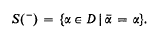
Let L/K be a quadratic extension of algebraic number fields, and D a central L-division algebra of finite L-dimension d2. If - is an involution (i.e., a ring antiautomorphism of period two) of D, we write S(-) for the set of - symmetric elements of D:
Structure of l-class groups of certain number fields and ℤl-extensions
-
- Journal:
- Mathematika / Volume 24 / Issue 1 / June 1977
- Published online by Cambridge University Press:
- 26 February 2010, pp. 16-33
- Print publication:
- June 1977
-
- Article
- Export citation
-
Let l be a rational prime, and let ℤl denote the ring of l-adic integers. Let k0 be a finite extension field of the rational numbers ℚ, and let K be a ℤl-extension of k0 (i.e., Gal (K/k0) is topologically isomorphic to the additive group of Zl). Let the intermediate fields be denoted as follows:

where knk0 is a cyclic extension of degree ln, and
 Let An denote the l-class group of kn (i.e., the Sylow l-subgroup of the ideal class group of kn). It is known that the order of An is given by
  , with
 Let A
Let A , with
