Refine search
Actions for selected content:
26078 results in Abstract analysis
On a class of weighted Sobolev spaces and the minimization of quadratic forms
-
- Journal:
- Proceedings of the Royal Society of Edinburgh. Section A: Mathematics / Volume 81 / Issue 1-2 / 1978
- Published online by Cambridge University Press:
- 14 November 2011, pp. 119-130
- Print publication:
- 1978
-
- Article
- Export citation
Direct summands in l-groups
-
- Journal:
- Proceedings of the Royal Society of Edinburgh. Section A: Mathematics / Volume 81 / Issue 3-4 / 1978
- Published online by Cambridge University Press:
- 14 November 2011, pp. 175-186
- Print publication:
- 1978
-
- Article
- Export citation
Asymptotic formulas for solutions of a singular linear ordinary differential equation
-
- Journal:
- Proceedings of the Royal Society of Edinburgh. Section A: Mathematics / Volume 81 / Issue 1-2 / 1978
- Published online by Cambridge University Press:
- 14 November 2011, pp. 57-70
- Print publication:
- 1978
-
- Article
- Export citation
Idempotent generators in finite full transformation semigroups*
-
- Journal:
- Proceedings of the Royal Society of Edinburgh. Section A: Mathematics / Volume 81 / Issue 3-4 / 1978
- Published online by Cambridge University Press:
- 14 November 2011, pp. 317-323
- Print publication:
- 1978
-
- Article
- Export citation
-
It was proved by Howie in 1966 that
 , the semigroup of all singular mappings of a finite set X into itself, is generated by its idempotents. Implicit in the method of proof, though not formally stated, is the result that if |X| = n then the n(n – 1) idempotents whose range has cardinal n – 1 form a generating set for. Here it is shown that if n ≧ 3 then a minimal set M of idempotent generators for contains ½n(n–1) members. A formula is given for the number of distinct sets M.
 , the semigroup of all singular mappings of a finite set X into itself, is generated by its idempotents. Implicit in the method of proof, though not formally stated, is the result that if |X| = n then the n(n – 1) idempotents whose range has cardinal n – 1 form a generating set for. Here it is shown that if n ≧ 3 then a minimal set M of idempotent generators for
 Classes of groups related to Fa,b,c *
-
- Journal:
- Proceedings of the Royal Society of Edinburgh. Section A: Mathematics / Volume 78 / Issue 3-4 / 1978
- Published online by Cambridge University Press:
- 14 November 2011, pp. 209-218
- Print publication:
- 1978
-
- Article
- Export citation
-
Groups
 having two generators and two relations are studied. The Reidemeister-Schreier algorithm is used to determine presentations for their derived groups. This enables the orders of the groups to be found. Necessary and sufficient conditions are given for the groups to be metabelian. Certain classes closely related to the class are also discussed.
 having two generators and two relations are studied. The Reidemeister-Schreier algorithm is used to determine presentations for their derived groups. This enables the orders of the groups
 A stability problem with algebraic aspects
-
- Journal:
- Proceedings of the Royal Society of Edinburgh. Section A: Mathematics / Volume 78 / Issue 3-4 / 1978
- Published online by Cambridge University Press:
- 14 November 2011, pp. 299-314
- Print publication:
- 1978
-
- Article
- Export citation
-
We consider the set S(f) of λ-values for which there exists a function g ∊ L(t 0, ∞) such that

has a solution not tending to 0; here f is a fixed function which is positive, non-decreasing and tends to ∞ with t. It is shown that if the jumps of logf(t) at its discontinuities are uniformly bounded, then S(f) is an additive group. This group is determined in some cases; some related groups are noted, which may coincide with S(f).
The Schrödinger equation as a singular perturbation problem†
-
- Journal:
- Proceedings of the Royal Society of Edinburgh. Section A: Mathematics / Volume 82 / Issue 1-2 / 1978
- Published online by Cambridge University Press:
- 14 November 2011, pp. 1-11
- Print publication:
- 1978
-
- Article
- Export citation
-
Comparisons have been made of the eigenvalues and the corresponding eigenfunctions of the eigenvalue problems

and

with φ ∈ C(-∞, +∞) and 0≦φ(x)≦C|x|i+1(1+|x|1), −∞<x<+∞ where i and l are arbitrary positive numbers with i≧2k≧2, k integer. In first approximation the eigenvalues λ and λ− and the corresponding eigenfunctions ψ and ψ are the same for ε→0; the error decreases whenever the exponent i increases.

PRM volume 81 issue 1-2 Cover and Back matter
-
- Journal:
- Proceedings of the Royal Society of Edinburgh. Section A: Mathematics / Volume 81 / Issue 1-2 / 1978
- Published online by Cambridge University Press:
- 14 November 2011, pp. b1-b2
- Print publication:
- 1978
-
- Article
-
- You have access
- Export citation
A Bessel function inequality*
-
- Journal:
- Proceedings of the Royal Society of Edinburgh. Section A: Mathematics / Volume 81 / Issue 3-4 / 1978
- Published online by Cambridge University Press:
- 14 November 2011, pp. 187-194
- Print publication:
- 1978
-
- Article
- Export citation
-
This paper proves some inequalities for the imaginary part of the transcendental function

 in a simply connected sector of the complex z-plane, where 0 < v < 1, and part of the boundary depends on v. These inequalities arose in a work of Everitt and Jones [1] which was on a general integral inequality. We give an alternative method of proving these Bessel function inequalities.

 in a simply connected sector of the complex z-plane, where 0 < v < 1, and part of the boundary depends on v. These inequalities arose in a work of Everitt and Jones [1] which was on a general integral inequality. We give an alternative method of proving these Bessel function inequalities.
Periodic solutions of special differential equations: an example in non-linear functional analysis†
-
- Journal:
- Proceedings of the Royal Society of Edinburgh. Section A: Mathematics / Volume 81 / Issue 1-2 / 1978
- Published online by Cambridge University Press:
- 14 November 2011, pp. 131-151
- Print publication:
- 1978
-
- Article
- Export citation
-
We consider differential-delay equations which can be written in the form
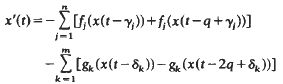
The functions fi and gk are all assumed odd. The equation
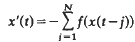
is a special case of such equations with q = N + 1 (assuming f is an odd function). We obtain an essentially best possible theorem which ensures the existence of a non-constant periodic solution x(t) with the properties (1) x(t)≧0 for 0≦t≦q, (2) x(–t) = –x(t) for all t and (3) x(t + q) = –x(t) for all t. We also derive uniqueness and constructibility results for such special periodic solutions. Our theorems answer a conjecture raised in [8].
On systems-disconjugacy and a question of Barrett
-
- Journal:
- Proceedings of the Royal Society of Edinburgh. Section A: Mathematics / Volume 78 / Issue 3-4 / 1978
- Published online by Cambridge University Press:
- 14 November 2011, pp. 219-224
- Print publication:
- 1978
-
- Article
- Export citation
Inequalities and separation for Schrödinger type operators in L2(Rn)*
-
- Journal:
- Proceedings of the Royal Society of Edinburgh. Section A: Mathematics / Volume 79 / Issue 3-4 / 1978
- Published online by Cambridge University Press:
- 14 November 2011, pp. 257-265
- Print publication:
- 1978
-
- Article
- Export citation
On the non-regularity of tangent sphere bundles
-
- Journal:
- Proceedings of the Royal Society of Edinburgh. Section A: Mathematics / Volume 82 / Issue 1-2 / 1978
- Published online by Cambridge University Press:
- 14 November 2011, pp. 13-17
- Print publication:
- 1978
-
- Article
- Export citation
Index
-
- Journal:
- Proceedings of the Royal Society of Edinburgh. Section A: Mathematics / Volume 80 / Issue 3-4 / 1978
- Published online by Cambridge University Press:
- 14 November 2011, pp. 363-365
- Print publication:
- 1978
-
- Article
- Export citation
On the location of eigenvalues of second order linear differential operators*
-
- Journal:
- Proceedings of the Royal Society of Edinburgh. Section A: Mathematics / Volume 80 / Issue 1-2 / 1978
- Published online by Cambridge University Press:
- 14 November 2011, pp. 15-22
- Print publication:
- 1978
-
- Article
- Export citation
-
This paper is concerned with finding upper bounds on the set of eigenvalues of self-adjoint differential operators generated in the Hilbert space L2[0, ∞) by the differential expression

on [0,∞), together with a real homogeneous boundary condition at t = 0.
The initial value problem for a nonlinear semi-infinite string†
-
- Journal:
- Proceedings of the Royal Society of Edinburgh. Section A: Mathematics / Volume 82 / Issue 1-2 / 1978
- Published online by Cambridge University Press:
- 14 November 2011, pp. 19-26
- Print publication:
- 1978
-
- Article
- Export citation
Padé approximant bounds on the positive solutions of some nonlinear elliptic equations
-
- Journal:
- Proceedings of the Royal Society of Edinburgh. Section A: Mathematics / Volume 80 / Issue 3-4 / 1978
- Published online by Cambridge University Press:
- 14 November 2011, pp. 183-200
- Print publication:
- 1978
-
- Article
- Export citation
A class of symmetric ordinary differential operators whose deficiency numbers differ by an integer†
-
- Journal:
- Proceedings of the Royal Society of Edinburgh. Section A: Mathematics / Volume 82 / Issue 1-2 / 1978
- Published online by Cambridge University Press:
- 14 November 2011, pp. 117-134
- Print publication:
- 1978
-
- Article
- Export citation
The wave equation, O(2, 2), and separation of variables on hyperboloids
-
- Journal:
- Proceedings of the Royal Society of Edinburgh. Section A: Mathematics / Volume 79 / Issue 3-4 / 1978
- Published online by Cambridge University Press:
- 14 November 2011, pp. 227-256
- Print publication:
- 1978
-
- Article
- Export citation
-
We classify group-theoretically all separable coordinate systems for the eigenvalue equation of the Laplace-Beltrami operator on the hyperboloid
 = 1, finding 71 orthogonal and 3 non-orthogonal systems. For a number of cases the explicit spectral resolutions are worked out. We show that our results have application to the problem of separation of variables for the wave equation and to harmonic analysis on the hyperboloid and the group manifold SL(2, R). In particular, most past studies of SL(2, R) have employed only 6 of the 74 coordinate systems in which the Casimir eigenvalue equation separates.
 = 1, finding 71 orthogonal and 3 non-orthogonal systems. For a number of cases the explicit spectral resolutions are worked out. We show that our results have application to the problem of separation of variables for the wave equation and to harmonic analysis on the hyperboloid and the group manifold SL(2, R). In particular, most past studies of SL(2, R) have employed only 6 of the 74 coordinate systems in which the Casimir eigenvalue equation separates.
Related oscillation criteria for higher order self-adjoint differential and integro-differential equations§
-
- Journal:
- Proceedings of the Royal Society of Edinburgh. Section A: Mathematics / Volume 80 / Issue 3-4 / 1978
- Published online by Cambridge University Press:
- 14 November 2011, pp. 333-345
- Print publication:
- 1978
-
- Article
- Export citation
