Refine search
Actions for selected content:
26077 results in Abstract analysis
Note on a theorem of Wiener and Pitt
-
- Journal:
- Mathematika / Volume 17 / Issue 2 / December 1970
- Published online by Cambridge University Press:
- 26 February 2010, pp. 189-192
- Print publication:
- December 1970
-
- Article
- Export citation
-
Let G be a locally compact Abelian non-discrete group. Let M(G) be the convolution algebra of Radon measures on G. Let µ be an element of M(G) with its Lebesgue decomposition [1]

into absolutely continuous, purely discontinuous and continuous singular parts. The chief problem one encounters in the study of the invertibility of µ is with the case µs ≠ 0. As observed by Wiener and Pitt [2], the problem can be handled provided µs be “not too large”. In fact, Wiener and Pitt (loc. cit.) proved the following:
Let µ be a Radon measure on R (the real line) such that


where
 are the Fourier transforms of µ, µd, and ≑µs≑ is the variational norm of µs. Then, µ has an inverse in M (R).
 are the Fourier transforms of µ, µ
Wave propagation in a transversely isotropic heat-conducting elastic material
-
- Journal:
- Mathematika / Volume 17 / Issue 2 / December 1970
- Published online by Cambridge University Press:
- 26 February 2010, pp. 255-274
- Print publication:
- December 1970
-
- Article
- Export citation
On a problem of Erdös, Straus and Schinzel
-
- Journal:
- Mathematika / Volume 17 / Issue 2 / December 1970
- Published online by Cambridge University Press:
- 26 February 2010, pp. 193-198
- Print publication:
- December 1970
-
- Article
- Export citation
-
Erdös and Straus have conjectured that for every integer n > 1,
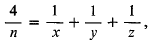
is soluble in positive integers x, y, z. Schinzel has conjectured that for every a > 0 if n > no(a),

is soluble in positive integers x, y, z.
A note on rotationally symmetric flow above an infinite rotating disc
-
- Journal:
- Mathematika / Volume 17 / Issue 2 / December 1970
- Published online by Cambridge University Press:
- 26 February 2010, pp. 243-249
- Print publication:
- December 1970
-
- Article
- Export citation
-
The fluid mechanical problem with which we are concerned is the behaviour of fluid occupying the half-space x > 0 above a rotating disc which is coincident with the horizontal plane x = 0 and rotating about its axis which remains fixed. Studying rotationally symmetric solutions of this problem, von Kármán [1] (see also [2; p. 93]; [3; p. 133]) reduced it to the solution of two simultaneous equations in functions f(x), g(x) which may, with suitable normalisation, be written in the form


with the boundary conditions


On generating functions for the number of invariants of orthogonal tensors
-
- Journal:
- Mathematika / Volume 17 / Issue 2 / December 1970
- Published online by Cambridge University Press:
- 26 February 2010, pp. 275-286
- Print publication:
- December 1970
-
- Article
- Export citation
The maximum numbers of faces of a convex polytope
-
- Journal:
- Mathematika / Volume 17 / Issue 2 / December 1970
- Published online by Cambridge University Press:
- 26 February 2010, pp. 179-184
- Print publication:
- December 1970
-
- Article
-
- You have access
- Export citation
Generalized Hausdorff dimension
-
- Journal:
- Mathematika / Volume 17 / Issue 2 / December 1970
- Published online by Cambridge University Press:
- 26 February 2010, pp. 324-327
- Print publication:
- December 1970
-
- Article
- Export citation
-
It is natural to say that a set S in a metric space has infinite generalized Hausdorff dimension if there is no Hausdorff measure Λh with Λh(S) = 0. In this note we study such sets. We first need some definitions.
We say that h(x) is a Hausdorff measure function if it satisfies the conditions:


On converging solid spheres in a highly viscous fluid
-
- Journal:
- Mathematika / Volume 17 / Issue 2 / December 1970
- Published online by Cambridge University Press:
- 26 February 2010, pp. 250-254
- Print publication:
- December 1970
-
- Article
- Export citation
Index to volume 17
-
- Journal:
- Mathematika / Volume 17 / Issue 2 / December 1970
- Published online by Cambridge University Press:
- 26 February 2010, p. 338
- Print publication:
- December 1970
-
- Article
- Export citation
Reuleaux polytopes
-
- Journal:
- Mathematika / Volume 17 / Issue 2 / December 1970
- Published online by Cambridge University Press:
- 26 February 2010, pp. 315-323
- Print publication:
- December 1970
-
- Article
- Export citation
Some dimensional properties of generalised difference sets
-
- Journal:
- Mathematika / Volume 17 / Issue 2 / December 1970
- Published online by Cambridge University Press:
- 26 February 2010, pp. 185-188
- Print publication:
- December 1970
-
- Article
- Export citation
Singular integral equations with logarithmic kernels
-
- Journal:
- Mathematika / Volume 17 / Issue 1 / June 1970
- Published online by Cambridge University Press:
- 26 February 2010, pp. 47-56
- Print publication:
- June 1970
-
- Article
- Export citation
Corrigendum and addendum: an analogue of a problem of Littlewood
-
- Journal:
- Mathematika / Volume 17 / Issue 1 / June 1970
- Published online by Cambridge University Press:
- 26 February 2010, pp. 173-178
- Print publication:
- June 1970
-
- Article
- Export citation
The number of d-polytopes with d+3 vertices
-
- Journal:
- Mathematika / Volume 17 / Issue 1 / June 1970
- Published online by Cambridge University Press:
- 26 February 2010, pp. 120-132
- Print publication:
- June 1970
-
- Article
- Export citation
Solution of some boundary value problems in potential theory
-
- Journal:
- Mathematika / Volume 17 / Issue 1 / June 1970
- Published online by Cambridge University Press:
- 26 February 2010, pp. 98-101
- Print publication:
- June 1970
-
- Article
- Export citation
The critical layer in stratified shear flow
-
- Journal:
- Mathematika / Volume 17 / Issue 1 / June 1970
- Published online by Cambridge University Press:
- 26 February 2010, pp. 102-119
- Print publication:
- June 1970
-
- Article
- Export citation
Measure function properties of the asymmetric Cauchy process
-
- Journal:
- Mathematika / Volume 17 / Issue 1 / June 1970
- Published online by Cambridge University Press:
- 26 February 2010, pp. 68-78
- Print publication:
- June 1970
-
- Article
- Export citation
-
§1. Preliminaries. A Cauchy process in d-dimensional Euclidean space, Rd, is a stochastic process, Xt(ω), with stationary independent increments and with a continuous transition density, p(t, y − x) defined by

and

where m, the isotropic measure, is a probability measure on Sd, the unit sphere in Rd, such that when d > 1 the support of m is not contained in any d − 1 dimensional subspace. In (2) w is given by

where
 . It follows that for each t > 0 and y we have p(t, y) > 0 and that for each t > 0 p(t, y) is a bounded and continuous function of y. Xt(ω) can be considered as being a standard Markov process (for a full description of the definition of such a process see Chapter 1 of [1]) and in particular we can assume that the sample functions of Xt(ω) are right continuous and have left limits. We can also assume that Xt(ω) enjoys the strong Markov property. We write Px and Ex for probabilities and expectations conditional on X0(ω) = x, and we write P for P0.
 . It follows that for each t > 0 and y we have p(t, y) > 0 and that for each t > 0 p(t, y) is a bounded and continuous function of y. X
Convex bodies of constant outer p-measure
-
- Journal:
- Mathematika / Volume 17 / Issue 1 / June 1970
- Published online by Cambridge University Press:
- 26 February 2010, pp. 21-27
- Print publication:
- June 1970
-
- Article
- Export citation
-
Suppose K is a convex body in Euclidean n-space En and that all the orthogonal projections of K onto p-dimensional linear subspaces have the same p-dimensional volume, that is K has constant outer p-measure. If p = 1, this means that K is of constant width; if p = n − 1, this means that K has constant brightness. It is known that, when the boundary of K is smooth enough to admit principal radii of curvature R1, …, Rn-1 as functions of the outer normal u, and if we define Fp(u) to be the p-th elementary symmetric function of these radii, then, when K has constant width,

A local form of the Phragmén-lindelöf indicator
-
- Journal:
- Mathematika / Volume 17 / Issue 1 / June 1970
- Published online by Cambridge University Press:
- 26 February 2010, pp. 149-172
- Print publication:
- June 1970
-
- Article
- Export citation
-
Let f(z) be an entire function. The definition of a Phragmén–Lindelöf indicator of f(z) requires the preliminary construction of a fairly regular comparison function V(r).
If f(z) is of order λ (0 < λ < + ∞), and of mean type, one takes

and associates with f(z) the indicator

A note on the classgroup of integral group rings of some cyclic groups
-
- Journal:
- Mathematika / Volume 17 / Issue 1 / June 1970
- Published online by Cambridge University Press:
- 26 February 2010, pp. 79-81
- Print publication:
- June 1970
-
- Article
- Export citation
-
In [1] Fröhlich considers the kernel D(Z(Γ)) of the map of class-groups C(Z(Γ)) → C(
 ), Γ a finite abelian group, the maximal order in the rational group ring Q(Γ). We obtain under mild hypotheses a non-trivial lower bound for the cardinality k(Γ) of the finite group D(Z(Γ)) when Γ is the cyclic group of order 2pn, p an odd prime. In fact, let f be the smallest positive integer such that 2f ≡ 1 mod.pn, If 2|f then k(Γ) > 1 for pn ≠ 3, 32, 5 and k(Γ) is divisible by primes ≠ 2, p except possibly when pn is a Fermat prime or when pn = 32. The latter result contrasts with the fact that D(Z(Γ)) is a p-group if Γ is a p-group [1; Theorem 5].
 ), Γ a finite abelian group,