Refine search
Actions for selected content:
26077 results in Abstract analysis
XII.—Quasi-residuated Mappings and Baer Assemblies*
-
- Journal:
- Proceedings of the Royal Society of Edinburgh Section A: Mathematical and Physical Sciences / Volume 69 / Issue 2 / 1971
- Published online by Cambridge University Press:
- 14 February 2012, pp. 165-179
- Print publication:
- 1971
-
- Article
- Export citation
VII.—Some Contributions to the Theory of Random Walk and Multiple Scattering of Particles
-
- Journal:
- Proceedings of the Royal Society of Edinburgh Section A: Mathematical and Physical Sciences / Volume 69 / Issue 2 / 1971
- Published online by Cambridge University Press:
- 14 February 2012, pp. 115-124
- Print publication:
- 1971
-
- Article
- Export citation
XIII.—The Graph-like State of Matter. I. Statistical effects of correlations due to substitution effects, including steric hindrance, on polymer distributions.
-
- Journal:
- Proceedings of the Royal Society of Edinburgh Section A: Mathematical and Physical Sciences / Volume 69 / Issue 3 / 1971
- Published online by Cambridge University Press:
- 14 February 2012, pp. 181-198
- Print publication:
- 1971
-
- Article
- Export citation
XVII.—Interaction of Toluenesulphinic Acid, Aldehydes and Secondary Amines*
-
- Journal:
- Proceedings of the Royal Society of Edinburgh Section A: Mathematical and Physical Sciences / Volume 69 / Issue 3 / 1971
- Published online by Cambridge University Press:
- 14 February 2012, pp. 247-249
- Print publication:
- 1971
-
- Article
- Export citation
XIV.—On Bounded Integral Operators in the Space of Integrable-Square Functions*
-
- Journal:
- Proceedings of the Royal Society of Edinburgh Section A: Mathematical and Physical Sciences / Volume 69 / Issue 3 / 1971
- Published online by Cambridge University Press:
- 14 February 2012, pp. 199-204
- Print publication:
- 1971
-
- Article
- Export citation
-
§ 1. Let L2(0, ∞) denote the Hilbert space of Lebesgue measurable, integrable-square functions on the half-line [0, ∞).
Integral operators of the form

acting on the space L2 (0, ∞) occur in the theory of ordinary differential equations; see for example the book by E. C. Titchmarsh [4; § 2.6]. It is important to establish when operators of this kind are bounded; see the book by A. E. Taylor [3; § 4.1 and §§4.11, 4.12 and § 4.13].
PRM volume 69 issue 3 Cover and Front matter
-
- Journal:
- Proceedings of the Royal Society of Edinburgh Section A: Mathematical and Physical Sciences / Volume 69 / Issue 3 / 1971
- Published online by Cambridge University Press:
- 14 February 2012, pp. f1-f2
- Print publication:
- 1971
-
- Article
-
- You have access
- Export citation
X.—The Two Parameter Sturm-Liouville Problem for Ordinary Differential Equations*
-
- Journal:
- Proceedings of the Royal Society of Edinburgh Section A: Mathematical and Physical Sciences / Volume 69 / Issue 2 / 1971
- Published online by Cambridge University Press:
- 14 February 2012, pp. 139-148
- Print publication:
- 1971
-
- Article
- Export citation
-
This paper discusses the existence, under fairly general conditions, of solutions of the two-parameter eigenvalue problem denned by the differential equation,
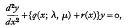
and three point Sturm-Liouville boundary conditions.
XI.—Correlations in alpha-Particle-accompanied fission*
-
- Journal:
- Proceedings of the Royal Society of Edinburgh Section A: Mathematical and Physical Sciences / Volume 69 / Issue 2 / 1971
- Published online by Cambridge University Press:
- 14 February 2012, pp. 149-164
- Print publication:
- 1971
-
- Article
- Export citation
PRM volume 69 issue 2 Cover and Front matter
-
- Journal:
- Proceedings of the Royal Society of Edinburgh Section A: Mathematical and Physical Sciences / Volume 69 / Issue 2 / 1971
- Published online by Cambridge University Press:
- 14 February 2012, pp. f1-f2
- Print publication:
- 1971
-
- Article
-
- You have access
- Export citation
XVI.—Creeping Waves in an Inhomogeneous Medium*
-
- Journal:
- Proceedings of the Royal Society of Edinburgh Section A: Mathematical and Physical Sciences / Volume 69 / Issue 3 / 1971
- Published online by Cambridge University Press:
- 14 February 2012, pp. 227-245
- Print publication:
- 1971
-
- Article
- Export citation
PRM volume 69 issue 3 Cover and Back matter
-
- Journal:
- Proceedings of the Royal Society of Edinburgh Section A: Mathematical and Physical Sciences / Volume 69 / Issue 3 / 1971
- Published online by Cambridge University Press:
- 14 February 2012, pp. b1-b2
- Print publication:
- 1971
-
- Article
-
- You have access
- Export citation
VIII.—The Schrödinger Equation with a Periodic Potential
-
- Journal:
- Proceedings of the Royal Society of Edinburgh Section A: Mathematical and Physical Sciences / Volume 69 / Issue 2 / 1971
- Published online by Cambridge University Press:
- 14 February 2012, pp. 125-131
- Print publication:
- 1971
-
- Article
- Export citation
-
The differential equation

in N dimensions is considered, where q(x) is periodic. When N = 1, it is known that the conditional stability set coincides with the spectrum and that these also coincide with two other sets involving eigenvalues of associated eigenvalue problems. These results have been proved by means of the Floquet theory and the discriminant. Here an alternative proof is given which avoids the Floquet theory and which applies to the general case of N dimensions.
XIX.—Some Triple Trigonometrical Series Equations and their Application
-
- Journal:
- Proceedings of the Royal Society of Edinburgh Section A: Mathematical and Physical Sciences / Volume 69 / Issue 3 / 1971
- Published online by Cambridge University Press:
- 14 February 2012, pp. 255-265
- Print publication:
- 1971
-
- Article
- Export citation
On uniqueness of flows for a class of second-order fluids
-
- Journal:
- Mathematika / Volume 17 / Issue 2 / December 1970
- Published online by Cambridge University Press:
- 26 February 2010, pp. 333-337
- Print publication:
- December 1970
-
- Article
- Export citation
-
In the present paper we consider the uniqueness of the solutions of the equations governing the motion of an incompressible second-order fluid in a bounded region. For such a fluid model the stress tensor S in a rectangular Cartesian coordinate system xi at a point xi of the fluid is determined from

where I is the unit tensor, p the hydrostatic pressure and μ, β, γ are material constants. The tensors A1 and A2 are the first and second Rivlin-Ericksen tensors which are defined in terms of the velocity field vi by

The distribution of rational points on hypersurfaces defined over a finite field
-
- Journal:
- Mathematika / Volume 17 / Issue 2 / December 1970
- Published online by Cambridge University Press:
- 26 February 2010, pp. 328-332
- Print publication:
- December 1970
-
- Article
- Export citation
-
Let p be an odd prime and denote by [p] the field of p elements. Let C = C(n, p) be the set of points x = (x1 …, xn) of Zn (n ≥ 1) satisfying

MTK volume 17 issue 2 Front matter
-
- Journal:
- Mathematika / Volume 17 / Issue 2 / December 1970
- Published online by Cambridge University Press:
- 26 February 2010, pp. f1-f2
- Print publication:
- December 1970
-
- Article
-
- You have access
- Export citation
Paths in the one-skeleton of a convex body
-
- Journal:
- Mathematika / Volume 17 / Issue 2 / December 1970
- Published online by Cambridge University Press:
- 26 February 2010, pp. 293-314
- Print publication:
- December 1970
-
- Article
- Export citation
Closed sets of algebraic numbers in complete fields
-
- Journal:
- Mathematika / Volume 17 / Issue 2 / December 1970
- Published online by Cambridge University Press:
- 26 February 2010, pp. 199-205
- Print publication:
- December 1970
-
- Article
- Export citation
The stability of the asymptotic suction boundary layer profile
-
- Journal:
- Mathematika / Volume 17 / Issue 2 / December 1970
- Published online by Cambridge University Press:
- 26 February 2010, pp. 206-242
- Print publication:
- December 1970
-
- Article
- Export citation
Note on parametrisations of normal elliptic scrolls
-
- Journal:
- Mathematika / Volume 17 / Issue 2 / December 1970
- Published online by Cambridge University Press:
- 26 February 2010, pp. 287-292
- Print publication:
- December 1970
-
- Article
- Export citation
