Refine search
Actions for selected content:
26077 results in Abstract analysis
27.—The Zeros of Optical Coherence Functions and their Utility in the Study of Spectra
-
- Journal:
- Proceedings of the Royal Society of Edinburgh Section A: Mathematical and Physical Sciences / Volume 70 / 1972
- Published online by Cambridge University Press:
- 14 February 2012, pp. 281-293
- Print publication:
- 1972
-
- Article
- Export citation
Index
-
- Journal:
- Proceedings of the Royal Society of Edinburgh Section A: Mathematical and Physical Sciences / Volume 69 / Issue 4 / 1972
- Published online by Cambridge University Press:
- 14 February 2012, pp. 365-369
- Print publication:
- 1972
-
- Article
- Export citation
17.—Remarks on the Prehistory of the Discovery of Slow Neutrons
-
- Journal:
- Proceedings of the Royal Society of Edinburgh Section A: Mathematical and Physical Sciences / Volume 70 / 1972
- Published online by Cambridge University Press:
- 14 February 2012, pp. 191-195
- Print publication:
- 1972
-
- Article
- Export citation
23.—Coincidence Studies of 144Pr with an X-ray Detector
-
- Journal:
- Proceedings of the Royal Society of Edinburgh Section A: Mathematical and Physical Sciences / Volume 70 / 1972
- Published online by Cambridge University Press:
- 14 February 2012, pp. 245-250
- Print publication:
- 1972
-
- Article
- Export citation
16.—Fast Neutron Polarisation*
-
- Journal:
- Proceedings of the Royal Society of Edinburgh Section A: Mathematical and Physical Sciences / Volume 70 / 1972
- Published online by Cambridge University Press:
- 14 February 2012, pp. 181-190
- Print publication:
- 1972
-
- Article
- Export citation
1.—Introduction—Personal Reflections
-
- Journal:
- Proceedings of the Royal Society of Edinburgh Section A: Mathematical and Physical Sciences / Volume 70 / 1972
- Published online by Cambridge University Press:
- 14 February 2012, pp. 5-8
- Print publication:
- 1972
-
- Article
- Export citation
2.—Asymptotic Behaviour of an Aperture Integral
-
- Journal:
- Proceedings of the Royal Society of Edinburgh Section A: Mathematical and Physical Sciences / Volume 71 / Issue 1 / 1972
- Published online by Cambridge University Press:
- 14 February 2012, pp. 9-29
- Print publication:
- 1972
-
- Article
- Export citation
PRM volume 71 issue 1 Cover and Front matter
-
- Journal:
- Proceedings of the Royal Society of Edinburgh Section A: Mathematical and Physical Sciences / Volume 71 / Issue 1 / 1972
- Published online by Cambridge University Press:
- 14 February 2012, pp. f1-f2
- Print publication:
- 1972
-
- Article
-
- You have access
- Export citation
10.—Understanding Physics Through Its History
-
- Journal:
- Proceedings of the Royal Society of Edinburgh Section A: Mathematical and Physical Sciences / Volume 70 / 1972
- Published online by Cambridge University Press:
- 14 February 2012, pp. 95-105
- Print publication:
- 1972
-
- Article
- Export citation
PRM volume 70 Cover and Front matter
-
- Journal:
- Proceedings of the Royal Society of Edinburgh Section A: Mathematical and Physical Sciences / Volume 70 / 1972
- Published online by Cambridge University Press:
- 14 February 2012, pp. f1-f6
- Print publication:
- 1972
-
- Article
-
- You have access
- Export citation
6.—On the Distribution of the Eigenvalues and the Order of the Eigenfunctions of a Fourth-order Singular Boundary Value Problem
-
- Journal:
- Proceedings of the Royal Society of Edinburgh Section A: Mathematical and Physical Sciences / Volume 71 / Issue 1 / 1972
- Published online by Cambridge University Press:
- 14 February 2012, pp. 61-75
- Print publication:
- 1972
-
- Article
- Export citation
-
This paper is concerned with the asymptotic properties of the eigenvalues and eigenfunctions of the boundary value problem

With suitable restrictions placed on the real-valued coefficient q the spectrum of this problem, with respect to the eigenvalue parameter λ, is discrete; let {λn; n = 1, 2, …} and {ψn; n = 1, 2, …} be the eigenvalues and associated eigenfunctions. Asymptotic formulae are obtained for N(λ), the number of eigenvalues not exceeding the real number λ, and for ψn(x) as n→∞ where x is a fixed, positive real number.
4.—The Principal Chords of an Elliptic Quartic*
-
- Journal:
- Proceedings of the Royal Society of Edinburgh Section A: Mathematical and Physical Sciences / Volume 71 / Issue 1 / 1972
- Published online by Cambridge University Press:
- 14 February 2012, pp. 43-50
- Print publication:
- 1972
-
- Article
- Export citation
A generalized lower-bound conjecture for simplicial polytopes
-
- Journal:
- Mathematika / Volume 18 / Issue 2 / December 1971
- Published online by Cambridge University Press:
- 26 February 2010, pp. 264-273
- Print publication:
- December 1971
-
- Article
- Export citation
-
Let P be a simplicial d-polytope, and, for – 1 ≤ j < d, let fj(P) denote the number of j-faces of P (with f_1 (P) = 1). For k = 0, ..., [½d] – 1, we define

and conjecture that
gk(d + 1)(P) ≥ 0,
with equality in the k-th relation if and only if P can be subdivided into a simplicial complex, all of whose simplices of dimension at most d – k – 1 are faces of P. This conjecture is compared with the usual lower-bound conjecture, evidence in support of the conjecture is given, and it is proved that any linear inequality satisfied by the numbers fj(P) is a consequence of the linear inequalities given above.
Sets which are null or non-sigma-finite for every translation invariant measure
-
- Journal:
- Mathematika / Volume 18 / Issue 2 / December 1971
- Published online by Cambridge University Press:
- 26 February 2010, pp. 161-162
- Print publication:
- December 1971
-
- Article
- Export citation
A note on a problem of Gauthier
-
- Journal:
- Mathematika / Volume 18 / Issue 2 / December 1971
- Published online by Cambridge University Press:
- 26 February 2010, pp. 274-275
- Print publication:
- December 1971
-
- Article
- Export citation
-
Let D denote the unit disc in the complex plane. If p and q are two complex numbers, let x(p, q) denote the chordal distance between p and q on the Riemann sphere. In particular, we have the formula

and

The following problem was posed by Paul Gauthier: if f(z) and g(z) are meromorphic functions in D such that
 Clunie [4] has answered this problem in the negative by constructing different meromorphic functions f(z) and g(z) with the desired property. However, the functions constructed by Clunie both have an infinity of poles in D. It is the purpose of this note to give an example of two analytic functions―which thus have no poles―which also give a negative answer to the problem of Gauthier.

 Clunie [4] has answered this problem in the negative by constructing different meromorphic functions f(z) and g(z) with the desired property. However, the functions constructed by Clunie both have an infinity of poles in D. It is the purpose of this note to give an example of two analytic functions―which thus have no poles―which also give a negative answer to the problem of Gauthier.
MTK volume 18 issue 2 Front matter
-
- Journal:
- Mathematika / Volume 18 / Issue 2 / December 1971
- Published online by Cambridge University Press:
- 26 February 2010, pp. f1-f2
- Print publication:
- December 1971
-
- Article
-
- You have access
- Export citation
On almost discrete spaces
- Part of
-
- Journal:
- Mathematika / Volume 18 / Issue 2 / December 1971
- Published online by Cambridge University Press:
- 26 February 2010, pp. 163-167
- Print publication:
- December 1971
-
- Article
- Export citation
On the large sieve method in GF (q, x)
-
- Journal:
- Mathematika / Volume 18 / Issue 2 / December 1971
- Published online by Cambridge University Press:
- 26 February 2010, pp. 172-184
- Print publication:
- December 1971
-
- Article
- Export citation
-
The method of the large sieve has played a very important role in number theory. It turns out that estimates of exponential sums are of basic importance for large sieve inequalities. Let
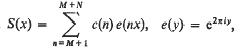
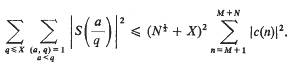
be an exponential sum with complex coefficients c(n). It follows from Theorem 1 of Bombieri and Davenport [1] that
Polyhedral diagrams for sections of the non-negative orthant
-
- Journal:
- Mathematika / Volume 18 / Issue 2 / December 1971
- Published online by Cambridge University Press:
- 26 February 2010, pp. 255-263
- Print publication:
- December 1971
-
- Article
- Export citation
Integral representations of solutions to a class of fourth order elliptic equations in three independent variables
- Part of
-
- Journal:
- Mathematika / Volume 18 / Issue 2 / December 1971
- Published online by Cambridge University Press:
- 26 February 2010, pp. 283-290
- Print publication:
- December 1971
-
- Article
- Export citation
