Refine search
Actions for selected content:
26077 results in Abstract analysis
Appendix A
-
- Book:
- Integration and Harmonic Analysis on Compact Groups
- Published online:
- 26 March 2010
- Print publication:
- 07 September 1972, pp 163-174
-
- Chapter
- Export citation
Contents
-
- Book:
- Integration and Harmonic Analysis on Compact Groups
- Published online:
- 26 March 2010
- Print publication:
- 07 September 1972, pp iii-iv
-
- Chapter
- Export citation
Acknowledgements
-
- Book:
- Integration and Harmonic Analysis on Compact Groups
- Published online:
- 26 March 2010
- Print publication:
- 07 September 1972, pp vi-vi
-
- Chapter
- Export citation
Part 1 - Integration and the Riesz representation theorem
-
- Book:
- Integration and Harmonic Analysis on Compact Groups
- Published online:
- 26 March 2010
- Print publication:
- 07 September 1972, pp 1-41
-
- Chapter
- Export citation
On some solutions of the Falkner-Skan equation
- Part of
-
- Journal:
- Mathematika / Volume 19 / Issue 1 / June 1972
- Published online by Cambridge University Press:
- 26 February 2010, pp. 76-83
- Print publication:
- June 1972
-
- Article
- Export citation
-
We shall be concerned with two boundary value problems for the Falkner-Skan Equation

when –β is a small positive number. Our interest is in solutions of (1) which exhibit “reversed flow”; that is, solutions f such that f′(x) < 0 for small positive values of x. The boundary conditions which we wish to consider are

and

The distribution of polynomial sequences
-
- Journal:
- Mathematika / Volume 19 / Issue 1 / June 1972
- Published online by Cambridge University Press:
- 26 February 2010, pp. 25-50
- Print publication:
- June 1972
-
- Article
- Export citation
On the exponential sum

-
- Journal:
- Mathematika / Volume 19 / Issue 1 / June 1972
- Published online by Cambridge University Press:
- 26 February 2010, pp. 84-87
- Print publication:
- June 1972
-
- Article
- Export citation
-
In a conversation with Professor R. G. Stoneham, he mentioned the estimate which he had found for a new type of exponential sum, namely

where p is a prime, g a primitive root mod p, pp × b, and l ≤ X ≤ p − 2. I found a proof and sent it to him. In correspondence with him and Professor D. A. Burgess,‡ I learnt that the estimate arose in Stoneham's work on normal numbers, in which they had been interested for some time. A proof of (1) will appear as a lemma in a paper by Stoneham [1] which has been submitted for publication. In fact, each of them has found several proofs of (1), and in particular, Burgess had found quite a simple one which is practically the same as my proof. However, my presentation led to an interesting generalization.
A note on primitive roots in finite fields
-
- Journal:
- Mathematika / Volume 19 / Issue 1 / June 1972
- Published online by Cambridge University Press:
- 26 February 2010, pp. 112-114
- Print publication:
- June 1972
-
- Article
- Export citation
Measures of Hausdorff-type, and Brownian motion
- Part of
-
- Journal:
- Mathematika / Volume 19 / Issue 1 / June 1972
- Published online by Cambridge University Press:
- 26 February 2010, pp. 115-119
- Print publication:
- June 1972
-
- Article
- Export citation
-
In this paper X(t) denotes Brownian motion on the line 0 ≤ t < ∞, E is a compact subset of (0, ∞) and F a compact subset of ( -∞, ∞). Then δ(E, F) is the supremum of the numbers c such that

In [4, 5] some lower and upper bounds for δ were found in terms of dim E and dim F, and it seemed possible that δ(E, F) could be determined entirely by these constants; this much is false, as the examples in our last paragraph will demonstrate. Here we shall show that δ(E, F) depends on a certain metric character η(E × F). However, η is not calculated relative to the Euclidean metric: the set F must be compressed to compensate for the oscillations of most paths X(t). Fortunately, η(E × F) can be calculated for a large enough class of sets E and F, by means of sequences of integers, to test any conjectures (and disprove most of them). In passing from η to δ we present a slight variation of Frostman's theory [3II].
MTK volume 19 issue 1 Front matter
-
- Journal:
- Mathematika / Volume 19 / Issue 1 / June 1972
- Published online by Cambridge University Press:
- 26 February 2010, pp. f1-f2
- Print publication:
- June 1972
-
- Article
-
- You have access
- Export citation
A note on linear thermoelasticity
-
- Journal:
- Mathematika / Volume 19 / Issue 1 / June 1972
- Published online by Cambridge University Press:
- 26 February 2010, pp. 69-75
- Print publication:
- June 1972
-
- Article
- Export citation
The realization of distances within sets in Euclidean space
- Part of
-
- Journal:
- Mathematika / Volume 19 / Issue 1 / June 1972
- Published online by Cambridge University Press:
- 26 February 2010, pp. 1-24
- Print publication:
- June 1972
-
- Article
- Export citation
The zeros of trigonometrical polynomials
-
- Journal:
- Mathematika / Volume 19 / Issue 1 / June 1972
- Published online by Cambridge University Press:
- 26 February 2010, pp. 88-90
- Print publication:
- June 1972
-
- Article
- Export citation
-
Let a−N,…, aN be any complex numbers and let
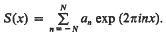
If y1,y2,…,yM are any real numbers such that

one form of the large sieve inequality (see [1], Chapter 2 and the Appendix) asserts that

where yM+1 ≡ y1 (mod 1).
A note on the locally finite sum theorem
- Part of
-
- Journal:
- Mathematika / Volume 19 / Issue 1 / June 1972
- Published online by Cambridge University Press:
- 26 February 2010, pp. 121-127
- Print publication:
- June 1972
-
- Article
- Export citation
-
Let
 be a topological property. We say that the locally finite sum theorem holds for the property if the following is true:
“If {Fα : α ∈ Λ} be a locally finite closed covering of X such that each Fα possesses the property
, then X possesses .” The above property is known as the locally finite sum theorem (referred to as LFST in the present note). The LFST has been of interest to many people for it holds for many interesting properties such as metrizability, paracompactness, normality, collectionwise normality, local compactness, stratifiability, the property of being a normal M-space etc. etc. In [10], a large number of properties for which the LFST holds have been noted. In the same paper, a general method for proving this has been obtained. It has been shown that if a property is such that it is preserved under finite-to-one, closed continuous maps and also preserved under disjoint topological sums, then the LFST holds for and the same has been used to establish the LFST for a large number of properties. In [9,10], several interesting consequences of the LFST have been obtained. In the present note, some more interesting consequences of it have been obtained in regular, normal, collectionwise normal and countably paracompact spaces. Also, the LFST has been established for some other topological properties
 be a topological property. We say that the locally finite sum theorem holds for the property
 On the fractional parts of a set of points
-
- Journal:
- Mathematika / Volume 19 / Issue 1 / June 1972
- Published online by Cambridge University Press:
- 26 February 2010, pp. 63-68
- Print publication:
- June 1972
-
- Article
- Export citation
-
Heilbronn [5] proved that for any ε > 0 there exists C(ε) such that for any real θ and N ≥ 1 there is an integer x satisfying

where ‖α‖ denotes the difference between α and the nearest integer, taken positively. The result is uniform in θ and so analogous to Dirichlet's inequality for the fractional parts of nθ. The result has been generalized to simultaneous approximations by Danicic [1] and Ming-chit Liu [6]. Here we shall extend the result to any finite number of simultaneous approximations when x2 is replaced by a k-th power.
Simple one-point extensions of tournaments
- Part of
-
- Journal:
- Mathematika / Volume 19 / Issue 1 / June 1972
- Published online by Cambridge University Press:
- 26 February 2010, pp. 57-62
- Print publication:
- June 1972
-
- Article
- Export citation
-
A tournament
 is a relational structure on the non-empty set T such that for x, y ∈ T exactly one of the three relations
holds. Here x → y expresses the fact that {x, y} ∈ → and we sometimes write this in the alternative form y ← x. Extending the notation to subsets of T we write A → B or B ← A if a → b holds for all pairs a, b with a ∈ A and b ∈ B.
 is a subtournament of
  , and is an extension of
  , if T′ ⊂ T and →′ is the restriction of → to T′; we will usually write 〈′, → 〉 instead of 〈 ′, → ′〉. In particular, if |T − T′| = k, we call a k-poinf extension of .
 is a relational structure on the non-empty set T such that for x, y ∈ T exactly one of the three relations
 is a subtournament of
  , and
, and  , if T′ ⊂ T and →′ is the restriction of → to T′; we will usually write 〈′, → 〉 instead of 〈 ′, → ′〉. In particular, if |T − T′| = k, we call
 One-class genera of positive ternary quadratic forms
-
- Journal:
- Mathematika / Volume 19 / Issue 1 / June 1972
- Published online by Cambridge University Press:
- 26 February 2010, pp. 96-104
- Print publication:
- June 1972
-
- Article
- Export citation
-
We consider positive-definite ternary quadratic forms with integer coefficients. Such a form, f, can be written in matrix notation as

Here x′ is the transpose of the column vector x = {x1, x2, x3) and a,ij = aji is the coefficient of xixj in f. Clearly det A is positive and even and so

is a negative integer.
Reverse flow solutions of the Falkner-Skan equation for λ > 1
- Part of
-
- Journal:
- Mathematika / Volume 19 / Issue 1 / June 1972
- Published online by Cambridge University Press:
- 26 February 2010, pp. 135-138
- Print publication:
- June 1972
-
- Article
- Export citation
-
In this note we report on some numerical results regarding reverse flow solutions of the Falkner-Skan equation

on the half line 0 < t < ∞, which satisfy the boundary conditions

and

Some problems on consecutive prime numbers
-
- Journal:
- Mathematika / Volume 19 / Issue 1 / June 1972
- Published online by Cambridge University Press:
- 26 February 2010, pp. 91-95
- Print publication:
- June 1972
-
- Article
- Export citation
On the classgroup of integral grouprings of finite Abelian groups II
- Part of
-
- Journal:
- Mathematika / Volume 19 / Issue 1 / June 1972
- Published online by Cambridge University Press:
- 26 February 2010, pp. 51-56
- Print publication:
- June 1972
-
- Article
- Export citation
-
In this note I settle a question which arose out of my first paper under the above title (cf. [1]), where I considered the classgroup C(Z(Γ)) of the integral groupring Z(Γ) of a finite Abelian group Γ. This classgroup maps onto the classgroup C(
 ) of the maximal order of the rational groupring Q(Γ), and C() is the product of the ideal classgroups of the algebraic number fields which occur as components of Q(Γ) and is thus in a sense known. One is then interested in the kernel D(Z(Γ)) of C(Z(Γ)) → C() and in its order k(Γ). In [1] I proved that, for Γ a p-group, k(Γ) is a power of p. I also computed k(Γ) for small exponents. My computation used crucially the fact that, for the groups Γ considered, the groups of units of algebraic integers which occurred were finite, i.e. that the only number fields which turned up were Q and Q(n) with n4 = 1 or n6 = 1. The numerical results obtained led me to the question whether in fact k(Γ) tends to infinity with the order of Γ.
 ) of the maximal order