Refine search
Actions for selected content:
26077 results in Abstract analysis
Class groups for integral representations of metacyclic groups
-
- Journal:
- Mathematika / Volume 19 / Issue 1 / June 1972
- Published online by Cambridge University Press:
- 26 February 2010, pp. 105-111
- Print publication:
- June 1972
-
- Article
- Export citation
-
Let R be a Dedekind domain whose quotient field K is an algebraic number field, and let Λ be an R-order in a semisimple K-algebra A with 1. A Λ-lattice is a finitely generated R-torsionfree left Λ-module. We shall call a Λ-lattice M locally free of rank n if for each maximal ideal p of R, Mp is Λp,-free on n generators. (The subscript p denotes localization.) The (locally free) class group of Λ is the additive group C(Λ) generated by symbols

where

and where xM = 0 if and only if M is stably free (that is, M + Λ(k) ≅ Λ + Λ(k) for some k).
On the uniqueness of solutions of the Falkner-Skan equation
- Part of
-
- Journal:
- Mathematika / Volume 19 / Issue 1 / June 1972
- Published online by Cambridge University Press:
- 26 February 2010, pp. 129-133
- Print publication:
- June 1972
-
- Article
- Export citation
-
The study of similarity solutions of Prandtl's equations for the steady two dimensional flow of an incompressible fluid past a rigid wall leads to the equation

where the primes denote differentiation with respect to the independent variable t, and λ is a parameter. It was first obtained in 1930 by Falkner and Skan [3]. For its derivation we refer to Schlichting [6] here we merely note that the function f′(t) represents, after suitable normalization, the velocity parallel to the wall.
3.—Solid-state Systematics
-
- Journal:
- Proceedings of the Royal Society of Edinburgh Section A: Mathematical and Physical Sciences / Volume 70 / 1972
- Published online by Cambridge University Press:
- 14 February 2012, pp. 27-37
- Print publication:
- 1972
-
- Article
- Export citation
6.—Electron Diffraction and Electron Mobility in Non-polar Crystals
-
- Journal:
- Proceedings of the Royal Society of Edinburgh Section A: Mathematical and Physical Sciences / Volume 70 / 1972
- Published online by Cambridge University Press:
- 14 February 2012, pp. 63-66
- Print publication:
- 1972
-
- Article
- Export citation
24.—Eigenvalue and Eigenvector Solutions of a Wave System in a Non-Linear Dissipative Medium*
-
- Journal:
- Proceedings of the Royal Society of Edinburgh Section A: Mathematical and Physical Sciences / Volume 70 / 1972
- Published online by Cambridge University Press:
- 14 February 2012, pp. 251-261
- Print publication:
- 1972
-
- Article
- Export citation
XXIV.—Separation of the Light Particle in the Ternary Fission Process (II).
-
- Journal:
- Proceedings of the Royal Society of Edinburgh Section A: Mathematical and Physical Sciences / Volume 69 / Issue 4 / 1972
- Published online by Cambridge University Press:
- 14 February 2012, pp. 335-345
- Print publication:
- 1972
-
- Article
- Export citation
-
A previous discussion (Feather 1969a) of the energetics of the separation of an α-particle in the ternary fission of an (e, e) nucleus
 is generalised to cover the case of a light particle of arbitrary mass and charge separating from a fissioning nucleus the nucleon-parity type of which may be any one of the four possible types. A ‘profitability index’ is defined in terms of which certain broad differences in the light-particle spectra from different types of fissioning nucleus are predicted, and the results of detailed calculations of the minimum energy expense of separation are given for various light particles emitted in the fission of
  and, for comparison, for an α-particle emitted in the fission of
  , an (o, o) nucleus.
 is generalised to cover the case of a light particle of arbitrary mass and charge separating from a fissioning nucleus the nucleon-parity type of which may be any one of the four possible types. A ‘profitability index’ is defined in terms of which certain broad differences in the light-particle spectra from different types of fissioning nucleus are predicted, and the results of detailed calculations of the minimum energy expense of separation are given for various light particles emitted in the fission of
  and, for comparison, for an α-particle emitted in the fission of
  , an (o, o) nucleus.
XXV.—A Surface Integral and Symmetric Functions.
-
- Journal:
- Proceedings of the Royal Society of Edinburgh Section A: Mathematical and Physical Sciences / Volume 69 / Issue 4 / 1972
- Published online by Cambridge University Press:
- 14 February 2012, pp. 347-364
- Print publication:
- 1972
-
- Article
- Export citation
21.—Riding Motion and Higher Cumulants in Crystallographic Models*
-
- Journal:
- Proceedings of the Royal Society of Edinburgh Section A: Mathematical and Physical Sciences / Volume 70 / 1972
- Published online by Cambridge University Press:
- 14 February 2012, pp. 225-232
- Print publication:
- 1972
-
- Article
- Export citation
14.—Ground State Rotational Bands in 158Dy, 160Dy and 162Dy
-
- Journal:
- Proceedings of the Royal Society of Edinburgh Section A: Mathematical and Physical Sciences / Volume 70 / 1972
- Published online by Cambridge University Press:
- 14 February 2012, pp. 155-163
- Print publication:
- 1972
-
- Article
- Export citation
7.—Beta-spectra Shape Factors in the Decay of 140La and 72Ga*
-
- Journal:
- Proceedings of the Royal Society of Edinburgh Section A: Mathematical and Physical Sciences / Volume 70 / 1972
- Published online by Cambridge University Press:
- 14 February 2012, pp. 67-74
- Print publication:
- 1972
-
- Article
- Export citation
2.—The Proportional Counter as a Position-Sensitive Device.*†
-
- Journal:
- Proceedings of the Royal Society of Edinburgh Section A: Mathematical and Physical Sciences / Volume 70 / 1972
- Published online by Cambridge University Press:
- 14 February 2012, pp. 9-26
- Print publication:
- 1972
-
- Article
- Export citation
29.—The Possibility of Second-Class Currents in Gamow-Teller β-Decay
-
- Journal:
- Proceedings of the Royal Society of Edinburgh Section A: Mathematical and Physical Sciences / Volume 70 / 1972
- Published online by Cambridge University Press:
- 14 February 2012, pp. 307-326
- Print publication:
- 1972
-
- Article
- Export citation
5.—Adiabatic Motion in a Charged Particle Trap*
-
- Journal:
- Proceedings of the Royal Society of Edinburgh Section A: Mathematical and Physical Sciences / Volume 70 / 1972
- Published online by Cambridge University Press:
- 14 February 2012, pp. 47-61
- Print publication:
- 1972
-
- Article
- Export citation
13.—A Search for the Quark in Extensive Air Showers, using a Counter-controlled Cloud Chamber*
-
- Journal:
- Proceedings of the Royal Society of Edinburgh Section A: Mathematical and Physical Sciences / Volume 70 / 1972
- Published online by Cambridge University Press:
- 14 February 2012, pp. 143-153
- Print publication:
- 1972
-
- Article
- Export citation
PRM volume 70 Cover and Back matter
-
- Journal:
- Proceedings of the Royal Society of Edinburgh Section A: Mathematical and Physical Sciences / Volume 70 / 1972
- Published online by Cambridge University Press:
- 14 February 2012, pp. b1-b2
- Print publication:
- 1972
-
- Article
-
- You have access
- Export citation
25.—Soft-mode Spectroscopy of NdA103*
-
- Journal:
- Proceedings of the Royal Society of Edinburgh Section A: Mathematical and Physical Sciences / Volume 70 / 1972
- Published online by Cambridge University Press:
- 14 February 2012, pp. 263-266
- Print publication:
- 1972
-
- Article
- Export citation
22.—Organic Scintillators with Improved Timing Characteristics.
-
- Journal:
- Proceedings of the Royal Society of Edinburgh Section A: Mathematical and Physical Sciences / Volume 70 / 1972
- Published online by Cambridge University Press:
- 14 February 2012, pp. 233-244
- Print publication:
- 1972
-
- Article
- Export citation
XXI.—The Synthesis of Some Methyl- and Dimethylfluoranthenes*
-
- Journal:
- Proceedings of the Royal Society of Edinburgh Section A: Mathematical and Physical Sciences / Volume 69 / Issue 4 / 1972
- Published online by Cambridge University Press:
- 14 February 2012, pp. 281-286
- Print publication:
- 1972
-
- Article
- Export citation
-
3-Methylfluorene-9-propionic acid (1) with hydrofluoric acid undergoes ring-closure on the substituted ring to give 1,2,3,10b-tetrahydro-5-methylfluoranthen-3-one (II).
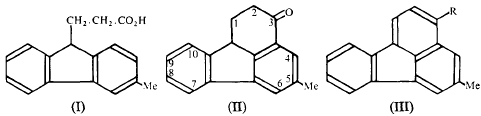
Wolff-Kishner reduction of the ketone yielded l,2,3,10b-tetrahydro-5-methylfluoranthene which on dehydrogenation gave 2-methylfluoranthene (III, R=H) identical with a sample prepared according to the method of Tucker (1952) and differing from 8-methylfluoranthene. This proved that ring-closure of (I) had occurred as expected on the methyl-bearing benzene ring. In this instance ring-closure occurs in the position meta to the methyl group and is reminiscent of the similar ring-closure of 2-phenyl-2-p-tolylpropionic acid to give 6-methyl-3-phenylindanone (Pfeiffer and Roos 1941). It thus provided a further example of the limitations of von Braun's statement that Friedel-Crafts ring-closure occurs much less readily at the position meta to a methyl group than on a phenyl ring (von Braun, Manz and Reinsch 1928).
XXII.—A Priori Estimates and Nonlinear Parabolic Equations of Arbitrary Order
-
- Journal:
- Proceedings of the Royal Society of Edinburgh Section A: Mathematical and Physical Sciences / Volume 69 / Issue 4 / 1972
- Published online by Cambridge University Press:
- 14 February 2012, pp. 287-293
- Print publication:
- 1972
-
- Article
- Export citation
XXIII.—On an Extension to an Integro-differential Inequality of Hardy, Littlewood and Polya*
-
- Journal:
- Proceedings of the Royal Society of Edinburgh Section A: Mathematical and Physical Sciences / Volume 69 / Issue 4 / 1972
- Published online by Cambridge University Press:
- 14 February 2012, pp. 295-333
- Print publication:
- 1972
-
- Article
- Export citation
-
This paper considers an extension of the following inequality given in the book Inequalities by Hardy, Littlewood and Polya; let f be real-valued, twice differentiable on [0, ∞) and such that f and f are both in the space fn, ∞), then f′ is in L,2(0, ∞) and
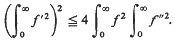
The extension consists in replacing f′ by M[f] where

choosing f so that f and M[f] are in L2(0, ∞) and then seeking to determine if there is an inequality of the form

where K is a positive number independent of f.
The analysis involves a fourth-order differential equation and the second-order equation associated with M.
A number of examples are discussed to illustrate the theorems obtained and to show that the extended inequality (*) may or may not hold.
