Refine search
Actions for selected content:
26077 results in Abstract analysis
Asymptotic formulas for the number of self-complementary graphs and digraphs
-
- Journal:
- Mathematika / Volume 17 / Issue 1 / June 1970
- Published online by Cambridge University Press:
- 26 February 2010, pp. 85-90
- Print publication:
- June 1970
-
- Article
- Export citation
-
The number
 of self-complementary graphs and the number
  of self-complementary digraphs were expressed by Read [4] in terms of cycle indexes of the appropriate pair groups. These formulas for and , together with a modification of the method employed by Oberschelp [3] for graphs, can be used to obtain estimates for and and a bound on the error. For graph theoretic definitions not given here, we refer to the book [2].
 of self-complementary graphs and the number
  of self-complementary digraphs were expressed by Read [4] in terms of cycle indexes of the appropriate pair groups. These formulas for
 The symmetric elements of a semi-simple S-ring
-
- Journal:
- Mathematika / Volume 17 / Issue 1 / June 1970
- Published online by Cambridge University Press:
- 26 February 2010, pp. 82-84
- Print publication:
- June 1970
-
- Article
- Export citation
-
Let Γ be a finite group of order n and let K be a field whose characteristic does does not divide n. The group ring K(Γ) is then an involution algebra if we define
 for y є Γ and extend by linearity, so that ¯ is trivial on K. A subalgebra T of K(Γ) is said to be an S-ring on Γ (see [4]) if there exists a decomposition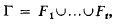
of Γ into non-empty, pairwise disjoint subsets Fi with the properties that the elements
 of K(Γ) form a K-basis of T and that for each τi there exists a τj such that
  .
.
 for y є Γ and extend by linearity, so that ¯ is trivial on K. A subalgebra T of K(Γ) is said to be an S-ring on Γ (see [4]) if there exists a decomposition
 of K(Γ) form a K-basis of T and that for each τ
 .
.A linear set of infinite measure with no two points having integral ratio
-
- Journal:
- Mathematika / Volume 17 / Issue 1 / June 1970
- Published online by Cambridge University Press:
- 26 February 2010, pp. 133-138
- Print publication:
- June 1970
-
- Article
- Export citation
Dense sequences of convex polytopes
-
- Journal:
- Mathematika / Volume 17 / Issue 1 / June 1970
- Published online by Cambridge University Press:
- 26 February 2010, pp. 28-38
- Print publication:
- June 1970
-
- Article
- Export citation
-
Let P be a d-dimensional convex polytope (briefly, a d-polytope) in d-dimensional euclidean space Ed. Associated with P is a vector f(P), known as the f-vector of P, defined by

where fj(P) is the number of j-faces of P for 0 ≤ j ≤ d − 1 and the superscript T denotes transposition. (We regard f(P) as a column vector, and identify it with the vector
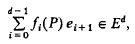
where (e1, …, ed) is some fixed basis of Ed.) Let
 d be the set of all d-polytopes in Ed, and
  d be any subset of
  d. Using tghe notation of [1; §8.1], we donate by f(d) the set of vectors {f(P): P ε d}, and write aff f(d) for the (unique) affine subspace of lowest dimension in Ed which contains all the vectors of f(d). Then it is well-known that
the equation of the hyperplane aff f(
d) being that given by the Euler relation between the numbers fj(P) [1; Theorem 8.1.1].


Probability, Hausdorff dimension, and fractional distribution
-
- Journal:
- Mathematika / Volume 17 / Issue 1 / June 1970
- Published online by Cambridge University Press:
- 26 February 2010, pp. 63-67
- Print publication:
- June 1970
-
- Article
- Export citation
-
§0. We begin by stating a theorem of Jarník [1]. Let m be a positive integer, 0 < β < m, and Ψ(q) a positive function of integers q > 0. Let E be the set of points (x1, …, xm) for which the inequality

admits infinitely many solutions q ≥ 1. Then, supposing

Jarník proves that E has infinite Hausdorff β-measure.
MTK volume 17 issue 1 Front matter
-
- Journal:
- Mathematika / Volume 17 / Issue 1 / June 1970
- Published online by Cambridge University Press:
- 26 February 2010, pp. f1-f2
- Print publication:
- June 1970
-
- Article
-
- You have access
- Export citation
The directions of the line segments and of the r-dimensional balls on the boundary of a convex body in Euclidean space
-
- Journal:
- Mathematika / Volume 17 / Issue 1 / June 1970
- Published online by Cambridge University Press:
- 26 February 2010, pp. 1-20
- Print publication:
- June 1970
-
- Article
- Export citation
Quotient overrings of integral domains
-
- Journal:
- Mathematika / Volume 17 / Issue 1 / June 1970
- Published online by Cambridge University Press:
- 26 February 2010, pp. 139-148
- Print publication:
- June 1970
-
- Article
- Export citation
On linear operators leaving a convex sex invariant in normed linear spaces
-
- Journal:
- Mathematika / Volume 17 / Issue 1 / June 1970
- Published online by Cambridge University Press:
- 26 February 2010, pp. 57-62
- Print publication:
- June 1970
-
- Article
- Export citation
Existence theorem for infinite integral matrices
-
- Journal:
- Mathematika / Volume 17 / Issue 1 / June 1970
- Published online by Cambridge University Press:
- 26 February 2010, pp. 91-97
- Print publication:
- June 1970
-
- Article
- Export citation
High-frequency approximations to ellipsoidal wave functions
-
- Journal:
- Mathematika / Volume 17 / Issue 1 / June 1970
- Published online by Cambridge University Press:
- 26 February 2010, pp. 39-46
- Print publication:
- June 1970
-
- Article
- Export citation
-
When the Helmholz equation

is separated in ellipsoidal coordinates [1; §1.6] and the technique of separation of variables applied, there results the ordinary differential equation

known as the ellipsoidal wave equation or Lamé wave equation. In this equation k is the modulus of the Jacobian elliptic function sn z, and is related to the eccentricity of the fundamental ellipse of the ellipsoidal coordinates; a, b are separation constants, and the parameter q is connected with the wave number χ by

l being a real constant, the dimensional parameter of the coordinate system.
Preface to the Second Edition
-
-
- Book:
- Random Variables and Probability Distributions
- Published online:
- 22 September 2009
- Print publication:
- 31 January 1970, pp vii-vii
-
- Chapter
- Export citation
Preface to the Third Edition
-
-
- Book:
- Random Variables and Probability Distributions
- Published online:
- 22 September 2009
- Print publication:
- 31 January 1970, pp viii-viii
-
- Chapter
- Export citation
Chapter X - The normal distribution and the central limit theorem
-
- Book:
- Random Variables and Probability Distributions
- Published online:
- 22 September 2009
- Print publication:
- 31 January 1970, pp 109-114
-
- Chapter
- Export citation
Abbreviations and Notations
-
- Book:
- Random Variables and Probability Distributions
- Published online:
- 22 September 2009
- Print publication:
- 31 January 1970, pp ix-x
-
- Chapter
- Export citation
FIRST PART - PRINCIPLES
-
- Book:
- Random Variables and Probability Distributions
- Published online:
- 22 September 2009
- Print publication:
- 31 January 1970, pp -
-
- Chapter
- Export citation
Front matter
-
- Book:
- Random Variables and Probability Distributions
- Published online:
- 22 September 2009
- Print publication:
- 31 January 1970, pp i-iv
-
- Chapter
- Export citation
THIRD PART - DISTRIBUTIONS IN RK
-
- Book:
- Random Variables and Probability Distributions
- Published online:
- 22 September 2009
- Print publication:
- 31 January 1970, pp -
-
- Chapter
- Export citation
Chapter IV - Characteristic functions
-
- Book:
- Random Variables and Probability Distributions
- Published online:
- 22 September 2009
- Print publication:
- 31 January 1970, pp 24-35
-
- Chapter
- Export citation
Preface to the First Edition
-
- Book:
- Random Variables and Probability Distributions
- Published online:
- 22 September 2009
- Print publication:
- 31 January 1970, pp vi-vi
-
- Chapter
- Export citation
