To save content items to your account,
please confirm that you agree to abide by our usage policies.
If this is the first time you use this feature, you will be asked to authorise Cambridge Core to connect with your account.
Find out more about saving content to .
To save content items to your Kindle, first ensure no-reply@cambridge.org
is added to your Approved Personal Document E-mail List under your Personal Document Settings
on the Manage Your Content and Devices page of your Amazon account. Then enter the ‘name’ part
of your Kindle email address below.
Find out more about saving to your Kindle.
Note you can select to save to either the @free.kindle.com or @kindle.com variations.
‘@free.kindle.com’ emails are free but can only be saved to your device when it is connected to wi-fi.
‘@kindle.com’ emails can be delivered even when you are not connected to wi-fi, but note that service fees apply.
We give an example of a long range Bernoulli percolation process on a group non-quasi-isometric with ℤ, in which clusters are almost surely finite for all values of the parameter. This random graph admits diverse equivalent definitions, and we study their ramifications. We also study its expected size and point out certain phase transitions.
We formulate a $q$-Schur algebra associated with an arbitrary $W$-invariant finite set $X_{\text{f}}$ of integral weights for a complex simple Lie algebra with Weyl group $W$. We establish a $q$-Schur duality between the $q$-Schur algebra and Hecke algebra associated with $W$. We then realize geometrically the $q$-Schur algebra and duality and construct a canonical basis for the $q$-Schur algebra with positivity. With suitable choices of $X_{\text{f}}$ in classical types, we recover the $q$-Schur algebras in the literature. Our $q$-Schur algebras are closely related to the category ${\mathcal{O}}$, where the type $G_{2}$ is studied in detail.
We introduce a generalization ${\rm{\pounds}}_d^{(\alpha)}(X)$ of the finite polylogarithms ${\rm{\pounds}}_d^{(0)}(X) = {{\rm{\pounds}}_d}(X) = \sum\nolimits_{k = 1}^{p - 1} {X^k}/{k^d}$, in characteristic p, which depends on a parameter α. The special case ${\rm{\pounds}}_1^{(\alpha)}(X)$ was previously investigated by the authors as the inverse, in an appropriate sense, of a parametrized generalization of the truncated exponential which is instrumental in a grading switching technique for nonassociative algebras. Here, we extend such generalization to ${\rm{\pounds}}_d^{(\alpha)}(X)$ in a natural manner and study some properties satisfied by those polynomials. In particular, we find how the polynomials ${\rm{\pounds}}_d^{(\alpha)}(X)$ are related to the powers of ${\rm{\pounds}}_1^{(\alpha)}(X)$ and derive some consequences.
In this paper we develop an in-depth analysis of non-reversible Markov chains on denumerable state space from a similarity orbit perspective. In particular, we study the class of Markov chains whose transition kernel is in the similarity orbit of a normal transition kernel, such as that of birth–death chains or reversible Markov chains. We start by identifying a set of sufficient conditions for a Markov chain to belong to the similarity orbit of a birth–death chain. As by-products, we obtain a spectral representation in terms of non-self-adjoint resolutions of identity in the sense of Dunford [21] and offer a detailed analysis on the convergence rate, separation cutoff and L2-cutoff of this class of non-reversible Markov chains. We also look into the problem of estimating the integral functionals from discrete observations for this class. In the last part of this paper we investigate a particular similarity orbit of reversible Markov kernels, which we call the pure birth orbit, and analyse various possibly non-reversible variants of classical birth–death processes in this orbit.
We prove the integral Hodge conjecture for all 3-folds $X$ of Kodaira dimension zero with $H^{0}(X,K_{X})$ not zero. This generalizes earlier results of Voisin and Grabowski. The assumption is sharp, in view of counterexamples by Benoist and Ottem. We also prove similar results on the integral Tate conjecture. For example, the integral Tate conjecture holds for abelian 3-folds in any characteristic.
The theta graph ${\Theta _{\ell ,t}}$ consists of two vertices joined by t vertex-disjoint paths, each of length $\ell $. For fixed odd $\ell $ and large t, we show that the largest graph not containing ${\Theta _{\ell ,t}}$ has at most ${c_\ell }{t^{1 - 1/\ell }}{n^{1 + 1/\ell }}$ edges and that this is tight apart from the value of ${c_\ell }$.
Based on the author's university lecture courses, this book presents the many facets of one of the most important open problems in operator algebra theory. Central to this book is the proof of the equivalence of the various forms of the problem, including forms involving C*-algebra tensor products and free groups, ultraproducts of von Neumann algebras, and quantum information theory. The reader is guided through a number of results (some of them previously unpublished) revolving around tensor products of C*-algebras and operator spaces, which are reminiscent of Grothendieck's famous Banach space theory work. The detailed style of the book and the inclusion of background information make it easily accessible for beginning researchers, Ph.D. students, and non-specialists alike.
We address the problem of defining Lyapunov exponents for an expansive homeomorphism f on a compact metric space (X, dist) using similar techniques as those developed in Barreira and Silva [Lyapunov exponents for continuous transformations and dimension theory, Discrete Contin. Dynam. Sys.13 (2005), 469–490]; Kifer [Characteristic exponents of dynamical systems in metric spaces, Ergod. Th. Dynam. Sys.3 (1983), 119–127]. Under certain conditions on the topology of the space X where f acts we obtain that there is a metric D defining the topology of X such that the Lyapunov exponents of f are different from zero with respect to D for every point x ∈ X. We give an example showing that this may not be true with respect to the original metric dist. But expansiveness of f ensures that Lyapunov exponents do not vanish on a Gδ subset of X with respect to any metric defining the topology of X. We define Lyapunov exponents on compact invariant sets of Peano spaces and prove that if the maximal exponent on the compact set is negative then the compact is an attractor.
We construct a separately continuous function $e:E\times K\rightarrow \{0,1\}$ on the product of a Baire space $E$ and a compact space $K$ such that no restriction of $e$ to any non-meagre Borel set in $E\times K$ is continuous. The function $e$ has no points of joint continuity, and, hence, it provides a negative solution of Talagrand’s problem in Talagrand [Espaces de Baire et espaces de Namioka, Math. Ann.270 (1985), 159–164].
Residential burglary is a social problem in every major urban area. As such, progress has been to develop quantitative, informative and applicable models for this type of crime: (1) the Deterministic-time-step (DTS) model [Short, D’Orsogna, Pasour, Tita, Brantingham, Bertozzi & Chayes (2008) Math. Models Methods Appl. Sci.18, 1249–1267], a pioneering agent-based statistical model of residential burglary criminal behaviour, with deterministic time steps assumed for arrivals of events in which the residential burglary aggregate pattern formation is quantitatively studied for the first time; (2) the SSRB model (agent-based stochastic-statistical model of residential burglary crime) [Wang, Zhang, Bertozzi & Short (2019) Active Particles, Vol. 2, Springer Nature Switzerland AG, in press], in which the stochastic component of the model is theoretically analysed by introduction of a Poisson clock with time steps turned into exponentially distributed random variables. To incorporate independence of agents, in this work, five types of Poisson clocks are taken into consideration. Poisson clocks (I), (II) and (III) govern independent agent actions of burglary behaviour, and Poisson clocks (IV) and (V) govern interactions of agents with the environment. All the Poisson clocks are independent. The time increments are independently exponentially distributed, which are more suitable to model individual actions of agents. Applying the method of merging and splitting of Poisson processes, the independent Poisson clocks can be treated as one, making the analysis and simulation similar to the SSRB model. A Martingale formula is derived, which consists of a deterministic and a stochastic component. A scaling property of the Martingale formulation with varying burglar population is found, which provides a theory to the finite size effects. The theory is supported by quantitative numerical simulations using the pattern-formation quantifying statistics. Results presented here will be transformative for both elements of application and analysis of agent-based models for residential burglary or in other domains.
Let c denote the largest constant such that every C6-free graph G contains a bipartite and C4-free subgraph having a fraction c of edges of G. Győri, Kensell and Tompkins showed that 3/8 ⩽ c ⩽ 2/5. We prove that c = 38. More generally, we show that for any ε > 0, and any integer k ⩾ 2, there is a C2k-free graph $G'$ which does not contain a bipartite subgraph of girth greater than 2k with more than a fraction
One of our proofs uses the following statement, which we prove using probabilistic ideas, generalizing a theorem of Erdős. For any ε > 0, and any integers a, b, k ⩾ 2, there exists an a-uniform hypergraph H of girth greater than k which does not contain any b-colourable subhypergraph with more than a fraction
of the hyperedges of H. We also prove further generalizations of this theorem.
In addition, we give a new and very short proof of a result of Kühn and Osthus, which states that every bipartite C2k-free graph G contains a C4-free subgraph with at least a fraction 1/(k−1) of the edges of G. We also answer a question of Kühn and Osthus about C2k-free graphs obtained by pasting together C2l’s (with k >l ⩾ 3).
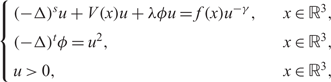
where λ > 0 is a real parameter, f belongs to a suitable Lebesgue space, $\mu \in L^{\infty}$ and $\mathbb {D}_s^2$ is a nonlocal ‘gradient square’ term given by
Depending on the real parameter λ > 0, we derive existence and non-existence results. The proof of our existence result relies on sharp Calderón–Zygmund type regularity results for the fractional Poisson equation with low integrability data. We also obtain existence results for related problems involving different nonlocal diffusion terms.
For p ≥ 1, one can define a generalisation of the unknotting number tup called the pth untwisting number, which counts the number of null-homologous twists on at most 2p strands required to convert the knot to the unknot. We show that for any p ≥ 2 the difference between the consecutive untwisting numbers tup–1 and tup can be arbitrarily large. We also show that torus knots exhibit arbitrarily large gaps between tu1 and tu2.
We show that a dense subset of a sufficiently large group multiplication table contains either a large part of the addition table of the integers modulo some k, or the entire multiplication table of a certain large abelian group, as a subgrid. As a consequence, we show that triples systems coming from a finite group contain configurations with t triples spanning $ O(\sqrt t )$ vertices, which is the best possible up to the implied constant. We confirm that for all t we can find a collection of t triples spanning at most t + 3 vertices, resolving the Brown–Erdős–Sós conjecture in this context. The proof applies well-known arithmetic results including the multidimensional versions of Szemerédi’s theorem and the density Hales–Jewett theorem.
This result was discovered simultaneously and independently by Nenadov, Sudakov and Tyomkyn [5], and a weaker result avoiding the arithmetic machinery was obtained independently by Wong [11].
Let M(u), H(u) be the maximal operator and Hilbert transform along the parabola (t, ut2). For U ⊂ (0, ∞) we consider Lp estimates for the maximal functions sup u∈U|M(u)f| and sup u∈U|H(u)f|, when 1 < p ≤ 2. The parabolas can be replaced by more general non-flat homogeneous curves.
We give a new hypergeometric construction of rational approximations to ζ(4), which absorbs the earlier one from 2003 based on Bailey's 9F8 hypergeometric integrals. With the novel ingredients we are able to gain better control of the arithmetic and produce a record irrationality measure for ζ(4).
We study the partial Gelfand–Shilov regularizing effect and the exponential decay for the solutions to evolution equations associated with a class of accretive non-selfadjoint quadratic operators, which fail to be globally hypoelliptic on the whole phase space. By taking advantage of the associated Gevrey regularizing effects, we study the null-controllability of parabolic equations posed on the whole Euclidean space associated with this class of possibly non-globally hypoelliptic quadratic operators. We prove that these parabolic equations are null-controllable in any positive time from thick control subsets. This thickness property is known to be a necessary and sufficient condition for the null-controllability of the heat equation posed on the whole Euclidean space. Our result shows that this geometric condition turns out to be a sufficient one for the null-controllability of a large class of quadratic differential operators.
Let X = (Xt)t≥0 be a stochastic process issued from $x \in \mathbb{R}$ that admits a marginal stationary measure v, i.e. vPtf = vf for all t ≥ 0, where $\textbf{P}_t\,f(x)= \mathbb{E}_x[f(\textbf{X}_t)]$. In this paper, we introduce the (resp. biorthogonal) spectral projections correlation functions which are expressed in terms of projections.” Also, update first published online date, if available. into the eigenspaces of Pt (resp. and of its adjoint in the weighted Hilbert space L2 (v)). We obtain closed-form expressions involving eigenvalues, the condition number and/or the angle between the projections in the following different situations: when X = X with X = (Xt)t ≥ 0 being a Markov process, X is the subordination of X in the sense of Bochner, and X is a non-Markovian process which is obtained by time-changing X with an inverse of a subordinator. It turns out that these spectral projections correlation functions have different expressions with respect to these classes of processes which enables to identify substantial and deep properties about their dynamics. This interesting fact can be used to design original statistical tests to make inferences, for example, about the path properties of the process (presence of jumps), distance from symmetry (self-adjoint or non-self-adjoint) and short-to-long-range dependence. To reveal the usefulness of our results, we apply them to a class of non-self-adjoint Markov semigroups studied in Patie and Savov (to appear, Mem. Amer. Math. Soc., 179p), and then time-change by subordinators and their inverses.