Refine search
Actions for selected content:
26076 results in Abstract analysis
9 - Nuclear pairs, WEP, LLP, QWEP
-
- Book:
- Tensor Products of <I>C</I>*-Algebras and Operator Spaces
- Published online:
- 10 February 2020
- Print publication:
- 27 February 2020, pp 180-209
-
- Chapter
- Export citation
16 - Equivalence with Tsirelson’s problem
-
- Book:
- Tensor Products of <I>C</I>*-Algebras and Operator Spaces
- Published online:
- 10 February 2020
- Print publication:
- 27 February 2020, pp 300-310
-
- Chapter
- Export citation
19 - Other proofs that C(n)<n: quantum expanders
-
- Book:
- Tensor Products of <I>C</I>*-Algebras and Operator Spaces
- Published online:
- 10 February 2020
- Print publication:
- 27 February 2020, pp 333-343
-
- Chapter
- Export citation
25 - Open problems
-
- Book:
- Tensor Products of <I>C</I>*-Algebras and Operator Spaces
- Published online:
- 10 February 2020
- Print publication:
- 27 February 2020, pp 434-437
-
- Chapter
- Export citation
21 - WEP as an extension property
-
- Book:
- Tensor Products of <I>C</I>*-Algebras and Operator Spaces
- Published online:
- 10 February 2020
- Print publication:
- 27 February 2020, pp 358-365
-
- Chapter
- Export citation
10 - Exactness and nuclearity
-
- Book:
- Tensor Products of <I>C</I>*-Algebras and Operator Spaces
- Published online:
- 10 February 2020
- Print publication:
- 27 February 2020, pp 210-224
-
- Chapter
- Export citation
24 - Full crossed products and failure of WEP for B ⊗min B
-
- Book:
- Tensor Products of <I>C</I>*-Algebras and Operator Spaces
- Published online:
- 10 February 2020
- Print publication:
- 27 February 2020, pp 410-433
-
- Chapter
- Export citation
20 - Local embeddability into C and nonseparability of (OSn, dcb)
-
- Book:
- Tensor Products of <I>C</I>*-Algebras and Operator Spaces
- Published online:
- 10 February 2020
- Print publication:
- 27 February 2020, pp 344-357
-
- Chapter
- Export citation
ON THE σ-NILPOTENT NORM AND THE σ-NILPOTENT LENGTH OF A FINITE GROUP
- Part of
-
- Journal:
- Glasgow Mathematical Journal / Volume 63 / Issue 1 / January 2021
- Published online by Cambridge University Press:
- 27 February 2020, pp. 121-132
-
- Article
-
- You have access
- Export citation
-
Let G be a finite group and σ = {σi| i ∈ I} some partition of the set of all primes $\Bbb{P}$. Then G is said to be: σ-primary if G is a σi-group for some i; σ-nilpotent if G = G1× … × Gt for some σ-primary groups G1, … , Gt; σ-soluble if every chief factor of G is σ-primary. We use $G^{{\mathfrak{N}}_{\sigma}}$ to denote the σ-nilpotent residual of G, that is, the intersection of all normal subgroups N of G with σ-nilpotent quotient G/N. If G is σ-soluble, then the σ-nilpotent length (denoted by lσ (G)) of G is the length of the shortest normal chain of G with σ-nilpotent factors. Let Nσ (G) be the intersection of the normalizers of the σ-nilpotent residuals of all subgroups of G, that is,
 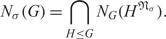 $${N_\sigma }(G) = \bigcap\limits_{H \le G} {{N_G}} ({H^{{_\sigma }}}).$$
Then the subgroup Nσ (G) is called the σ-nilpotent norm of G. We study the relationship of the σ-nilpotent length with the σ-nilpotent norm of G. In particular, we prove that the σ-nilpotent length of a σ-soluble group G is at most r (r > 1) if and only if lσ (G/ Nσ (G)) ≤ r.


12 - The Connes embedding problem
-
- Book:
- Tensor Products of <I>C</I>*-Algebras and Operator Spaces
- Published online:
- 10 February 2020
- Print publication:
- 27 February 2020, pp 262-279
-
- Chapter
- Export citation
23 - Haagerup’s characterizations of the WEP
-
- Book:
- Tensor Products of <I>C</I>*-Algebras and Operator Spaces
- Published online:
- 10 February 2020
- Print publication:
- 27 February 2020, pp 384-409
-
- Chapter
- Export citation
8 - Biduals, injective von Neumann algebras, and C*-norms
-
- Book:
- Tensor Products of <I>C</I>*-Algebras and Operator Spaces
- Published online:
- 10 February 2020
- Print publication:
- 27 February 2020, pp 161-179
-
- Chapter
- Export citation
14 - Equivalence of the two main questions
-
- Book:
- Tensor Products of <I>C</I>*-Algebras and Operator Spaces
- Published online:
- 10 February 2020
- Print publication:
- 27 February 2020, pp 291-296
-
- Chapter
- Export citation
5 - Multiplicative domains of c.p. maps
-
- Book:
- Tensor Products of <I>C</I>*-Algebras and Operator Spaces
- Published online:
- 10 February 2020
- Print publication:
- 27 February 2020, pp 106-112
-
- Chapter
- Export citation
Index
-
- Book:
- Tensor Products of <I>C</I>*-Algebras and Operator Spaces
- Published online:
- 10 February 2020
- Print publication:
- 27 February 2020, pp 482-484
-
- Chapter
- Export citation
22 - Complex interpolation and maximal tensor product
-
- Book:
- Tensor Products of <I>C</I>*-Algebras and Operator Spaces
- Published online:
- 10 February 2020
- Print publication:
- 27 February 2020, pp 366-383
-
- Chapter
- Export citation
7 - Tensorizing maps and functorial properties
-
- Book:
- Tensor Products of <I>C</I>*-Algebras and Operator Spaces
- Published online:
- 10 February 2020
- Print publication:
- 27 February 2020, pp 136-160
-
- Chapter
- Export citation
Appendix - Miscellaneous background
-
- Book:
- Tensor Products of <I>C</I>*-Algebras and Operator Spaces
- Published online:
- 10 February 2020
- Print publication:
- 27 February 2020, pp 438-469
-
- Chapter
- Export citation
6 - Decomposable maps
-
- Book:
- Tensor Products of <I>C</I>*-Algebras and Operator Spaces
- Published online:
- 10 February 2020
- Print publication:
- 27 February 2020, pp 113-135
-
- Chapter
- Export citation
4 - C*-tensor products
-
- Book:
- Tensor Products of <I>C</I>*-Algebras and Operator Spaces
- Published online:
- 10 February 2020
- Print publication:
- 27 February 2020, pp 87-105
-
- Chapter
- Export citation
