Refine search
Actions for selected content:
26079 results in Abstract analysis
Waveless subcritical flow past symmetric bottom topography
-
- Journal:
- European Journal of Applied Mathematics / Volume 24 / Issue 2 / April 2013
- Published online by Cambridge University Press:
- 09 November 2012, pp. 213-230
-
- Article
- Export citation
Existence results for diffuse interface models describing phase separation and damage*
-
- Journal:
- European Journal of Applied Mathematics / Volume 24 / Issue 2 / April 2013
- Published online by Cambridge University Press:
- 09 November 2012, pp. 179-211
-
- Article
- Export citation

Topics in Critical Point Theory
-
- Published online:
- 05 November 2012
- Print publication:
- 01 November 2012
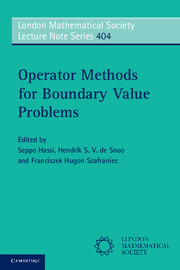
Operator Methods for Boundary Value Problems
-
- Published online:
- 05 November 2012
- Print publication:
- 11 October 2012
Index
-
- Book:
- Topics in Critical Point Theory
- Published online:
- 05 November 2012
- Print publication:
- 01 November 2012, pp 156-157
-
- Chapter
- Export citation
6 - Sandwich pairs
-
- Book:
- Topics in Critical Point Theory
- Published online:
- 05 November 2012
- Print publication:
- 01 November 2012, pp 125-142
-
- Chapter
- Export citation
2 - Linking
-
- Book:
- Topics in Critical Point Theory
- Published online:
- 05 November 2012
- Print publication:
- 01 November 2012, pp 30-46
-
- Chapter
- Export citation
Appendix Sobolev spaces
-
- Book:
- Topics in Critical Point Theory
- Published online:
- 05 November 2012
- Print publication:
- 01 November 2012, pp 143-146
-
- Chapter
- Export citation
Preface
-
- Book:
- Topics in Critical Point Theory
- Published online:
- 05 November 2012
- Print publication:
- 01 November 2012, pp ix-xii
-
- Chapter
- Export citation
Bibliography
-
- Book:
- Topics in Critical Point Theory
- Published online:
- 05 November 2012
- Print publication:
- 01 November 2012, pp 147-155
-
- Chapter
- Export citation
1 - Morse theory
-
- Book:
- Topics in Critical Point Theory
- Published online:
- 05 November 2012
- Print publication:
- 01 November 2012, pp 1-29
-
- Chapter
- Export citation
Contents
-
- Book:
- Topics in Critical Point Theory
- Published online:
- 05 November 2012
- Print publication:
- 01 November 2012, pp vii-viii
-
- Chapter
- Export citation
3 - Applications to semilinear problems
-
- Book:
- Topics in Critical Point Theory
- Published online:
- 05 November 2012
- Print publication:
- 01 November 2012, pp 47-66
-
- Chapter
- Export citation
4 - Fučík spectrum
-
- Book:
- Topics in Critical Point Theory
- Published online:
- 05 November 2012
- Print publication:
- 01 November 2012, pp 67-106
-
- Chapter
- Export citation
5 - Jumping nonlinearities
-
- Book:
- Topics in Critical Point Theory
- Published online:
- 05 November 2012
- Print publication:
- 01 November 2012, pp 107-124
-
- Chapter
- Export citation
Frontmatter
-
- Book:
- Topics in Critical Point Theory
- Published online:
- 05 November 2012
- Print publication:
- 01 November 2012, pp i-vi
-
- Chapter
- Export citation
EJM volume 23 issue 6 Cover and Front matter
-
- Journal:
- European Journal of Applied Mathematics / Volume 23 / Issue 6 / December 2012
- Published online by Cambridge University Press:
- 30 October 2012, pp. f1-f2
-
- Article
-
- You have access
- Export citation
Sums of Dilates in
 p
p
-
- Journal:
- Combinatorics, Probability and Computing / Volume 22 / Issue 2 / March 2013
- Published online by Cambridge University Press:
- 30 October 2012, pp. 282-293
-
- Article
- Export citation
-
We consider the problem of sums of dilates in groups of prime order. It is well known that sets with small density and small sumset in

 \begin{linenomath}$$| \lambda_{1}A+\lambda_{2}A+\cdots+ \lambda_{k}A | \ge\biggl(\sum_{i}|\lambda_{i}|\biggr)|A|- o(|A|).$$\end{linenomath}


EJM volume 23 issue 6 Cover and Back matter
-
- Journal:
- European Journal of Applied Mathematics / Volume 23 / Issue 6 / December 2012
- Published online by Cambridge University Press:
- 30 October 2012, pp. b1-b8
-
- Article
-
- You have access
- Export citation
A model for the evolution of the thermal bar system
-
- Journal:
- European Journal of Applied Mathematics / Volume 24 / Issue 2 / April 2013
- Published online by Cambridge University Press:
- 30 October 2012, pp. 161-177
-
- Article
- Export citation
