Refine search
Actions for selected content:
26079 results in Abstract analysis
ON THE DIOPHANTINE PROPERTIES OF λ-EXPANSIONS
- Part of
-
- Journal:
- Mathematika / Volume 59 / Issue 1 / January 2013
- Published online by Cambridge University Press:
- 05 December 2012, pp. 65-86
- Print publication:
- January 2013
-
- Article
- Export citation
-
For
 and α, we consider sets of numbers x such that for infinitely many n, x is 2−αn-close to some ∑ ni=1ωiλi, where ωi∈{0,1}. These sets are in Falconer’s intersection classes for Hausdorff dimension s for some s such that −(1/α)(log λ /log 2 )≤s≤1/α. We show that for almost all
  , the upper bound of s is optimal, but for a countable infinity of values of λ the lower bound is the best possible result.
 and α, we consider sets of numbers x such that for infinitely many n, x is 2
 , the upper bound of s is optimal, but for a countable infinity of values of λ the lower bound is the best possible result.
Induced Representations of Locally Compact Groups
-
- Published online:
- 05 December 2012
- Print publication:
- 22 November 2012
On inverse categories and transfer in cohomology
- Part of
-
- Journal:
- Proceedings of the Edinburgh Mathematical Society / Volume 56 / Issue 1 / February 2013
- Published online by Cambridge University Press:
- 05 December 2012, pp. 187-210
-
- Article
-
- You have access
- Export citation
-
It follows from methods of B. Steinberg, extended to inverse categories, that finite inverse category algebras are isomorphic to their associated groupoid algebras; in particular, they are symmetric algebras with canonical symmetrizing forms.We deduce the existence of transfer maps in cohomology and Hochschild cohomology from certain inverse subcategories. This is in part motivated by the observation that, for certain categories
 , being a Mackey functor on is equivalent to being extendible to a suitable inverse category containing . We further show that extensions of inverse categories by abelian groups are again inverse categories.
 , being a Mackey functor on
 Nilpotence in group cohomology
- Part of
-
- Journal:
- Proceedings of the Edinburgh Mathematical Society / Volume 56 / Issue 1 / February 2013
- Published online by Cambridge University Press:
- 05 December 2012, pp. 151-175
-
- Article
-
- You have access
- Export citation
Tensor structure on kC-mod and cohomology
- Part of
-
- Journal:
- Proceedings of the Edinburgh Mathematical Society / Volume 56 / Issue 1 / February 2013
- Published online by Cambridge University Press:
- 05 December 2012, pp. 349-370
-
- Article
-
- You have access
- Export citation
-
Let
 be a finite category and let k be a field. We consider the category algebra
  and show that -mod is closed symmetric monoidal. Through comparing with a co-commutative bialgebra, we exhibit the similarities and differences between them in terms of homological properties. In particular, we give a module-theoretic approach to the multiplicative structure of the cohomology rings of small categories. As an application, we prove that the Hochschild cohomology rings of a certain type of finite category algebras are finitely generated.
 be a finite category and let k be a field. We consider the category algebra
  and show that
 The string of nets
- Part of
-
- Journal:
- Proceedings of the Edinburgh Mathematical Society / Volume 56 / Issue 1 / February 2013
- Published online by Cambridge University Press:
- 05 December 2012, pp. 223-262
-
- Article
-
- You have access
- Export citation
GMJ volume 55 issue 1 Cover and Front matter
-
- Journal:
- Glasgow Mathematical Journal / Volume 55 / Issue 1 / January 2013
- Published online by Cambridge University Press:
- 04 December 2012, pp. f1-f2
-
- Article
-
- You have access
- Export citation
GMJ volume 55 issue 1 Cover and Back matter
-
- Journal:
- Glasgow Mathematical Journal / Volume 55 / Issue 1 / January 2013
- Published online by Cambridge University Press:
- 04 December 2012, pp. b1-b2
-
- Article
-
- You have access
- Export citation
JMJ volume 12 issue 1 Cover and Front matter
-
- Journal:
- Journal of the Institute of Mathematics of Jussieu / Volume 12 / Issue 1 / January 2013
- Published online by Cambridge University Press:
- 30 November 2012, pp. f1-f2
- Print publication:
- January 2013
-
- Article
-
- You have access
- Export citation
JMJ volume 12 issue 1 Cover and Back matter
-
- Journal:
- Journal of the Institute of Mathematics of Jussieu / Volume 12 / Issue 1 / January 2013
- Published online by Cambridge University Press:
- 30 November 2012, pp. b1-b2
- Print publication:
- January 2013
-
- Article
-
- You have access
- Export citation
Positive solutions of the nonlinear Schrödinger equation with the fractional Laplacian
-
- Journal:
- Proceedings of the Royal Society of Edinburgh. Section A: Mathematics / Volume 142 / Issue 6 / December 2012
- Published online by Cambridge University Press:
- 27 November 2012, pp. 1237-1262
- Print publication:
- December 2012
-
- Article
-
- You have access
- Export citation
-
We study the existence of positive solutions for the nonlinear Schrödinger equation with the fractional Laplacian
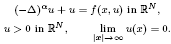
Furthermore, we analyse the regularity, decay and symmetry properties of these solutions.
The Lax–Oleinik semi-group: a Hamiltonian point of view
-
- Journal:
- Proceedings of the Royal Society of Edinburgh. Section A: Mathematics / Volume 142 / Issue 6 / December 2012
- Published online by Cambridge University Press:
- 27 November 2012, pp. 1131-1177
- Print publication:
- December 2012
-
- Article
- Export citation
Index to Volume 141
-
- Journal:
- Proceedings of the Royal Society of Edinburgh. Section A: Mathematics / Volume 142 / Issue 6 / December 2012
- Published online by Cambridge University Press:
- 27 November 2012, pp. 1338-1342
- Print publication:
- December 2012
-
- Article
- Export citation
On the almost-everywhere convergence of the continuous wavelet transforms
-
- Journal:
- Proceedings of the Royal Society of Edinburgh. Section A: Mathematics / Volume 142 / Issue 6 / December 2012
- Published online by Cambridge University Press:
- 27 November 2012, pp. 1121-1129
- Print publication:
- December 2012
-
- Article
- Export citation
The zero-level centralizer in endomorphism algebras
-
- Journal:
- Proceedings of the Royal Society of Edinburgh. Section A: Mathematics / Volume 142 / Issue 6 / December 2012
- Published online by Cambridge University Press:
- 27 November 2012, pp. 1325-1336
- Print publication:
- December 2012
-
- Article
- Export citation
Real hypersurfaces in complex two-plane Grassmannians with parallel Ricci tensor
-
- Journal:
- Proceedings of the Royal Society of Edinburgh. Section A: Mathematics / Volume 142 / Issue 6 / December 2012
- Published online by Cambridge University Press:
- 27 November 2012, pp. 1309-1324
- Print publication:
- December 2012
-
- Article
- Export citation
A sharp trace inequality for functions of bounded variation in the ball
-
- Journal:
- Proceedings of the Royal Society of Edinburgh. Section A: Mathematics / Volume 142 / Issue 6 / December 2012
- Published online by Cambridge University Press:
- 27 November 2012, pp. 1179-1191
- Print publication:
- December 2012
-
- Article
- Export citation
A Landesman–Lazer-type condition for asymptotically linear second-order equations with a singularity
-
- Journal:
- Proceedings of the Royal Society of Edinburgh. Section A: Mathematics / Volume 142 / Issue 6 / December 2012
- Published online by Cambridge University Press:
- 27 November 2012, pp. 1263-1277
- Print publication:
- December 2012
-
- Article
- Export citation
-
We consider the T-periodic problem
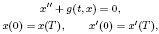
where g: [0,T]×]0,+∞[→ℝ exhibits a singularity of a repulsive type at the origin, and an asymptotically linear behaviour at infinity. In particular, for large x, g(t, x) is controlled from both sides by two consecutive asymptotes of the T-periodic Fučik spectrum, with possible equality on one side. Using a suitable Landesman–Lazer-type condition, we prove the existence of a solution.
Long-time behaviour of solutions to a one-dimensional strongly nonlinear model for phase transitions with micro-movements
-
- Journal:
- Proceedings of the Royal Society of Edinburgh. Section A: Mathematics / Volume 142 / Issue 6 / December 2012
- Published online by Cambridge University Press:
- 27 November 2012, pp. 1279-1307
- Print publication:
- December 2012
-
- Article
- Export citation
Global existence of solutions for a chemotaxis-type system arising in crime modelling
-
- Journal:
- European Journal of Applied Mathematics / Volume 24 / Issue 2 / April 2013
- Published online by Cambridge University Press:
- 27 November 2012, pp. 273-296
-
- Article
- Export citation
