Refine search
Actions for selected content:
26076 results in Abstract analysis
GENERALISED FERMAT HYPERMAPS AND GALOIS ORBITS
-
- Journal:
- Glasgow Mathematical Journal / Volume 51 / Issue 2 / May 2009
- Published online by Cambridge University Press:
- 01 May 2009, pp. 289-299
-
- Article
-
- You have access
- Export citation
A CHARACTERISATION OF BERGMAN SPACES ON THE UNIT BALL OF ℂn
-
- Journal:
- Glasgow Mathematical Journal / Volume 51 / Issue 2 / May 2009
- Published online by Cambridge University Press:
- 01 May 2009, pp. 315-330
-
- Article
-
- You have access
- Export citation
-
We obtain a new characterisation for weighted Bergman spaces Apα on the unit ball


QUIVERS, LONG EXACT SEQUENCES AND HORN TYPE INEQUALITIES II
-
- Journal:
- Glasgow Mathematical Journal / Volume 51 / Issue 2 / May 2009
- Published online by Cambridge University Press:
- 01 May 2009, pp. 201-217
-
- Article
-
- You have access
- Export citation
ON INTEGER SEQUENCES GENERATED BY LINEAR MAPS
-
- Journal:
- Glasgow Mathematical Journal / Volume 51 / Issue 2 / May 2009
- Published online by Cambridge University Press:
- 01 May 2009, pp. 243-252
-
- Article
-
- You have access
- Export citation
CPC volume 18 issue 3 Cover and Front matter
-
- Journal:
- Combinatorics, Probability and Computing / Volume 18 / Issue 3 / May 2009
- Published online by Cambridge University Press:
- 01 May 2009, pp. f1-f2
-
- Article
-
- You have access
- Export citation
MODULES WITH FI-EXTENDING HULLS
-
- Journal:
- Glasgow Mathematical Journal / Volume 51 / Issue 2 / May 2009
- Published online by Cambridge University Press:
- 01 May 2009, pp. 347-357
-
- Article
-
- You have access
- Export citation
-
It is shown that every finitely generated projective module PR over a semiprime ring R has the smallest FI-extending essential module extension
 (called the absolute FI-extending hull of PR) in a fixed injective hull of PR. This module hull is explicitly described. It is proved that
  , where
 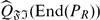 is the smallest right FI-extending right ring of quotients of End(PR) (in a fixed maximal right ring of quotients of End(PR). Moreover, we show that a finitely generated projective module PR over a semiprime ring R is FI-extending if and only if it is a quasi-Baer module and if and only if End(PR) is a quasi-Baer ring. An application of this result to C*-algebras is considered. Various examples which illustrate and delimit the results of this paper are provided.
 (called the absolute FI-extending hull of P
 , where
  is the smallest right FI-extending right ring of quotients of End(P
On the Difference of Expected Lengths of Minimum Spanning Trees
-
- Journal:
- Combinatorics, Probability and Computing / Volume 18 / Issue 3 / May 2009
- Published online by Cambridge University Press:
- 01 May 2009, pp. 423-434
-
- Article
- Export citation
Simplex Stability
-
- Journal:
- Combinatorics, Probability and Computing / Volume 18 / Issue 3 / May 2009
- Published online by Cambridge University Press:
- 01 May 2009, pp. 441-454
-
- Article
- Export citation
-
A d-simplex is a collection of d + 1 sets such that every d of them has non-empty intersection and the intersection of all of them is empty. Fix k ≥ d + 2 ≥ 3 and let

 , then there is a vertex x of
 Our main result is actually stronger, and implies that if
 for any ϵ < 0 and n sufficiently large, then

 , then there is a vertex x of
  for any ϵ < 0 and n sufficiently large, then
 A CHARACTERIZATION OF SELF-ADJOINT OPERATORS DETERMINED BY THE WEAK FORMULATION OF SECOND-ORDER SINGULAR DIFFERENTIAL EXPRESSIONS
-
- Journal:
- Glasgow Mathematical Journal / Volume 51 / Issue 2 / May 2009
- Published online by Cambridge University Press:
- 01 May 2009, pp. 385-404
-
- Article
-
- You have access
- Export citation
On the Likely Number of Solutions for the Stable Marriage Problem
-
- Journal:
- Combinatorics, Probability and Computing / Volume 18 / Issue 3 / May 2009
- Published online by Cambridge University Press:
- 01 May 2009, pp. 371-421
-
- Article
- Export citation
SCALAR CURVATURE OF HYPERSURFACES WITH CONSTANT MEAN CURVATURE IN A SPHERE
-
- Journal:
- Glasgow Mathematical Journal / Volume 51 / Issue 2 / May 2009
- Published online by Cambridge University Press:
- 01 May 2009, pp. 413-423
-
- Article
-
- You have access
- Export citation
-
Let M be an n-dimensional closed hypersurface with constant mean curvature H satisfying |H| ≤ ϵ(n) in a unit sphere Sn+1, n ≤ 7, and S the square of the length of the second fundamental form of M. There exists a constant δ(n, H) > 0, which depends only on n and H, such that if S0 ≤ S ≤ S0 + δ(n, H), then S ≡ S0 and M is isometric to a Clifford hypersurface, where ϵ(n) is a sufficiently small constant depending on n and
 .
.
 .
.Growing at a Perfect Speed
-
- Journal:
- Combinatorics, Probability and Computing / Volume 18 / Issue 3 / May 2009
- Published online by Cambridge University Press:
- 01 May 2009, pp. 301-308
-
- Article
- Export citation
Freiman's Theorem in Finite Fields via Extremal Set Theory
-
- Journal:
- Combinatorics, Probability and Computing / Volume 18 / Issue 3 / May 2009
- Published online by Cambridge University Press:
- 01 May 2009, pp. 335-355
-
- Article
- Export citation
-
Using various results from extremal set theory (interpreted in the language of additive combinatorics), we prove an asymptotically sharp version of Freiman's theorem in
 : if
: if  is a set for which |A + A| ≤ K|A| then A is contained in a subspace of size
  ; except for the
  error, this is best possible. If in addition we assume that A is a downset, then we can also cover A by O(K46) translates of a coordinate subspace of size at most |A|, thereby verifying the so-called polynomial Freiman–Ruzsa conjecture in this case. A common theme in the arguments is the use of compression techniques. These have long been familiar in extremal set theory, but have been used only rarely in the additive combinatorics literature.
 : if
: if  is a set for which |A + A| ≤ K|A| then A is contained in a subspace of size
  ; except for the
  error, this is best possible. If in addition we assume that A is a downset, then we can also cover A by O(K
EXISTENCE OF POSITIVE SOLUTION FOR A QUASI-LINEAR PROBLEM WITH CRITICAL GROWTH IN
 N+
N+
-
- Journal:
- Glasgow Mathematical Journal / Volume 51 / Issue 2 / May 2009
- Published online by Cambridge University Press:
- 01 May 2009, pp. 367-383
-
- Article
-
- You have access
- Export citation

Algebraic Properties of Modulo q Complete ℓ-Wide Families
-
- Journal:
- Combinatorics, Probability and Computing / Volume 18 / Issue 3 / May 2009
- Published online by Cambridge University Press:
- 01 May 2009, pp. 309-333
-
- Article
- Export citation
-
Let q be a power of a prime p, and let n, d, ℓ be integers such that 1 ≤ n, 1 ≤ ℓ < q. Consider the modulo q complete ℓ-wide family:
![\[
\cF = \bigl\{F\subseteq[n]\,:\, \exists\,f\in\Z~~\text{s.t.}~~
d\leq f< d+\ell~~\text{and}~~ |F|\equiv f\pmod q
\bigr\}.
\]](//static.cambridge.org/content/id/urn%3Acambridge.org%3Aid%3Aarticle%3AS0963548308009619/resource/name/S0963548308009619_eqnU1.gif?pub-status=live)
We describe a Gröbner basis of the vanishing ideal I(

We compute the Hilbert function of I(
We apply our results to problems from extremal set theory. We prove a sharp upper bound of the cardinality of a modulo q ℓ-wide family, which shatters only small sets. This is closely related to a conjecture of Frankl [13] on certain ℓ-antichains. The formula of the Hilbert function also allows us to obtain an upper bound on the size of a set system with certain restricted intersections, generalizing a bound proposed by Babai and Frankl [6].
The paper generalizes and extends the results of [15], [16] and [17].
![\[
\cF = \bigl\{F\subseteq[n]\,:\, \exists\,f\in\Z~~\text{s.t.}~~
d\leq f< d+\ell~~\text{and}~~ |F|\equiv f\pmod q
\bigr\}.
\]](http://static.cambridge.org/content/id/urn%3Acambridge.org%3Aid%3Aarticle%3AS0963548308009619/resource/name/S0963548308009619_eqnU1.gif?pub-status=live)

CPC volume 18 issue 3 Cover and Back matter
-
- Journal:
- Combinatorics, Probability and Computing / Volume 18 / Issue 3 / May 2009
- Published online by Cambridge University Press:
- 01 May 2009, pp. b1-b4
-
- Article
-
- You have access
- Export citation
COMPACT TOEPLITZ OPERATORS WITH CONTINUOUS SYMBOLS
-
- Journal:
- Glasgow Mathematical Journal / Volume 51 / Issue 2 / May 2009
- Published online by Cambridge University Press:
- 01 May 2009, pp. 257-261
-
- Article
-
- You have access
- Export citation
-
For any rotation-invariant positive regular Borel measure ν on the closed unit ball
 whose support contains the unit sphere
  , let L2a be the closure in L2 = L2(, dν) of all analytic polynomials. For a bounded Borel function f on , the Toeplitz operator Tf is defined by Tf(ϕ) = P(fϕ) for ϕ ∈ L2a, where P is the orthogonal projection from L2 onto L2a. We show that if f is continuous on , then Tf is compact if and only if f(z) = 0 for all z on the unit sphere. This is well known when L2a is replaced by the classical Bergman or Hardy space.
 whose support contains the unit sphere
  , let L
CONSTANT SCALAR CURVATURE HYPERSURFACES WITH SECOND-ORDER UMBILICITY
-
- Journal:
- Glasgow Mathematical Journal / Volume 51 / Issue 2 / May 2009
- Published online by Cambridge University Press:
- 01 May 2009, pp. 219-241
-
- Article
-
- You have access
- Export citation
-
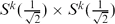
We extend the concept of umbilicity to higher order umbilicity in Riemannian manifolds saying that an isometric immersion is k-umbilical when APk−1(A) is a multiple of the identity, where Pk(A) is the kth Newton polynomial in the second fundamental form A with P0(A) being the identity. Thus, for k=1, one-umbilical coincides with umbilical. We determine the principal curvatures of the two-umbilical isometric immersions in terms of the mean curvatures. We give a description of the two-umbilical isometric immersions in space forms which includes the product of spheres
 embedded in the Euclidean sphere S2k+1 of radius 1. We also introduce an operator φk which measures how an isometric immersion fails to be k-umbilical, giving in particular that φ1 ≡ 0 if and only if the immersion is totally umbilical. We characterize the two-umbilical hypersurfaces of a space form as images of isometric immersions of Einstein manifolds.
 embedded in the Euclidean sphere S
Decision Trees and Influences of Variables Over Product Probability Spaces
-
- Journal:
- Combinatorics, Probability and Computing / Volume 18 / Issue 3 / May 2009
- Published online by Cambridge University Press:
- 01 May 2009, pp. 357-369
-
- Article
- Export citation
-
A celebrated theorem of Friedgut says that every function f : {0, 1}n → {0, 1} can be approximated by a function g : {0, 1}n → {0, 1} with
 , which depends only on eO(If / ε) variables, where If is the sum of the influences of the variables of f. Dinur and Friedgut later showed that this statement also holds if we replace the discrete domain {0, 1}n with the continuous domain [0, 1]n, under the extra assumption that f is increasing. They conjectured that the condition of monotonicity is unnecessary and can be removed.
We show that certain constant-depth decision trees provide counter-examples to the Dinur–Friedgut conjecture. This suggests a reformulation of the conjecture in which the function g : [0, 1]n → {0, 1}, instead of depending on a small number of variables, has a decision tree of small depth. In fact we prove this reformulation by showing that the depth of the decision tree of g can be bounded by eO(If / ε2).
Furthermore, we consider a second notion of the influence of a variable, and study the functions that have bounded total influence in this sense. We use a theorem of Bourgain to show that these functions have certain properties. We also study the relation between the two different notions of influence.
 , which depends only on e
A Spectral Erdős–Stone–Bollobás Theorem
-
- Journal:
- Combinatorics, Probability and Computing / Volume 18 / Issue 3 / May 2009
- Published online by Cambridge University Press:
- 01 May 2009, pp. 455-458
-
- Article
- Export citation
-
Let r ≥ 3 and (c/rr)r log n ≥ 1. If G is a graph of order n and its largest eigenvalue μ(G) satisfies
![$\[ \mu ( G ) geq ( 1-1/ ( r-1 ) +c ) n, \]$](//static.cambridge.org/content/id/urn%3Acambridge.org%3Aid%3Aarticle%3AS0963548309009687/resource/name/S0963548309009687_eqnU1.gif?pub-status=live) then G contains a complete r-partite subgraph with r − 1 parts of size ⌊(c/rr)r log n⌋ and one part of size greater than n1−cr−1.
then G contains a complete r-partite subgraph with r − 1 parts of size ⌊(c/rr)r log n⌋ and one part of size greater than n1−cr−1.This result implies the Erdős–Stone–Bollobás theorem, the essential quantitative form of the Erdős–Stone theorem. Another easy consequence is that if F1, F2, . . . are r-chromatic graphs satisfying v(Fn) = o(log n), then

![$\[ \mu ( G ) geq ( 1-1/ ( r-1 ) +c ) n, \]$](http://static.cambridge.org/content/id/urn%3Acambridge.org%3Aid%3Aarticle%3AS0963548309009687/resource/name/S0963548309009687_eqnU1.gif?pub-status=live)
