Refine search
Actions for selected content:
26064 results in Abstract analysis
Weierstrass points on rational nodal curves
-
- Journal:
- Glasgow Mathematical Journal / Volume 29 / Issue 1 / January 1987
- Published online by Cambridge University Press:
- 18 May 2009, pp. 131-140
-
- Article
-
- You have access
- Export citation
Some precisions on the Fourier-Borel transform and infinite order differential equations
-
- Journal:
- Glasgow Mathematical Journal / Volume 14 / Issue 2 / September 1973
- Published online by Cambridge University Press:
- 18 May 2009, pp. 161-167
-
- Article
-
- You have access
- Export citation
-
Let f(z) be an entire function (of several variables). We define the function
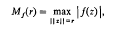
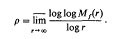
which is increasing. The orderof f(z) is the constant (perhaps infinite)
Dual integral equations with trigonometrical kernels†
-
- Journal:
- Proceedings of the Glasgow Mathematical Association / Volume 5 / Issue 3 / January 1962
- Published online by Cambridge University Press:
- 18 May 2009, pp. 147-152
-
- Article
-
- You have access
- Export citation
-
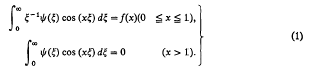
In the analysis of mixed boundary value problems in the plane, we encounter dual integral equations of the type
If we make the substitutions cos
 we obtain a pair of dual integral equations of the Titchmarsh type [1, p. 334] with α = − 1, v = − ½ (in Titchmarsh's notation). This is a particular case which is not covered by Busbridge's general solution [2], so that special methods have to be derived for the solution.
 we obtain a pair of dual integral equations of the Titchmarsh type [1, p. 334] with α = − 1, v = − ½ (in Titchmarsh's notation). This is a particular case which is not covered by Busbridge's general solution [2], so that special methods have to be derived for the solution.
New characterizations of approximately Gorenstein rings
-
- Journal:
- Glasgow Mathematical Journal / Volume 34 / Issue 3 / September 1992
- Published online by Cambridge University Press:
- 18 May 2009, pp. 361-363
-
- Article
-
- You have access
- Export citation
On projective Hjelmslev planes of level n
-
- Journal:
- Glasgow Mathematical Journal / Volume 31 / Issue 3 / September 1989
- Published online by Cambridge University Press:
- 18 May 2009, pp. 257-261
-
- Article
-
- You have access
- Export citation
Some triple integral equations
-
- Journal:
- Proceedings of the Glasgow Mathematical Association / Volume 4 / Issue 4 / September 1960
- Published online by Cambridge University Press:
- 18 May 2009, pp. 200-203
-
- Article
-
- You have access
- Export citation
-
Potential problems in which different conditions hold over two different parts of the same boundary can often be conveniently reduced to the solution of a pair of dual integral equations. In some problems, however, the boundary condition is such that different conditions hold over three different parts of the boundary and, in such cases, the integral equations involved are frequently of the form
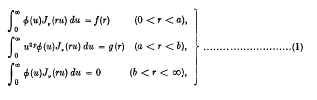
where f(r), g(r) are specified functions of r, p = ± ½ and ø(u) is to be found. Such equations might well be called triple integral equations and, in this note, I point out certain special cases which I have found to be capable of solution in closed form.
Bifree objects in e-varieties of strict orthodox semigroups and the lattice of strict orthodox *-semigroup varieties
-
- Journal:
- Glasgow Mathematical Journal / Volume 35 / Issue 1 / January 1993
- Published online by Cambridge University Press:
- 18 May 2009, pp. 25-37
-
- Article
-
- You have access
- Export citation
On strong Rieszian summability
-
- Journal:
- Proceedings of the Glasgow Mathematical Association / Volume 3 / Issue 3 / December 1957
- Published online by Cambridge University Press:
- 18 May 2009, pp. 123-131
-
- Article
-
- You have access
- Export citation
Inverse semigroups whose full inverse subsemigroups form a chain
-
- Journal:
- Glasgow Mathematical Journal / Volume 22 / Issue 2 / July 1981
- Published online by Cambridge University Press:
- 18 May 2009, pp. 159-165
-
- Article
-
- You have access
- Export citation
On the product of all nonzero elements of a finite ring
-
- Journal:
- Glasgow Mathematical Journal / Volume 30 / Issue 3 / September 1988
- Published online by Cambridge University Press:
- 18 May 2009, pp. 325-330
-
- Article
-
- You have access
- Export citation
Some remarks on regular Banach spaces
-
- Journal:
- Glasgow Mathematical Journal / Volume 38 / Issue 2 / May 1996
- Published online by Cambridge University Press:
- 18 May 2009, pp. 243-248
-
- Article
-
- You have access
- Export citation
Extended centroids of power series rings
-
- Journal:
- Glasgow Mathematical Journal / Volume 32 / Issue 3 / September 1990
- Published online by Cambridge University Press:
- 18 May 2009, pp. 371-375
-
- Article
-
- You have access
- Export citation
GMJ volume 20 issue 2 Cover and Back matter
-
- Journal:
- Glasgow Mathematical Journal / Volume 20 / Issue 2 / July 1979
- Published online by Cambridge University Press:
- 18 May 2009, p. b1
-
- Article
-
- You have access
- Export citation
A note on Köthe spaces
-
- Journal:
- Glasgow Mathematical Journal / Volume 11 / Issue 2 / July 1970
- Published online by Cambridge University Press:
- 18 May 2009, pp. 152-155
-
- Article
-
- You have access
- Export citation
-
Let E be a locally compact space which can be expressed as the union of an increasing sequence of compact subsets Kn (n =1, 2, …) and let μ be a positive Radon measure on E. Ω is the space of equivalence classes of locally integrable functions on E. We denote the equivalence class of a function f by
 and if is an equivalence class then f denotes any function belonging to f. Provided with the topology defined by the sequence of seminorms
Ω is a Fréchet space. The dual of Ω is the space φ of equivalence classes of measurable, p.p. bounded functions vanishing outside a compact subset of E. For a subset Γ of Ω, the collection Λ of all
∊Ω, such that for each g∊Γ the product fg is integrable, is called a Köthe space and Γ is said to be the denning set of Λ. The Köthe space Λx which has Λ as a denning set is called the associated Kothe space of Λ. Λ and Λx are put into duality by the bilinear form
 and if
Optimisation of quadratic forms associated with graphs
-
- Journal:
- Glasgow Mathematical Journal / Volume 18 / Issue 1 / January 1977
- Published online by Cambridge University Press:
- 18 May 2009, pp. 79-85
-
- Article
-
- You have access
- Export citation
A note on congruences on orthodox semigroups
-
- Journal:
- Glasgow Mathematical Journal / Volume 26 / Issue 1 / January 1985
- Published online by Cambridge University Press:
- 18 May 2009, pp. 25-30
-
- Article
-
- You have access
- Export citation
-
C. Eberhart and W. Williams [3] showed that the least inverse semigroup congruence
 , on an orthodox semigroup S, plays a very important role in determining the structure of the lattice of congruences on S. In this note we show that their results can be applied to give an explicit construction for the idempotent separating congruences on S in terms of idempotent separating congruences on S/.
 , on an orthodox semigroup S, plays a very important role in determining the structure of the lattice of congruences on S. In this note we show that their results can be applied to give an explicit construction for the idempotent separating congruences on S in terms of idempotent separating congruences on S/
Bi-embeddings of graphs
-
- Journal:
- Glasgow Mathematical Journal / Volume 15 / Issue 2 / September 1974
- Published online by Cambridge University Press:
- 18 May 2009, pp. 162-165
-
- Article
-
- You have access
- Export citation
A confluent hypergeometric integral equation
-
- Journal:
- Glasgow Mathematical Journal / Volume 23 / Issue 1 / January 1982
- Published online by Cambridge University Press:
- 18 May 2009, pp. 31-40
-
- Article
-
- You have access
- Export citation
-
Recently there have appeared papers ([7], [8]; also see [9]) in which integral equations with kernels involving the confluent hypergeometric function

have been studied. These equations are mainly Volterra equations of the first kind except that they have infinite domain (0, ∞). The rest are of the related type with integrals over (x, ∞) instead of (0, x); and all are convolution equations.
A remarkable identity found in Ramanujan's third notebook
-
- Journal:
- Glasgow Mathematical Journal / Volume 34 / Issue 3 / September 1992
- Published online by Cambridge University Press:
- 18 May 2009, pp. 341-345
-
- Article
-
- You have access
- Export citation
Clifford semigroups of left quotients
-
- Journal:
- Glasgow Mathematical Journal / Volume 28 / Issue 2 / July 1986
- Published online by Cambridge University Press:
- 18 May 2009, pp. 181-191
-
- Article
-
- You have access
- Export citation
