Refine search
Actions for selected content:
26064 results in Abstract analysis
Hilbert cusp forms and special values of Dirichlet series of Rankin type
-
- Journal:
- Glasgow Mathematical Journal / Volume 40 / Issue 1 / March 1998
- Published online by Cambridge University Press:
- 18 May 2009, pp. 71-77
-
- Article
-
- You have access
- Export citation
-
Let K be a totally real number field of degree nover ℚ and let c be an integral ideal of a maximal order
 of K. Given a nonnegative integer j and a Hecke character on the group
  of ideles of K, let
  denote the space of Hilbert cusp forms of holomorphic type on ℋn of weight j, level c and character ψ where ℋn is the n-th power of the Poincaré upper half plane ℋ.Let g be an element of
  , where 1 is the trivial character. If u ∈ Sk(c, ψ), then the product gu is an element of Sk+l (c, ψ), and therefore we can consider the linear map
  sending u to gu. Let
  be the adjoint of the linear map Φg with respect to the Petersson inner product.
 of K. Given a nonnegative integer j and a Hecke character on the group
  of ideles of K, let
  denote the space of Hilbert cusp forms of holomorphic type on ℋ
 , where 1 is the trivial character. If
  sending
  be the adjoint of the linear map Φ
Cohomology Theory for Non-Normal Subgroups and Non-Normal Fields*
-
- Journal:
- Proceedings of the Glasgow Mathematical Association / Volume 2 / Issue 2 / October 1954
- Published online by Cambridge University Press:
- 18 May 2009, pp. 66-76
-
- Article
-
- You have access
- Export citation
-
Let G be a finite group, H an arbitrary subgroup (i.e., not necessarily normal); we decompose G as a union of left cosets modulo H:

choosing fixed coset representatives
 v. In this paper we construct a “coset space complex” and assign cohomology groups; Hr([G: H], A), to it for all coefficient modules A and all dimensions, -∞<r<∞. We show that if
is an exact sequence of coefficient modules such that H1U, A')= 0 for all subgroups U of H, then a cohomology group sequence

may be defined and is exact for -∞<r<∞. We also provide a link between the cohomology groups Hr([G: H], A) and the cohomology groups of G and H; namely, we prove that if Hv(U, A)= 0 for all subgroups U of H and for v = 1, 2, …, n–1, then the sequence

is exact, where the homomorphisms of the sequence are those induced by injection, inflation and restriction respectively.


Integrals Involving E-Functions and Modified Bessel Functions of the Second Kind
-
- Journal:
- Proceedings of the Glasgow Mathematical Association / Volume 2 / Issue 1 / April 1954
- Published online by Cambridge University Press:
- 18 May 2009, pp. 52-56
-
- Article
-
- You have access
- Export citation
-
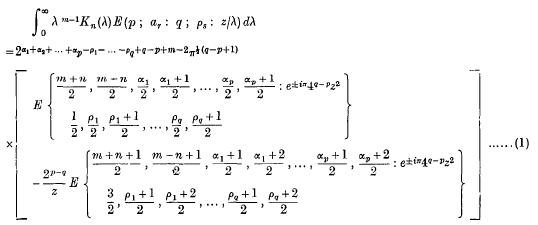
The two following formulae are to be established.
If R (m ± n) > 0, | amp z | < π,
If p ≧ q + 1, R(k ± n + 2αr) > 0, r = 1, 2, …, p, | amp z | < π,
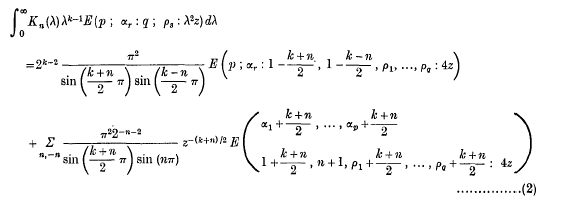
For other values of p and q the formula holds if the integral is convergent.
Some convexity theorems for matrices
-
- Journal:
- Glasgow Mathematical Journal / Volume 12 / Issue 2 / September 1971
- Published online by Cambridge University Press:
- 18 May 2009, pp. 110-117
-
- Article
-
- You have access
- Export citation
-
The numerical range of a bounded linear operator A on a complex Hilbertspace H is the set W(A) = {(Af, f): ║f║ = 1}. Because it is convex andits closure contains the spectrum of A, the numerical range is often a useful toolin operator theory. However, even when H is two-dimensional, the numerical range of an operator can be large relative to its spectrum, so that knowledge of W(A) generally permits only crude information about A. P. R. Halmos [2] has suggested a refinement of the notion of numerical range by introducing the k-numerical ranges

for k = 1, 2, 3, …. It is clear that W1(A) = W(A). C. A. Berger [2] has shown that Wk(A) is convex.
Centers of mass for operator-families
-
- Journal:
- Glasgow Mathematical Journal / Volume 34 / Issue 1 / January 1992
- Published online by Cambridge University Press:
- 18 May 2009, pp. 123-126
-
- Article
-
- You have access
- Export citation
-
Let Hbe a complex Hilbert space and let B(H) be the algebra of (bounded) operators on H. Let A =(A,…,An) be an n-tuple of operators on H. The joint numerical range of A is the subset W(A) of ℂn such that

Further Duals of a verbal Subgroup
-
- Journal:
- Proceedings of the Glasgow Mathematical Association / Volume 4 / Issue 2 / July 1959
- Published online by Cambridge University Press:
- 18 May 2009, pp. 88-91
-
- Article
-
- You have access
- Export citation
-
In a previous paper [3] we gave two methods for constructing subgroups which in certain senses may be considered to be dual to a verbal subgroup Vf(G) of an arbitrary group G. Associated with a word h (u, v) in the two symbols u and v, we have (i) the first dual subgroup
 which is defined as the minimal subgroup of G containing all elements ξ of G for which
for all values of x1, x2, …, in xn in G, and (ii), the second dual subgroup
 which is defined as the minimal subgroup of G containing all elements z of G for which
for all values of x1, x2, …, xn in G. Below we introduce slight variations to these definitions, which give rise to the concepts of the third and the fourth dual subgroups respectively. For certain values of h(u, v) we obtain concepts which also arise from
and , namely, the marginal subgroup, the invariable subgroup and the centralizer of a verbal subgroup. We also obtain the new concepts of elemental subgroups and commutal subgroups and briefly sketch some of their properties. Finally we conclude by showing that MacLane's dual for the centralizer of a verbal subgroup is a closely related verbal subgroup.
 which is defined as the minimal subgroup of G containing all elements ξ of G for which
 which is defined as the minimal subgroup of G containing all elements z of G for which
Nontrivial solutions for a multivalued problem with strong resonance
-
- Journal:
- Glasgow Mathematical Journal / Volume 38 / Issue 1 / January 1996
- Published online by Cambridge University Press:
- 18 May 2009, pp. 53-59
-
- Article
-
- You have access
- Export citation
On the normal cores of certain subgroups of nilpotent groups
-
- Journal:
- Glasgow Mathematical Journal / Volume 36 / Issue 1 / January 1994
- Published online by Cambridge University Press:
- 18 May 2009, pp. 113-115
-
- Article
-
- You have access
- Export citation
On the enumeration of planar trees of hexagons
-
- Journal:
- Glasgow Mathematical Journal / Volume 15 / Issue 2 / September 1974
- Published online by Cambridge University Press:
- 18 May 2009, pp. 131-147
-
- Article
-
- You have access
- Export citation
Series involving products of two E-functions
-
- Journal:
- Proceedings of the Glasgow Mathematical Association / Volume 6 / Issue 4 / July 1964
- Published online by Cambridge University Press:
- 18 May 2009, pp. 172-176
-
- Article
-
- You have access
- Export citation
An Infinite Construction in Ring Theory
-
- Journal:
- Glasgow Mathematical Journal / Volume 33 / Issue 1 / January 1991
- Published online by Cambridge University Press:
- 18 May 2009, pp. 121-123
-
- Article
-
- You have access
- Export citation
Convergent processes, projective systems of measures and martingale decompositions
-
- Journal:
- Glasgow Mathematical Journal / Volume 20 / Issue 2 / July 1979
- Published online by Cambridge University Press:
- 18 May 2009, pp. 119-124
-
- Article
-
- You have access
- Export citation
On the Gauss map of ruled surfaces
-
- Journal:
- Glasgow Mathematical Journal / Volume 34 / Issue 3 / September 1992
- Published online by Cambridge University Press:
- 18 May 2009, pp. 355-359
-
- Article
-
- You have access
- Export citation
-
Let M2 be a (connected) surface in Euclidean 3-space E3, and let G:M2→S2(1) ⊂ E3 be its Gauss map. Then, according to a theorem of E. A. Ruh and J. Vilms [3], M2 is a surface of constant mean curvature if and only if, as a map from M2 to S2(1), G is harmonic, or equivalently, if and only if

where δ is the Laplace operator on M2 corresponding to the induced metric on M2 from E3 and where G is seen as a map from M2to E3. A special case of (1.1) is given by

i.e., the case where the Gauss map G:M2→E3 is an eigenfunction of the Laplacian δ on M2.
Standard prime ideals and lying over for finite extensions of Noetherian algebras
-
- Journal:
- Glasgow Mathematical Journal / Volume 37 / Issue 3 / September 1995
- Published online by Cambridge University Press:
- 18 May 2009, pp. 311-326
-
- Article
-
- You have access
- Export citation
Montel subspaces of Fréchet spaces of Moscatelli type
-
- Journal:
- Glasgow Mathematical Journal / Volume 39 / Issue 3 / September 1997
- Published online by Cambridge University Press:
- 18 May 2009, pp. 345-350
-
- Article
-
- You have access
- Export citation
Corrigendum
-
- Journal:
- Glasgow Mathematical Journal / Volume 32 / Issue 2 / May 1990
- Published online by Cambridge University Press:
- 18 May 2009, pp. 261-263
-
- Article
-
- You have access
- Export citation
Annihilators and the CS-condition
-
- Journal:
- Glasgow Mathematical Journal / Volume 40 / Issue 2 / May 1998
- Published online by Cambridge University Press:
- 18 May 2009, pp. 213-222
-
- Article
-
- You have access
- Export citation
Integral ∨-ideals
-
- Journal:
- Glasgow Mathematical Journal / Volume 22 / Issue 2 / July 1981
- Published online by Cambridge University Press:
- 18 May 2009, pp. 167-172
-
- Article
-
- You have access
- Export citation
Torsion of beams of L-cross-section
-
- Journal:
- Proceedings of the Glasgow Mathematical Association / Volume 5 / Issue 4 / July 1962
- Published online by Cambridge University Press:
- 18 May 2009, pp. 176-182
-
- Article
-
- You have access
- Export citation
Martingale convergence theorems for sequences of Stone algebras
-
- Journal:
- Glasgow Mathematical Journal / Volume 10 / Issue 1 / January 1969
- Published online by Cambridge University Press:
- 18 May 2009, pp. 77-83
-
- Article
-
- You have access
- Export citation
-
A vector lattice W is boundedly complete when each subset {aj:j ∊ J} of W which is bounded above by an element of W has a least upper bound in W. The least upper bound of {aj:j ∊ J} is denoted by
 and the greatest lower bound by whenever these exist.
 and the greatest lower bound by