Refine search
Actions for selected content:
26063 results in Abstract analysis
Strongly simply connected Auslander algebras
-
- Journal:
- Glasgow Mathematical Journal / Volume 39 / Issue 1 / January 1997
- Published online by Cambridge University Press:
- 18 May 2009, pp. 21-27
-
- Article
-
- You have access
- Export citation
An embedding for π2 of a subcomplex of a finite contractible two-complex
-
- Journal:
- Glasgow Mathematical Journal / Volume 33 / Issue 3 / September 1991
- Published online by Cambridge University Press:
- 18 May 2009, pp. 365-371
-
- Article
-
- You have access
- Export citation
Compact actions on C*-algebras
-
- Journal:
- Glasgow Mathematical Journal / Volume 21 / Issue 1 / January 1980
- Published online by Cambridge University Press:
- 18 May 2009, pp. 143-149
-
- Article
-
- You have access
- Export citation
-
In Section 33 of [2], Bonsall and Duncan define an element t of a Banach algebra
 to act compactly on if the map a → tat is a compact operator on . In this paper, the arguments and technique of [1] are used to study this question for C*-algebras (see also [10]). We determine the elements b of a C*-algebra for which the maps a→ba, a→ab, a→ab + ba, a→bab are compact (respectively weakly compact), determine the C*-algebras which are compact in the sense of Definition 9, of [2, p. 177] and give a characterization of the *-automorphisms of which are weakly compact perturbations of the identity.
 to act compactly on
 The algebraic structure of the semigroup of binary relations on a finite set
-
- Journal:
- Glasgow Mathematical Journal / Volume 22 / Issue 1 / January 1981
- Published online by Cambridge University Press:
- 18 May 2009, pp. 57-68
-
- Article
-
- You have access
- Export citation
Lacunarity of Dedekind η-products
-
- Journal:
- Glasgow Mathematical Journal / Volume 37 / Issue 1 / January 1995
- Published online by Cambridge University Press:
- 18 May 2009, pp. 1-14
-
- Article
-
- You have access
- Export citation
-
The Dedekind η-function is defined by
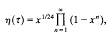
where τ lies in the upper half plane ℋ = {tau;|Im(τ) > 0}, and x = e2πiτ. It is a modular form of weight ½ with a multiplier system. We define an η-product to be a function f (τ) of the form

where rδ ε ℤ. This is a modular form of weight
 with a multiplier system. The Fourier coefficients of η-products are related to many well-known number-theoretic functions, including partition functions and quadratic form representation numbers. They also arise from representations of the “monster” group [3] and the Mathieu group M24 [13]. The multiplicative structure of these Fourier coefficients has been extensively studied. Recent papers include [1], [4], [5] and [6]. Here we study the connections between the density of the non-zero Fourier coefficients of f(τ) and the representability of f(τ) as a linear combination of Hecke character forms (defined in Section 4 below). We first make the following definition.
 with a multiplier system. The Fourier coefficients of η-products are related to many well-known number-theoretic functions, including partition functions and quadratic form representation numbers. They also arise from representations of the “monster” group [3] and the Mathieu group M
Bisimple weakly inverse semigroups with partial right unitoids
-
- Journal:
- Glasgow Mathematical Journal / Volume 30 / Issue 1 / January 1988
- Published online by Cambridge University Press:
- 18 May 2009, pp. 1-10
-
- Article
-
- You have access
- Export citation
On the values of the Epstein zeta function
-
- Journal:
- Glasgow Mathematical Journal / Volume 14 / Issue 1 / February 1973
- Published online by Cambridge University Press:
- 18 May 2009, pp. 1-12
-
- Article
-
- You have access
- Export citation
-
Let ζ(s) = σn-s (Res >1) denote the Riemann zeta function; then, as is well known,
 , where Bm denotes the mth Bernoulli number, In this paper we investigate the possibility of similar evaluations of the Epstein zeta function ζq(s) at the rational integers s = k> 2. Let
be a positive definite quadratic form and

where the summation is over all pairs of integers except (0, 0). In attempting to evaluate ζq(k) we are guided by Kronecker's first limit formula [11]

where γ is Euler's constant,

is the Dedekind eta-function, and τ is the complex number in the upper half plane, ℋ, associated with Q by the formula

On the basis of (1.3) we would expect a formula involving functions of τ. This formula is stated in Theorem 1, (2.13).
 , where B
GMJ volume 35 issue 1 Cover and Front matter
-
- Journal:
- Glasgow Mathematical Journal / Volume 35 / Issue 1 / January 1993
- Published online by Cambridge University Press:
- 18 May 2009, pp. f1-f2
-
- Article
-
- You have access
- Export citation
Some remarks on the p-homotopy type of B∑p2
-
- Journal:
- Glasgow Mathematical Journal / Volume 38 / Issue 3 / September 1996
- Published online by Cambridge University Press:
- 18 May 2009, pp. 337-342
-
- Article
-
- You have access
- Export citation
-
Let G be a finite group, H a copy of its p-Sylow subgroup, and N the normalizer of H in G. A theorem by Nishida [10] states the p-homotopy equivalence of suitable suspensions of BN and BG when H is abelian. Recently, in [3] the authors proved a stronger result: let ΩkH be the subgroup of H generated by elements of order pk or less; if

then BN and BG are stably p-homotopy equivalent. The hypothesis above is obviously verified when H is abelian. In the same paper the authors recall that H does not verify such condition when p = 2 and G = SL2(Fq) for a suitable odd prime power q; in this case BG and BN are not stably 2-homotopy equivalent.
Range inclusion for normal derivations
-
- Journal:
- Glasgow Mathematical Journal / Volume 25 / Issue 2 / July 1984
- Published online by Cambridge University Press:
- 18 May 2009, pp. 255-262
-
- Article
-
- You have access
- Export citation
Automorphisms of functions in abelian permutation groups
-
- Journal:
- Glasgow Mathematical Journal / Volume 16 / Issue 2 / September 1975
- Published online by Cambridge University Press:
- 18 May 2009, pp. 107-108
-
- Article
-
- You have access
- Export citation
Note on a paper of Tsuzuku
-
- Journal:
- Proceedings of the Glasgow Mathematical Association / Volume 6 / Issue 4 / July 1964
- Published online by Cambridge University Press:
- 18 May 2009, pp. 196-197
-
- Article
-
- You have access
- Export citation
Delange's characterization of the sine function
-
- Journal:
- Glasgow Mathematical Journal / Volume 15 / Issue 1 / March 1974
- Published online by Cambridge University Press:
- 18 May 2009, pp. 66-68
-
- Article
-
- You have access
- Export citation
-
In [2], H. Delange gives the following characterization of the sine function.
Theorem A. f(x)=sin x is the only infinitely differentiable real-valued function on the real line such that f'(O)= 1 and

for all real x and n = 0,1,2,….
It is clear that, if f satisfies (1), then the analytic continuation of f is an entire function satisfying

for all z in the complex plane. Hence f is of at most order one and type one. In this note, we prove the following theorem.

GMJ volume 6 issue 1 Cover and Front matter
-
- Journal:
- Proceedings of the Glasgow Mathematical Association / Volume 6 / Issue 1 / January 1963
- Published online by Cambridge University Press:
- 18 May 2009, pp. f1-f7
-
- Article
-
- You have access
- Export citation
General Products of Two Finite Cyclic Groups
-
- Journal:
- Proceedings of the Glasgow Mathematical Association / Volume 2 / Issue 3 / July 1955
- Published online by Cambridge University Press:
- 18 May 2009, pp. 116-123
-
- Article
-
- You have access
- Export citation
GMJ volume 35 issue 3 Cover and Back matter
-
- Journal:
- Glasgow Mathematical Journal / Volume 35 / Issue 3 / September 1993
- Published online by Cambridge University Press:
- 18 May 2009, pp. b1-b2
-
- Article
-
- You have access
- Export citation
GMJ volume 22 issue 2 Cover and Back matter
-
- Journal:
- Glasgow Mathematical Journal / Volume 22 / Issue 2 / July 1981
- Published online by Cambridge University Press:
- 18 May 2009, p. b1
-
- Article
-
- You have access
- Export citation
On two-sided artinian quotient rings
-
- Journal:
- Glasgow Mathematical Journal / Volume 13 / Issue 2 / September 1972
- Published online by Cambridge University Press:
- 18 May 2009, pp. 159-163
-
- Article
-
- You have access
- Export citation
Quotient rings of semiprime rings with bounded index
-
- Journal:
- Glasgow Mathematical Journal / Volume 23 / Issue 1 / January 1982
- Published online by Cambridge University Press:
- 18 May 2009, pp. 53-64
-
- Article
-
- You have access
- Export citation
GMJ volume 23 issue 2 Cover and Front matter
-
- Journal:
- Glasgow Mathematical Journal / Volume 23 / Issue 2 / July 1982
- Published online by Cambridge University Press:
- 18 May 2009, pp. f1-f2
-
- Article
-
- You have access
- Export citation
