Refine search
Actions for selected content:
26063 results in Abstract analysis
Corrigendum
-
- Journal:
- Glasgow Mathematical Journal / Volume 40 / Issue 3 / September 1998
- Published online by Cambridge University Press:
- 18 May 2009, pp. 475-476
-
- Article
-
- You have access
- Export citation
The lattice of congruences on a band of groups
-
- Journal:
- Glasgow Mathematical Journal / Volume 14 / Issue 2 / September 1973
- Published online by Cambridge University Press:
- 18 May 2009, pp. 187-197
-
- Article
-
- You have access
- Export citation
On projective characters of the same degree
-
- Journal:
- Glasgow Mathematical Journal / Volume 40 / Issue 3 / September 1998
- Published online by Cambridge University Press:
- 18 May 2009, pp. 431-434
-
- Article
-
- You have access
- Export citation
A note on the thermoelastic problem for a penny-shaped crack
-
- Journal:
- Glasgow Mathematical Journal / Volume 10 / Issue 2 / July 1969
- Published online by Cambridge University Press:
- 18 May 2009, pp. 169-172
-
- Article
-
- You have access
- Export citation
The structure of discontinuous homomorphisms from non-commutative C*-algebras
-
- Journal:
- Glasgow Mathematical Journal / Volume 36 / Issue 2 / May 1994
- Published online by Cambridge University Press:
- 18 May 2009, pp. 209-218
-
- Article
-
- You have access
- Export citation
-
Let X be a compact Hausdorff space, let C(X) denote the algebra of all continuous functions on X, let B be a Banach algebra, and let θ: → C(X) → B be a (possibly discontinuous) homomorphism with dense range. A classical theorem by W. G. Bade and P. C. Curtis ([2, Theorem 4.3]) describes in great detail the structure of θ we shall refer to this result as the Bade–Curtis theorem. Before we give a brief sketch of this theorem, we fix some notation. For Y ⊂ X let I(Y) and J(Y) denote the ideals of all functions in C(X) that vanish on Y and on a neighborhood of Y respectively; if Y = {x} for some x ɛ X, we write mx and Jx for I(Y) and J(Y) respectively. According to the Bade–Curtis theorem there is a finite set {x1,…, xn) ⊂ X, the so-called singularity set of θ, such that θ | ({x1, …, xn}) is continuous. As a consequence, the restriction of θ to the dense subalgebra of C (X) consisting of all those functions which are constant near each Xj (j = 1,…, n) is continuous, and extends to a continuous homomorphism θcont: C(X)→ B. Let θsing: = θ – θcont. Then θsing | I({x1,…, xn}) is a homomorphism onto a dense subalgebra of rad (B). θcont, and θsing are called the continuous and the singular part of θ respectively. Moreover, there are linear maps
 : C(X)⊒ B such that
(i)

(ii)
 is a homomorphism, and
Condition (iii) forces the homomorphisms
 to map into rad(B); such homomorphisms are called radical homomorphisms.
 : C(X)⊒ B such that
 is a homomorphism, and
 to map into rad(B); such homomorphisms are called radical homomorphisms.
GMJ volume 26 issue 2 Cover and Front matter
-
- Journal:
- Glasgow Mathematical Journal / Volume 26 / Issue 2 / July 1985
- Published online by Cambridge University Press:
- 18 May 2009, pp. f1-f2
-
- Article
-
- You have access
- Export citation
Addendum to a paper of M. Saks
-
- Journal:
- Glasgow Mathematical Journal / Volume 25 / Issue 1 / January 1984
- Published online by Cambridge University Press:
- 18 May 2009, pp. 31-33
-
- Article
-
- You have access
- Export citation
-
Throughout, (X, ≤ ) denotes a partially ordered set (p. o. set), where X is assumed to be finite. A subset Y of X is called a k-union if Y contains no chain of length K + 1. In particular, therefore, a 1-union is just an antichain; and it is readily seen that Y is a k-union if and only if it is a union of K antichains. (Dually, a subset Z of X is a k-counion if Z contains no antichain of length k + 1.) We denote by dk (X) the maximum cardinality of a k-union in X, with a similar notation for other p. o. sets. Now let
 be any partition of X into chains, and write
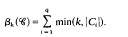 .
.
 be any partition of X into chains, and write
The minimal degree of a faithful quasi-permutation representation of an abelian group
-
- Journal:
- Glasgow Mathematical Journal / Volume 39 / Issue 1 / January 1997
- Published online by Cambridge University Press:
- 18 May 2009, pp. 51-57
-
- Article
-
- You have access
- Export citation
The solution of certain simultaneous pairs of dual integral equations†
-
- Journal:
- Glasgow Mathematical Journal / Volume 9 / Issue 2 / July 1968
- Published online by Cambridge University Press:
- 18 May 2009, pp. 92-102
-
- Article
-
- You have access
- Export citation
-
In the analysis of mixed boundary value problems by Hankel transforms, one often encounters dual integral equations of the form


where I1 = (0, 1), I2 = (1, ∞); w1(x), w2(x) are weight functions, ψ(x) is the unknown function, and f(y), g(y) are functions continuously differentiate on I1 and I2 respectively. Many successful attempts have been made to solve (1.1) and (1.2). These are all discussed in a recent book by Sneddon [7]. As pointed out in a recent paper by Erdogan and Bahar [4], in mixed boundary value problems of semi-infinite domains involving more than one unknown function such as those arising in elastostatics, viscoelasticity, and electrostatics, the formulation will lead to a system of simultaneous dual integral equations which is a generalization of (1.1) and (1.2). These equations may be expressed as follows:


with i = 1, 2, …, n, where we use the notation
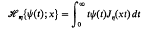
Compact Hankel operators on weighted harmonic Bergman spaces
-
- Journal:
- Glasgow Mathematical Journal / Volume 39 / Issue 1 / January 1997
- Published online by Cambridge University Press:
- 18 May 2009, pp. 77-84
-
- Article
-
- You have access
- Export citation
On 2-class field towers for quadratic number fields with 2-class group of type (2,2)
-
- Journal:
- Glasgow Mathematical Journal / Volume 40 / Issue 1 / March 1998
- Published online by Cambridge University Press:
- 18 May 2009, pp. 63-69
-
- Article
-
- You have access
- Export citation
Digraphs and the semigroup of all functions on a finite set
-
- Journal:
- Glasgow Mathematical Journal / Volume 30 / Issue 1 / January 1988
- Published online by Cambridge University Press:
- 18 May 2009, pp. 41-57
-
- Article
-
- You have access
- Export citation
-
Let Tn denote the full transformation semigroup on the finite set
 = {1, 2, … n}, that is the set of all mappings from to , with function composition as the semigroup operation. In this paper algorithms are introduced to solve equations such as axmb = c and ax = xb (a, b, c ∊ Tn), which employ a representation of members of Tn as special directed graphs.
 = {1, 2, … n}, that is the set of all mappings from
 Generalized Cesaro means of order −1
-
- Journal:
- Proceedings of the Glasgow Mathematical Association / Volume 7 / Issue 3 / January 1966
- Published online by Cambridge University Press:
- 18 May 2009, pp. 119-124
-
- Article
-
- You have access
- Export citation
Solutions of the Diffusion Equation for a Medium Generating Heat
-
- Journal:
- Proceedings of the Glasgow Mathematical Association / Volume 1 / Issue 1 / January 1952
- Published online by Cambridge University Press:
- 18 May 2009, pp. 21-27
-
- Article
-
- You have access
- Export citation
Approximate point spectrum and commuting compact perturbations
-
- Journal:
- Glasgow Mathematical Journal / Volume 28 / Issue 2 / July 1986
- Published online by Cambridge University Press:
- 18 May 2009, pp. 193-198
-
- Article
-
- You have access
- Export citation
-
Let X be an infinite-dimensional complex Banach space and denote the set of bounded (compact) linear operators on X by B (X) (K(X)). Let σ(A) and σa(A) denote, respectively, the spectrum and approximate point spectrum of an element A of B(X). Set


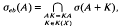
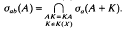
σem(A)and σeb(A) are respectively Schechter's and Browder's essential spectrum of A ([16], [9]). σea (A) is a non-empty compact subset of the set of complex numbers ℂ and it is called the essential approximate point spectrum of A ([13], [14]). In this note we characterize σab(A) and show that if f is a function analytic in a neighborhood of σ(A), then σab(f(A)) = f(σab(A)). The relation between σa(A) and σeb(A), that is exhibited in this paper, resembles the relation between the σ(A) and the σeb(A), and it is reasonable to call σab(A) Browder's essential approximate point spectrum of A.
Inverse semigroups as extensions of semilattices
-
- Journal:
- Glasgow Mathematical Journal / Volume 16 / Issue 1 / March 1975
- Published online by Cambridge University Press:
- 18 May 2009, pp. 12-21
-
- Article
-
- You have access
- Export citation
Monogenic endomorphisms of a free monoid
-
- Journal:
- Glasgow Mathematical Journal / Volume 31 / Issue 1 / January 1989
- Published online by Cambridge University Press:
- 18 May 2009, pp. 87-101
-
- Article
-
- You have access
- Export citation
A remark on a conjecture of Marcus on the generalized numerical range
-
- Journal:
- Glasgow Mathematical Journal / Volume 24 / Issue 2 / July 1983
- Published online by Cambridge University Press:
- 18 May 2009, pp. 191-194
-
- Article
-
- You have access
- Export citation
-
Let A be an n × n complex matrix and c = (c1… cn) єℂn. Define the c-numerical range of A to be the set
 is an orthonormal set in
  , where * denotes the conjugate transpose. Westwick [8[ proved that if c … cn are collinear, then Wc(A) is convex. (Poon [6] gave another proof.) But in general for n ≧3, Wc(A) may fail to be convex even for normal A (for example, see Marcus [4] or Lemma 3 in this note) though it is star-shaped (Tsing [7]). In the following, we shall assume that A is normal. Let W(A) = {diag UAU*: U is unitary}. Horn [3] proved that if the eigenvalues of A are collinear, then W(A) is convex. Au-Yeung and Sing [2] showed that the converse is also true. Marcus [4] further conjectured (and proved for n = 3) that if Wc(A) is convex for all cєℂn then the eigenvalues of A are collinear. Let λ = (λ1, …, λn єℂn. We denote by
  the vector λ1, …, λn and by [λ] the diagonal matrix with λ1, …, λn lying on its diagonal. Since, for any unitary matrix U,. Wc(A) = Wc (UAU*), the Marcus conjecture reduces to: if Wc([λ]) is convex for all c єℂn then λ1, … λn are collinear. For the case n = 3, Au-Yeung and Poon [1] gave a complete characterization on the convexity of the set Wc([λ]) in terms of the relative position of the points
  , where σ є S3 the permutation group of order 3. As an example they showed that if λ1, λ2, λ3 are not collinear, then
  is not convex (Lemma 3 in this note gives another proof). We shall show that for the case n = 4, is not convex if λ1, λ2. λ3. λ4 are not collinear. Thus for n = 3, 4 the Marcus conjecture is answered and improved.
 is an orthonormal set in
  , where * denotes the conjugate transpose. Westwick [8[ proved that if c … cn are collinear, then W
 the vector λ
 , where σ є S
 is not convex (Lemma 3 in this note gives another proof). We shall show that for the case n = 4,
 Weyl's theorem holds for p-hyponormal operators*
-
- Journal:
- Glasgow Mathematical Journal / Volume 39 / Issue 2 / May 1997
- Published online by Cambridge University Press:
- 18 May 2009, pp. 217-220
-
- Article
-
- You have access
- Export citation
-
Let ℋ be a complex Hilbert space and B(ℋ) the algebra of all bounded linear operators on ℋ. Let ℋ(ℋ) be the algebra of all compact operators of B(ℋ). For an operator T ε B(ℋ), let σ(T), σp(T), σπ(T) and πoo(T) denote the spectrum, the point spectrum, the approximate point spectrum and the set of all isolated eigenvalues of finite multiplicity of T, respectively. We denote the kernel and the range of an operator T by ker(T) and R(T), respectively. For a subset
 of ℋ, the norm closure of is denoted by
  . The Weyl spectrum ω(T) of T ε B(ℋ) is defined as the set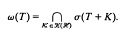
 of ℋ, the norm closure of
  . The Weyl spectrum ω(T) of T ε B(ℋ) is defined as the set
On Schoeneberg's theorem
-
- Journal:
- Glasgow Mathematical Journal / Volume 14 / Issue 2 / September 1973
- Published online by Cambridge University Press:
- 18 May 2009, pp. 202-204
-
- Article
-
- You have access
- Export citation
