Refine search
Actions for selected content:
26063 results in Abstract analysis
On the Arens semi-regularity of weighted group algebras
-
- Journal:
- Glasgow Mathematical Journal / Volume 36 / Issue 3 / September 1994
- Published online by Cambridge University Press:
- 18 May 2009, pp. 269-275
-
- Article
-
- You have access
- Export citation
Note on a partition theorem
-
- Journal:
- Glasgow Mathematical Journal / Volume 11 / Issue 2 / July 1970
- Published online by Cambridge University Press:
- 18 May 2009, pp. 108-109
-
- Article
-
- You have access
- Export citation
On Lattice Complements
-
- Journal:
- Proceedings of the Glasgow Mathematical Association / Volume 7 / Issue 1 / January 1965
- Published online by Cambridge University Press:
- 18 May 2009, pp. 22-23
-
- Article
-
- You have access
- Export citation
A note on surface film driven convection
-
- Journal:
- Glasgow Mathematical Journal / Volume 33 / Issue 2 / May 1991
- Published online by Cambridge University Press:
- 18 May 2009, pp. 155-158
-
- Article
-
- You have access
- Export citation
Rings characterized by cyclic modules
-
- Journal:
- Glasgow Mathematical Journal / Volume 31 / Issue 2 / May 1989
- Published online by Cambridge University Press:
- 18 May 2009, pp. 251-256
-
- Article
-
- You have access
- Export citation
Generalisation of an Integral due to Hardy
-
- Journal:
- Proceedings of the Glasgow Mathematical Association / Volume 1 / Issue 3 / September 1953
- Published online by Cambridge University Press:
- 18 May 2009, pp. 115-117
-
- Article
-
- You have access
- Export citation
-
§ 1. Introductory. The integral

where b>0, was given by Hardy (1). It was proved by applying Mellin's inversion formula. An alternative proof, based on the differential equation

satisfied by Kn(x), has been given by the author (2).
Note on a pair of dual trigonometric series
-
- Journal:
- Glasgow Mathematical Journal / Volume 9 / Issue 1 / January 1968
- Published online by Cambridge University Press:
- 18 May 2009, pp. 30-35
-
- Article
-
- You have access
- Export citation
-
It is the purpose of this note to discuss the solution of the pair of series


where F(x) and G(x) are given and the coefficients an are to be determined.
Left regular bands of groups of left quotients
-
- Journal:
- Glasgow Mathematical Journal / Volume 33 / Issue 1 / January 1991
- Published online by Cambridge University Press:
- 18 May 2009, pp. 29-40
-
- Article
-
- You have access
- Export citation
Theorems relating Hankel and Meijer's Bessel transforms
-
- Journal:
- Proceedings of the Glasgow Mathematical Association / Volume 6 / Issue 2 / July 1963
- Published online by Cambridge University Press:
- 18 May 2009, pp. 107-112
-
- Article
-
- You have access
- Export citation
-
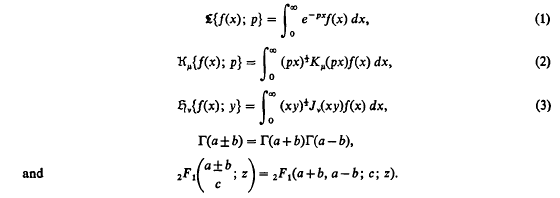
In this note a theorem, giving a relation between the Hankel transform of f(x) and Meijer's Bessel function transform of f(x)g(x), is proved. Some corollaries, obtained by specializing the function g(x), are stated as theorems. These theorems are further illustrated by certain suitable examples in which certain integrals involving products of Bessel functions or of Gauss's hypergeometric function and Appell's hypergeometric function are evaluated. Throughout this note we use the following notations:
Biduals of Banach spaces with bases
-
- Journal:
- Glasgow Mathematical Journal / Volume 26 / Issue 1 / January 1985
- Published online by Cambridge University Press:
- 18 May 2009, pp. 101-103
-
- Article
-
- You have access
- Export citation
-
R. C. James [2] (or see p. 7ff of [3]) gave a useful representation of the bidual of any space with a shrinking basis. This note gives a representation of the bidual of any space with a basis.
Our notation follows that of [3], where undefined terms can be found. Let {en} be a basic sequence with coefficient functionals {fn}. We will assume {en} is bimonotone; that is
 . The space {en}LIM is the set of scalar sequences {an} so that ∥{an}∥ =
  . We will abuse notation and squate such {an} with the formal sum Σ anen.
 . The space {e
 . We will abuse notation and squate such {a
On the monodromy groups of lifted Euler equations
-
- Journal:
- Glasgow Mathematical Journal / Volume 25 / Issue 1 / January 1984
- Published online by Cambridge University Press:
- 18 May 2009, pp. 47-57
-
- Article
-
- You have access
- Export citation
-
In [13], Poincaré asked the following question: Which abstract groups can appear as monodromy groups [14] of second order, linear, homogeneous differential equations with meromorphic coefficients (which might depend on one or more parameters) on ℂ? In the present paper, we initiate a classification of monodromy groups of differential equations on compact Riemann surfaces of genus 1. We proceed as follows: Let

be the general Euler equation [1] which has two regular singular points at 0 and λ in the extended complex plane C. Further, let yu(z)(v – 1,2) be an arbitrary but fixed pair of linearly independent solutions to (1) valid in a neighborhood of some ordinary point. Analytic continuation of each solution along a closed loop A in C–{0, λ}, starting and ending at some fixed base point, produces a new solution yv,A (v = 1, 2) which can be expressed as

where the constants avlx (v1 ν = l,2) in C depend on the homotopy class [A] of A. Clearly, y1,A(z)/y2,A(z) = To(y1(z)/y2(z)) where the Möbius transformation T:w→ (a11W + a12)/(a21W + a22) depends on [A]. The set of all Mobius transformations T belonging to every possible closed loop A in C–{0,λ} forms a group G, called the monodromy group of the Euler equation (1). G is generated by the Mobius transformation belonging to a simple, closed loop Ao encircling 0. Hence, G is cyclic.
Ramanujan congruences for p-k (mod 11')
-
- Journal:
- Glasgow Mathematical Journal / Volume 24 / Issue 2 / July 1983
- Published online by Cambridge University Press:
- 18 May 2009, pp. 107-123
-
- Article
-
- You have access
- Export citation
-
Denote by
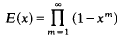
the Euler product, and by
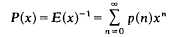
the partition generating function. More generally, if k is any integer, put
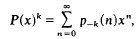
so that p(n) = p−1(n). In [3], Atkin proved the following theorem.
Compactness and ordinals
-
- Journal:
- Glasgow Mathematical Journal / Volume 13 / Issue 2 / September 1972
- Published online by Cambridge University Press:
- 18 May 2009, pp. 153-158
-
- Article
-
- You have access
- Export citation
The zeros of a certain family of trinomials
-
- Journal:
- Glasgow Mathematical Journal / Volume 34 / Issue 1 / January 1992
- Published online by Cambridge University Press:
- 18 May 2009, pp. 55-74
-
- Article
-
- You have access
- Export citation
-
Many of the classical inequalities of analysis can be written in the form P(x) ≥ 0 for x ∈ I or P(x) > 0 for x ∈ I′, where P(x) is a polynomial and I′ ⊂ I are certain intervals on the real line. This gives rise to the question of where the zeros of P(x) are located. For example, if f is a polynomial with real zeros, then an inequality of Laguerre [8, p. 171 f.] asserts that

for all x. A detailed study of the zeros of this particular P(x) has been made [5].
The values of a polynomial over a finite field
-
- Journal:
- Glasgow Mathematical Journal / Volume 14 / Issue 2 / September 1973
- Published online by Cambridge University Press:
- 18 May 2009, pp. 205-208
-
- Article
-
- You have access
- Export citation
The order of magnitude of the mth coefficients of cyclotomic polynomials
-
- Journal:
- Glasgow Mathematical Journal / Volume 27 / October 1985
- Published online by Cambridge University Press:
- 18 May 2009, pp. 143-159
-
- Article
-
- You have access
- Export citation
-
We define the nth cyclotomic polynomial Φn(z) by the equation

and we write

where ϕ is Euler's function.
Erdös and Vaughan [3] have shown that

uniformly in n as m-→∞, where
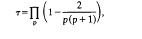
and that for every large m

⋏-distributive Boolean matrices
-
- Journal:
- Proceedings of the Glasgow Mathematical Association / Volume 7 / Issue 2 / July 1965
- Published online by Cambridge University Press:
- 18 May 2009, pp. 93-100
-
- Article
-
- You have access
- Export citation
-
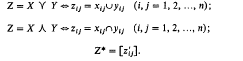
In this paper we shall be concerned with the set Mn(B) of n x n matrices whose elements belong to a given Boolean algebra B(≤, ∪,∩,').
It is well known that Mn(B) also forms a Boolean algebra with respect to the partial ordering ≼ defined by

in which union (⋎), intersection (⋏) and complementation (*) are given by
GMJ volume 31 issue 2 Cover and Front matter
-
- Journal:
- Glasgow Mathematical Journal / Volume 31 / Issue 2 / May 1989
- Published online by Cambridge University Press:
- 18 May 2009, pp. f1-f2
-
- Article
-
- You have access
- Export citation
Modules over polycyclic groups have many irreducible images
-
- Journal:
- Glasgow Mathematical Journal / Volume 22 / Issue 2 / July 1981
- Published online by Cambridge University Press:
- 18 May 2009, pp. 141-150
-
- Article
-
- You have access
- Export citation
-
Recall that a Noetherian ring R is a Hilbert ring if the Jacobson radical of every factor ring of R is nilpotent. As one of the main results of [13], J. E. Roseblade proved that if J is a commutative Hilbert ring and G is a polycyclic-by-finite group then JG is a Hilbert ring. The main theorem of this paper is a generalisation of this result in the case where all the field images of J are absolute fields—we shall say that J is absolutely Hilbert. The result is stated in terms of the (Gabriel–Rentschler–) Krull dimension; the definition and basic properties of this may be found in [5]. Let M be a finitely generated right module over the ring R. We write AnnR(M) (or just Ann(M)) for the ideal {r ∈ R: Mr = 0}, the annihilator of M in R. If M is also a left module, its left annihilator will be denoted l-AnnR(M). If R is a group ring JG, put

Some generating-function equivalences†
-
- Journal:
- Glasgow Mathematical Journal / Volume 16 / Issue 1 / March 1975
- Published online by Cambridge University Press:
- 18 May 2009, pp. 34-39
-
- Article
-
- You have access
- Export citation
