Refine search
Actions for selected content:
26063 results in Abstract analysis
Jacobians for Measures in Coset Spaces
-
- Journal:
- Proceedings of the Glasgow Mathematical Association / Volume 4 / Issue 4 / September 1960
- Published online by Cambridge University Press:
- 18 May 2009, pp. 208-212
-
- Article
-
- You have access
- Export citation
-
Let G be a locally compact topological group, let H be a closed subgroup and let G/H be the space of left cosets
 = xH with the natural topology. We denote by μ a non-negative measure in G/Hdefined on the ring of Baire sets. G acts by left multiplication as a transitive group of homeomorphisms on G/H: Every t ∈ G defines the homeomorphism
  We write, for E ⊂ G/H, tE =
  . The measure μ is called stable (cf. [3], [4]) if from t ∈ G, E ⊂ G/H and μ(E) = 0 follows μ(tE) = 0. We say that μ is locally finite [3], [5] if every set of positive measure contains a subset of positive finite measure.
 = xH with the natural topology. We denote by μ a non-negative measure in G/Hdefined on the ring of Baire sets. G acts by left multiplication as a transitive group of homeomorphisms on G/H: Every t ∈ G defines the homeomorphism
  We write, for E ⊂ G/H, tE =
  . The measure μ is called stable (cf. [3], [4]) if from t ∈ G, E ⊂ G/H and μ(E) = 0 follows μ(tE) = 0. We say that μ is locally finite [3], [5] if every set of positive measure contains a subset of positive finite measure.
On maximal nilpotent subrings of right Noetherian rings
-
- Journal:
- Glasgow Mathematical Journal / Volume 8 / Issue 2 / July 1967
- Published online by Cambridge University Press:
- 18 May 2009, pp. 89-101
-
- Article
-
- You have access
- Export citation
Prime ideals of quantized Weyl algebras
-
- Journal:
- Glasgow Mathematical Journal / Volume 38 / Issue 3 / September 1996
- Published online by Cambridge University Press:
- 18 May 2009, pp. 283-297
-
- Article
-
- You have access
- Export citation
-
The main object of study in this paper is the quantized Weyl algebra
 which arises from the work of Maltsiniotis [10] on noncommutative differential calculus. This algebra has been studied from the point of view of noncommutative ring theory by various authors including Alev and Dumas [1], the second author [9], Cauchon [3], and Goodearl and Lenagan [5]. In [9], it is shown that has n normal elements zi and, subject to a condition on the parameters, the localization
  obtained on inverting these elements is simple of Krull and global dimension n. It is easy to show that each of these normal elements generates a height one prime ideal and that these are all the height one prime ideals of . The purpose of this paper is to determine, under a stronger condition on the parameters, all the prime ideals of and to compare the prime spectrum with that of a related algebra
  . This algebra has more symmetric defining relations than those of but it shares the same simple localization which again is obtained by inverting n normal elements zi. Like the alternative algebra can be regarded as an algebra of skew differential (or difference) operators on the coordinate ring of quantum n-space.
 which arises from the work of Maltsiniotis [10] on noncommutative differential calculus. This algebra has been studied from the point of view of noncommutative ring theory by various authors including Alev and Dumas [1], the second author [9], Cauchon [3], and Goodearl and Lenagan [5]. In [9], it is shown that
  obtained on inverting these elements is simple of Krull and global dimension n. It is easy to show that each of these normal elements generates a height one prime ideal and that these are all the height one prime ideals of
  . This algebra has more symmetric defining relations than those of
 On Ramanujan and Dirichlet series with Euler products
-
- Journal:
- Glasgow Mathematical Journal / Volume 25 / Issue 2 / July 1984
- Published online by Cambridge University Press:
- 18 May 2009, pp. 203-206
-
- Article
-
- You have access
- Export citation
Note on the Strong Summability of Series
-
- Journal:
- Proceedings of the Glasgow Mathematical Association / Volume 1 / Issue 1 / January 1952
- Published online by Cambridge University Press:
- 18 May 2009, pp. 16-20
-
- Article
-
- You have access
- Export citation
-
Given the series
 ,the n-th Casáro sum of order k is defined by the relation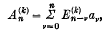
where
 is the binomial coefficient
  . Let
. Let  Then Σan is said to be summable (C; K) to the sum s if, as n → ∞,
  The series is said to be absolutely summable (C; k), or summable |
 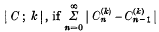 is convergent. The series is said to be strongly summable (C; k) with index p, or summable [Ck, p], to the sum s if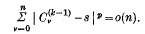
It is assumed that k and p are positive.
 ,the n-th Casáro sum of order k is defined by the relation
 is the binomial coefficient
  . Let
. Let  Then Σa
 The series is said to be absolutely summable (C; k), or summable |
  is convergent. The series is said to be strongly summable (C; k) with index p, or summable [Ck, p], to the sum s if
Isotopies of generic plane curves
-
- Journal:
- Glasgow Mathematical Journal / Volume 24 / Issue 2 / July 1983
- Published online by Cambridge University Press:
- 18 May 2009, pp. 195-206
-
- Article
-
- You have access
- Export citation
Sums of two regular elements
-
- Journal:
- Glasgow Mathematical Journal / Volume 25 / Issue 1 / January 1984
- Published online by Cambridge University Press:
- 18 May 2009, pp. 7-11
-
- Article
-
- You have access
- Export citation
Polynomials in a hermitian element
-
- Journal:
- Glasgow Mathematical Journal / Volume 30 / Issue 2 / May 1988
- Published online by Cambridge University Press:
- 18 May 2009, pp. 171-176
-
- Article
-
- You have access
- Export citation
Some automorphisms of finite nilpotent groups
-
- Journal:
- Proceedings of the Glasgow Mathematical Association / Volume 4 / Issue 4 / September 1960
- Published online by Cambridge University Press:
- 18 May 2009, pp. 204-207
-
- Article
-
- You have access
- Export citation
GMJ volume 2 issue 4 Cover and Back matter
-
- Journal:
- Proceedings of the Glasgow Mathematical Association / Volume 2 / Issue 4 / February 1956
- Published online by Cambridge University Press:
- 18 May 2009, pp. b1-b2
-
- Article
-
- You have access
- Export citation
Properties and applications of a certain operator associated with the Kontorovich-Lebedev transform†
-
- Journal:
- Glasgow Mathematical Journal / Volume 16 / Issue 2 / September 1975
- Published online by Cambridge University Press:
- 18 May 2009, pp. 109-122
-
- Article
-
- You have access
- Export citation
-
The integral

arises in problems of scalar wave propagation in welded elastic wedges. In (1.1), Kim(β1r) is the modified Bessel function of the second kind and m, τ are real. It is shown that Q(τ, m) is a generalized function that includes a complex shift operator. We shall investigate the properties of this operator and establish a new integral transform based on the kernel Q(τ, m).
Embedding any countable semigroup in a 2-generated bisimple monoid
-
- Journal:
- Glasgow Mathematical Journal / Volume 25 / Issue 2 / July 1984
- Published online by Cambridge University Press:
- 18 May 2009, pp. 153-161
-
- Article
-
- You have access
- Export citation
Integrals involving Products of Bessel Functions
-
- Journal:
- Proceedings of the Glasgow Mathematical Association / Volume 2 / Issue 4 / February 1956
- Published online by Cambridge University Press:
- 18 May 2009, pp. 180-182
-
- Article
-
- You have access
- Export citation
-
The first formula to be proved is
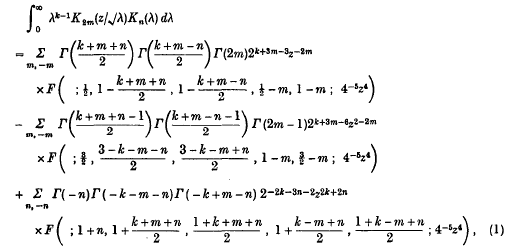
where R(z)>0.
GMJ volume 11 issue 1 Cover and Front matter
-
- Journal:
- Glasgow Mathematical Journal / Volume 11 / Issue 1 / January 1970
- Published online by Cambridge University Press:
- 18 May 2009, pp. f1-f2
-
- Article
-
- You have access
- Export citation
The Quadratic Law of Reciprocity and the Theory of Galois Fields
-
- Journal:
- Proceedings of the Glasgow Mathematical Association / Volume 1 / Issue 2 / July 1952
- Published online by Cambridge University Press:
- 18 May 2009, pp. 64-71
-
- Article
-
- You have access
- Export citation
-
The theory of quadratic congruences modulo an integer is dominated by the Quadratic Law of Reciprocity (see § 1), which makes it possible to decide in a very short time whether a quadratic congruence

is solvable or not. The law was first proved by Gauss.* It took him over a year to obtain his first proof, which depends on a tedious lemma in elementary number theory. He subsequently obtained seven further proofs, and today more than fifty proofs are known, most of them based on the ideas of Gauss. The object of the present paper is to present a proof which is a modernised version of Gauss's seventh proof, applying the ideas of that proof to a finite set of objects, the elements of a finite or Galois field.

A generalized inductive limit topology for linear spaces
-
- Journal:
- Glasgow Mathematical Journal / Volume 14 / Issue 2 / September 1973
- Published online by Cambridge University Press:
- 18 May 2009, pp. 105-110
-
- Article
-
- You have access
- Export citation
Autoclinisms and automorphisms of finite groups II
-
- Journal:
- Glasgow Mathematical Journal / Volume 21 / Issue 1 / January 1980
- Published online by Cambridge University Press:
- 18 May 2009, pp. 205-207
-
- Article
-
- You have access
- Export citation
An identity for certain Dirichlet series†
-
- Journal:
- Glasgow Mathematical Journal / Volume 9 / Issue 2 / July 1968
- Published online by Cambridge University Press:
- 18 May 2009, pp. 79-82
-
- Article
-
- You have access
- Export citation
On the numerical radius of an element of a normed algebra
-
- Journal:
- Glasgow Mathematical Journal / Volume 15 / Issue 1 / March 1974
- Published online by Cambridge University Press:
- 18 May 2009, pp. 90-93
-
- Article
-
- You have access
- Export citation
-
Let A be a unital normed algebra over the complex field ℂ, A' the dual space of A, i.e., the Banach space of all continuous linear functionals on A, and let S be the set of all states on A, i.e.,

Cone characterization of reflexive Banach lattices
-
- Journal:
- Glasgow Mathematical Journal / Volume 37 / Issue 1 / January 1995
- Published online by Cambridge University Press:
- 18 May 2009, pp. 65-67
-
- Article
-
- You have access
- Export citation
