Refine search
Actions for selected content:
26063 results in Abstract analysis
Abelian ergodic theorems for vector-valued functions
-
- Journal:
- Glasgow Mathematical Journal / Volume 16 / Issue 1 / March 1975
- Published online by Cambridge University Press:
- 18 May 2009, pp. 57-60
-
- Article
-
- You have access
- Export citation
Rings all of whose torsion quasi-injective modules are injective
-
- Journal:
- Glasgow Mathematical Journal / Volume 25 / Issue 2 / July 1984
- Published online by Cambridge University Press:
- 18 May 2009, pp. 219-227
-
- Article
-
- You have access
- Export citation
Automorphisms of compact non-orientable Riemann surfaces
-
- Journal:
- Glasgow Mathematical Journal / Volume 12 / Issue 1 / April 1971
- Published online by Cambridge University Press:
- 18 May 2009, pp. 50-59
-
- Article
-
- You have access
- Export citation
Spectral properties of p-hyponormal operators
-
- Journal:
- Glasgow Mathematical Journal / Volume 36 / Issue 1 / January 1994
- Published online by Cambridge University Press:
- 18 May 2009, pp. 117-122
-
- Article
-
- You have access
- Export citation
Finite abelian surface coverings†
-
- Journal:
- Glasgow Mathematical Journal / Volume 25 / Issue 2 / July 1984
- Published online by Cambridge University Press:
- 18 May 2009, pp. 207-218
-
- Article
-
- You have access
- Export citation
-
Let G be a finite abelian group, and Y be a closed surface. The problems of classifying and enumerating the free and effective G-actions on Y modulo selfhomeomorphisms of Y and X = Y/G can be transferred into ones of classifying regular G-coverings on X. P. A. Smith [7], proved that for any prime number p there are pr(r–1)/2 equivalence classes of free (ℤp)r actions on Y provided that rℤgenus of X. This paper is devoted to the classification and the enumeration of regular G-covering surfaces, when G is any finite abelian group. Recently, A. Edmonds [2] classified the G-actions on closed surfaces by their G-bordism classes in the set
 (G) of free oriented G-cobordism classes of free oriented G-surfaces.
 (G) of free oriented G-cobordism classes of free oriented G-surfaces.
On various types of barrelledness and the hereditary property of (DF)-spaces
-
- Journal:
- Glasgow Mathematical Journal / Volume 17 / Issue 2 / July 1976
- Published online by Cambridge University Press:
- 18 May 2009, pp. 134-143
-
- Article
-
- You have access
- Export citation
GMJ volume 36 issue 2 Cover and Back matter
-
- Journal:
- Glasgow Mathematical Journal / Volume 36 / Issue 2 / May 1994
- Published online by Cambridge University Press:
- 18 May 2009, pp. b1-b2
-
- Article
-
- You have access
- Export citation
A reflection principle for solutions to the Helmholtz equation and an application to the inverse scattering problem†
-
- Journal:
- Glasgow Mathematical Journal / Volume 18 / Issue 2 / July 1977
- Published online by Cambridge University Press:
- 18 May 2009, pp. 125-130
-
- Article
-
- You have access
- Export citation
The kernel relation for a strict extension of certain regular semigroups
-
- Journal:
- Glasgow Mathematical Journal / Volume 38 / Issue 3 / September 1996
- Published online by Cambridge University Press:
- 18 May 2009, pp. 347-357
-
- Article
-
- You have access
- Export citation
-
Let R be a regular semigroup and denote by
 (R) its congruence lattice. For
  , the kernel of pis the set ker
  . The relation K on (R) defined by λKp if ker λ = ker p is the kernel relation on (R). In general, K is a complete ∩-congruence but it is not a v-congruence. In view of the importance of the kernel-trace approach to the study of congruences on a regular semigroup (the trace of p is its restriction to idempotents of R), it is of considerable interest to determine necessary and sufficient conditions on R in order for K to be a congruence. This being in general a difficult task, one restricts attention to special classes of regular semigroups. For a background on this subject, consult [1].
 (R) its congruence lattice. For
  , the kernel of pis the set ker
  . The relation K on
 Topological types of Klein surfaces with a maximum order automorphism
-
- Journal:
- Glasgow Mathematical Journal / Volume 30 / Issue 1 / January 1988
- Published online by Cambridge University Press:
- 18 May 2009, pp. 87-96
-
- Article
-
- You have access
- Export citation
Unit-regular orthodox semigroups
-
- Journal:
- Glasgow Mathematical Journal / Volume 25 / Issue 2 / July 1984
- Published online by Cambridge University Press:
- 18 May 2009, pp. 229-240
-
- Article
-
- You have access
- Export citation
Strongly closed bounded Boolean algebras of projections
-
- Journal:
- Glasgow Mathematical Journal / Volume 22 / Issue 1 / January 1981
- Published online by Cambridge University Press:
- 18 May 2009, pp. 73-75
-
- Article
-
- You have access
- Export citation
Rational period functions of the modular group II
-
- Journal:
- Glasgow Mathematical Journal / Volume 22 / Issue 2 / July 1981
- Published online by Cambridge University Press:
- 18 May 2009, pp. 185-197
-
- Article
-
- You have access
- Export citation
-
In the earlier article [7], I began the study of rational period functions for the modular group Γ(l) = SL(2, Z) (regarded as a group of linear fractional transformations) acting on the Riemann sphere. These are rational functions q(z) which occur in functional equations of the form

where k∈Z and F is a function meromorphic in the upper half-plane ℋ, restricted in growth at the parabolic cusp ∞. The growth restriction may be phrased in terms of the Fourier expansion of F(z) at ∞:

with some μ∈Z. If (1.1) and (1.2) hold, then we call F a modular integral of weight 2k and q(z) the period of F.
On the solution of certain dual integral equations
-
- Journal:
- Proceedings of the Glasgow Mathematical Association / Volume 6 / Issue 1 / January 1963
- Published online by Cambridge University Press:
- 18 May 2009, pp. 39-44
-
- Article
-
- You have access
- Export citation
-
1. In this note we consider the formal solution of the dual integral equations
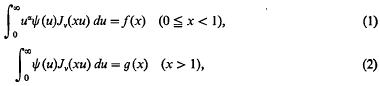
where f(x) and g(x) are given and χ(x) is to be found. The direct solution of these equations has been given by Noble [1] but we shall show that they may be solved more easily if they are first reduced to a form in which g(x) ≡ 0.
Nuclear operators on spaces of continuous vector-valued functions
-
- Journal:
- Glasgow Mathematical Journal / Volume 33 / Issue 2 / May 1991
- Published online by Cambridge University Press:
- 18 May 2009, pp. 223-230
-
- Article
-
- You have access
- Export citation
-
Let Ω: be a compact Hausdorff space, let E be a Banach space, and let C(Ω, E) stand for the Banach space of continuous E-valued functions on Ω under supnorm. It is well known [3, p. 182] that if F is a Banach space then any bounded linear operator T:C(Ω, E)→ F has a finitely additive vector measure G defined on the σ-field of Borel subsets of Ω with values in the space ℒ(E, F**) of bounded linear operators from E to the second dual F** of F. The measure G is said to represent T. The purpose of this note is to study the interplay between certain properties of the operator T and properties of the representing measure G. Precisely, one of our goals is to study when one can characterize nuclear operators in terms of their representing measures. This is of course motivated by a well-known theorem of L. Schwartz [5] (see also [3, p. 173]) concerning nuclear operators on spaces C(Ω) of continuous scalar-valued functions. The study of nuclear operators on spaces C(Ω, E) of continuous vector-valued functions was initiated in [1], where the author extended Schwartz's result in case E* has the Radon-Nikodym property. In this paper, we will show that the condition on E* to have the Radon-Nikodym property is necessary to have a Schwartz's type theorem. This leads to a new characterization of dual spaces E* with the Radon-Nikodym property. In [2], it was shown that if T:C(Ω, E)→ F is nuclear than its representing measure G takes its values in the space
 (E, F) of nuclear operators from E to F. One of the results of this paper is that if T:C(Ω, E)→ F is nuclear then its representing measure G is countably additive and of bounded variation as a vector measure taking its values in (E, F) equipped with the nuclear norm. Finally, we show by easy examples that the above mentioned conditions on the representing measure G do not characterize nuclear operators on C(Ω, E) spaces, and we also look at cases where nuclear operators are indeed characterized by the above two conditions. For all undefined notions and terminologies, we refer the reader to [3].
 (E, F) of nuclear operators from E to F. One of the results of this paper is that if T:C(Ω, E)→ F is nuclear then its representing measure G is countably additive and of bounded variation as a vector measure taking its values in
 Topological invariants of weighted homogeneous polynomials
-
- Journal:
- Glasgow Mathematical Journal / Volume 33 / Issue 3 / September 1991
- Published online by Cambridge University Press:
- 18 May 2009, pp. 241-245
-
- Article
-
- You have access
- Export citation
A remark on the generalized numerical range of a normal matrix
-
- Journal:
- Glasgow Mathematical Journal / Volume 18 / Issue 2 / July 1977
- Published online by Cambridge University Press:
- 18 May 2009, pp. 179-180
-
- Article
-
- You have access
- Export citation
-
Let A be an n × n complex normal matrix and let
 (A) = {diag UAU*: U is unitary) where U* is the conjugate transpose of U. It is known that (A) may not be convex [1, 3] and it is convex when A is Hermitian [1, 2]. In this note we show that (A) is convex if and only if the eigenvalues of A are collinear (i.e. there exist complex numbers α ( ≠ 0) and β such that αA + βi is Hermitian).
 (A) = {diag UAU*: U is unitary) where U* is the conjugate transpose of U. It is known that
 On right duo p.p. rings
-
- Journal:
- Glasgow Mathematical Journal / Volume 32 / Issue 2 / May 1990
- Published online by Cambridge University Press:
- 18 May 2009, pp. 221-225
-
- Article
-
- You have access
- Export citation
-
Throughout the paper, rings are associative rings with identity. A ring is called right duo if every right ideal is two-sided, and it is called right p.p. if every principal right ideal is projective. A left duo (p.p.) ring is denned similarly, and a duo (p.p.) ring will mean a ring which is both right and left duo (p.p.). There is a right p.p. ring that is not left p.p. (see Chase [2[). Small [9] proved that right p.p. implies left p.p. if there are no infinite sets of orthogonal idempotents, and Endo [5, Proposition 2] has shown the same implication in the case where each idempotent in the ring is central. Since Courter [3, Theorem 1.3] noted that every idempotent in a right duo ring is central, we can simply speak of right duo p.p. rings. A typical example of a right duo ring which is not left duo is the following. Let F be a field and F(x) the field of rational functions over F. Let R = F(x)× F(x) as an additive group and define the multiplication as follows:

Then R is a local artinian ring with c(RR) = 2 and c(RR)= 3. Thus R is right duo but not left due.
A Zeuthen Segre formula for even dimensional submanifolds of real projective space
-
- Journal:
- Glasgow Mathematical Journal / Volume 24 / Issue 1 / January 1983
- Published online by Cambridge University Press:
- 18 May 2009, pp. 97-99
-
- Article
-
- You have access
- Export citation
On the idempotence and stability of kernel functors
-
- Journal:
- Glasgow Mathematical Journal / Volume 37 / Issue 1 / January 1995
- Published online by Cambridge University Press:
- 18 May 2009, pp. 37-43
-
- Article
-
- You have access
- Export citation
