Refine search
Actions for selected content:
26063 results in Abstract analysis
On relative difference sets and projective planes
-
- Journal:
- Glasgow Mathematical Journal / Volume 15 / Issue 2 / September 1974
- Published online by Cambridge University Press:
- 18 May 2009, pp. 150-154
-
- Article
-
- You have access
- Export citation
Arithmetical Functions of a Greatest Common Divisor, III. Cesàro's Divisor Problem
-
- Journal:
- Proceedings of the Glasgow Mathematical Association / Volume 5 / Issue 2 / July 1961
- Published online by Cambridge University Press:
- 18 May 2009, pp. 67-75
-
- Article
-
- You have access
- Export citation
-
Let σ1(n) denote the sum of the tth powers of the divisors of n, σ(n) = σ1(n). Also place

where γ is Euler's constant, ζ(s) is the Riemann ζ-function and x ≧ 2. The function Δ(x) is the remainder term arising in the divisor problem for σ((m, n)). Cesàro proved originally [1], [6, p. 328] that Δ(x) = o(x2 log x). More recently in I [2, (3.14)] it was shown by elementary methods that
 . This estimate was later improved to in II [3, (3.7)]. In the present paper (§ 3) we obtain a much more substantial reduction in the order of Δ(x), by showing that Δ(x) can be expressed in terms of the remainder term in the classical Dirichlet divisor problem. On the basis of well known results for this problem, it follows easily that
  . The precise statement of the result for σ((m, n)) is contained in (3.2).
 . This estimate was later improved to
  . The precise statement of the result for σ((m, n)) is contained in (3.2).
Functional iteration and the Josephus problem
-
- Journal:
- Glasgow Mathematical Journal / Volume 33 / Issue 2 / May 1991
- Published online by Cambridge University Press:
- 18 May 2009, pp. 235-240
-
- Article
-
- You have access
- Export citation
Quantum stochastic integrals as belated integrals
-
- Journal:
- Glasgow Mathematical Journal / Volume 34 / Issue 2 / May 1992
- Published online by Cambridge University Press:
- 18 May 2009, pp. 165-173
-
- Article
-
- You have access
- Export citation
Averaging operators in non commutative Lp spaces I
-
- Journal:
- Glasgow Mathematical Journal / Volume 24 / Issue 1 / January 1983
- Published online by Cambridge University Press:
- 18 May 2009, pp. 71-74
-
- Article
-
- You have access
- Export citation
-
The origin of the theory of averaging operators is explained in [1]. The theory has been developed on spaces of continuous functions that vanish at infinity by Kelley in [3] and on the Lp spaces of measure theory by Rota [5]. The motivation for this paper arose out of the latter paper. The aim of this paper is to prove a generalisation of Rota's main representation theorem (every average is a conditional expectation) in the context of a ‘non commutative integration’. This context is as follows. Let
 be a finite von Neumann algebra and ϕ a faithful normal finite trace on such that ϕ(I) = 1, where I is the identity of . We can construct the Banach spaces Lp (, ϕ), where 1 ≤ p < °, with norm ∥x∥p = ϕ(÷x÷p)1/p, of possibly unbounded operators affiliated with , as in [9]. We note that is dense in Lp(, ϕ). These spaces share many of the features of the Lp spaces of measure theory; indeed if is abelian then Lp(,ϕ) is isometrically isomorphic to Lp of some measure space.
 be a finite von Neumann algebra and ϕ a faithful normal finite trace on
 Subnormality and generalized commutation relations
-
- Journal:
- Glasgow Mathematical Journal / Volume 30 / Issue 3 / September 1988
- Published online by Cambridge University Press:
- 18 May 2009, pp. 259-262
-
- Article
-
- You have access
- Export citation
Solution of an integral equation
-
- Journal:
- Glasgow Mathematical Journal / Volume 19 / Issue 1 / January 1978
- Published online by Cambridge University Press:
- 18 May 2009, pp. 69-73
-
- Article
-
- You have access
- Export citation
-
In this paper we obtain the general solution of the equation

whose kernel is

where 0<α, β<1, μ, η, σ > 0, δ>0, are real parameters, z = max(x, y), φ(t) and g(y) are prescribed functions and ƒ(x) is to be determined.
Subgroups of infinite index in the modular group II
-
- Journal:
- Glasgow Mathematical Journal / Volume 22 / Issue 1 / January 1981
- Published online by Cambridge University Press:
- 18 May 2009, pp. 101-118
-
- Article
-
- You have access
- Export citation
-
Let H be a subgroup of Γ, the modular group. Let h be the number of orbits of
 under the action of H. In each orbit, the stabilizers are H-conjugate. Let U be the mapping z↦z + 1. Each stabilizer is Γ-conjugate to 〈Uc〉 for some non-negative integer c. The integer c is the cusp-width of the orbit. Let h0 be the number of orbits with non-trivial stabilizer, i.e. with c>0. The sequence (c(1), …, c(h0)) of non-zero cuspwidths is the cusp-split of H. Clearly, h0<h, and h∞ = h−h0 is the number of orbits with trivial stabilizer.
 under the action of H. In each orbit, the stabilizers are H-conjugate. Let U be the mapping z↦z + 1. Each stabilizer is Γ-conjugate to 〈U
On quasi-duo rings
-
- Journal:
- Glasgow Mathematical Journal / Volume 37 / Issue 1 / January 1995
- Published online by Cambridge University Press:
- 18 May 2009, pp. 21-31
-
- Article
-
- You have access
- Export citation
Endomorphism regular Ockham algebras of finite Boolean type
-
- Journal:
- Glasgow Mathematical Journal / Volume 39 / Issue 1 / January 1997
- Published online by Cambridge University Press:
- 18 May 2009, pp. 99-110
-
- Article
-
- You have access
- Export citation
An inverse limit representation for complete Boolean algebras
-
- Journal:
- Glasgow Mathematical Journal / Volume 13 / Issue 2 / September 1972
- Published online by Cambridge University Press:
- 18 May 2009, pp. 164-166
-
- Article
-
- You have access
- Export citation
Simple proof of a theorem on permanents
-
- Journal:
- Glasgow Mathematical Journal / Volume 10 / Issue 1 / January 1969
- Published online by Cambridge University Press:
- 18 May 2009, pp. 52-54
-
- Article
-
- You have access
- Export citation
-
Let A = (aij) be an n × n complex matrix. The permanent of this matrix is

where the sum is taken over all permutations p of the set {1, …, n}.
In a recent paper [1] E. H. Lieb proved an interesting theorem (see below) which he applied to verify some conjectures of M. Marcus and M. Newman. The purpose of this note is to give a simple proof of Lieb's theorem.

Order and Schwartz distributions†
-
- Journal:
- Glasgow Mathematical Journal / Volume 18 / Issue 1 / January 1977
- Published online by Cambridge University Press:
- 18 May 2009, pp. 25-33
-
- Article
-
- You have access
- Export citation
-
The space
 of Schwartz distributions on the unit circle Г in the plane is topologically a considerable generalization of the space of regular, finite Borel measures on Г. However, the order structure of is usually taken to be the same as that of
  : there are no “positive” distributions which are not measures. This perhaps warrants consideration, since the order structure of generates its topology. In this paper we construct a system of order structures for which is a more natural complement in the intermediate stages to the topology of and which provides an interpretation of with its Schwartz topology as a quotient of a generalized base norm space V′. Where
  denotes the space of continuous functions on Г with its supremum norm topology, V′ is the dual of
  . The space
  contains the infinitely differentiable functions on Г with their usual topology, and (via the pointwise ordering on ) in its product ordering is realized as a generalized order unit space. Some consequences for harmonic functions are discussed.
 of Schwartz distributions on the unit circle Г in the plane is topologically a considerable generalization of the space
  : there are no “positive” distributions which are not measures. This perhaps warrants consideration, since the order structure of
  denotes the space of continuous functions on Г with its supremum norm topology, V′ is the dual of
  . The space
  contains the infinitely differentiable functions on Г with their usual topology, and (via the pointwise ordering on
 On Frattini-like subgroups
-
- Journal:
- Glasgow Mathematical Journal / Volume 35 / Issue 1 / January 1993
- Published online by Cambridge University Press:
- 18 May 2009, pp. 95-98
-
- Article
-
- You have access
- Export citation
Sets of integers containing no n terms in geometric progression
-
- Journal:
- Glasgow Mathematical Journal / Volume 10 / Issue 2 / July 1969
- Published online by Cambridge University Press:
- 18 May 2009, pp. 137-146
-
- Article
-
- You have access
- Export citation
-
R. A. Rankin [3] considered the problem of finding, for each integer n ≧ 3, a sequence of positive integers containing no n−term geometric progression. He constructed such sets Bn having asymptotic density
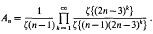
For example A3 ≑ 0·71975, A4 ≑ 0·8626, and An→1 as n → ∞.
Regular graphs with regular neighborhoods
-
- Journal:
- Glasgow Mathematical Journal / Volume 34 / Issue 2 / May 1992
- Published online by Cambridge University Press:
- 18 May 2009, pp. 215-218
-
- Article
-
- You have access
- Export citation
GMJ volume 40 issue 3 Cover and Back matter
-
- Journal:
- Glasgow Mathematical Journal / Volume 40 / Issue 3 / September 1998
- Published online by Cambridge University Press:
- 18 May 2009, pp. b1-b2
-
- Article
-
- You have access
- Export citation
On non-Hurwitz groups and non-congruence subgroups of the modular group
-
- Journal:
- Glasgow Mathematical Journal / Volume 22 / Issue 1 / January 1981
- Published online by Cambridge University Press:
- 18 May 2009, pp. 1-7
-
- Article
-
- You have access
- Export citation
GMJ volume 31 issue 3 Cover and Front matter
-
- Journal:
- Glasgow Mathematical Journal / Volume 31 / Issue 3 / September 1989
- Published online by Cambridge University Press:
- 18 May 2009, pp. f1-f2
-
- Article
-
- You have access
- Export citation
GMJ volume 34 issue 1 Cover and Back matter
-
- Journal:
- Glasgow Mathematical Journal / Volume 34 / Issue 1 / January 1992
- Published online by Cambridge University Press:
- 18 May 2009, pp. b1-b2
-
- Article
-
- You have access
- Export citation
