Refine search
Actions for selected content:
26063 results in Abstract analysis
Remarks on Weak Compactness in L1(μ,X)
-
- Journal:
- Glasgow Mathematical Journal / Volume 18 / Issue 1 / January 1977
- Published online by Cambridge University Press:
- 18 May 2009, pp. 87-91
-
- Article
-
- You have access
- Export citation
-
Let (Ω,Σ,μ) be a finite measure space and X a Banach space. Denote by L1 (μ,X) the Banach space of (equivalence classes of) μ-strongly measurable X-valued Bochner integrable functions f:Ω→X normed by
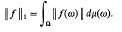
The problem of characterizing the relatively weakly compact subsets of L1(Ω, X) remains open. It is known that for a bounded subset of L1(μ, X) to be relatively weakly compact it is necessary that the set be uniformly integrable; recall that K ⊆ L1, (μ, X) is uniformly integrable whenever given ε >0 there exists δ > 0 such that if μ (E) ≦ δ then ∫E∥f∥ dμ ≦ δ, for all f ∈ K. S. Chatterji has noted that in case X is reflexive this condition is also sufficient [4]. At present unless one assumes that both X and X* have the Radon-Nikodym Property (see [1]), a rather severe restriction which, for purposes of potential applicability, is tantamount to assuming reflexivity, no good sufficient conditions for weak compactness in L1(μ, X) exist. This note puts forth such sufficient conditions; the basic tool is the recent factorization method of W. J. Davis, T. Figiel, W. B. Johnson and A. Pelczynski [3].
Two Notes on Matrices
-
- Journal:
- Proceedings of the Glasgow Mathematical Association / Volume 5 / Issue 3 / January 1962
- Published online by Cambridge University Press:
- 18 May 2009, pp. 109-113
-
- Article
-
- You have access
- Export citation
-
1. The properties of the circulant determinant or the circulant matrix are familiar. The circulant matrix C of order 4 x 4, with elements in the complex field, will serve for illustration.
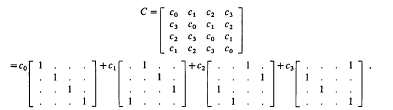
The four matrix coefficients of c0, c1 c2, c3 form a reducible matrix representation of the cyclic group ℐ4, so that C is a group matrix for this. Let ω be a primitive 4th root of 1. Then Ω as below, its columns being normalized latent vectors of C,
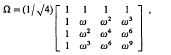
is unitary and symmetric, and reduces Cto diagonal form thus,
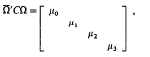
where the μr, the latent roots of C, are given by

All of the above extends naturally to the n x n case.
Sur une inégalité
-
- Journal:
- Proceedings of the Glasgow Mathematical Association / Volume 6 / Issue 1 / January 1963
- Published online by Cambridge University Press:
- 18 May 2009, pp. 1-10
-
- Article
-
- You have access
- Export citation
-
Dans cet article nous considerons l'inégalité

où les xi désignent les nombres réels qui remplissent les conditions suivantes

Cette inégalité est proposée par H. S. Shapiro [1].
Isomorphisms of multiplier algebras
-
- Journal:
- Glasgow Mathematical Journal / Volume 28 / Issue 1 / January 1986
- Published online by Cambridge University Press:
- 18 May 2009, pp. 73-77
-
- Article
-
- You have access
- Export citation
Duals of Banach spaces of entire functions
-
- Journal:
- Glasgow Mathematical Journal / Volume 32 / Issue 2 / May 1990
- Published online by Cambridge University Press:
- 18 May 2009, pp. 215-220
-
- Article
-
- You have access
- Export citation
-
Let w be a strictly positive function on ℂ and let
 , respectively
  denote the Banach spaces of those entire functions φ(z) with ∣φ(z)∣= O(w(z)) and ∣φ(z)∣ = o(w(z)). In this generality, these spaces may contain only constants, but for many functions w(z) these will be interesting Banach spaces with norm
 .
.We study two specific problems.
 , respectively
  denote the Banach spaces of those entire functions φ(z) with ∣φ(z)∣= O(w(z)) and ∣φ(z)∣ = o(w(z)). In this generality, these spaces may contain only constants, but for many functions w(z) these will be interesting Banach spaces with norm
On an integral equation
-
- Journal:
- Glasgow Mathematical Journal / Volume 15 / Issue 2 / September 1974
- Published online by Cambridge University Press:
- 18 May 2009, pp. 95-98
-
- Article
-
- You have access
- Export citation
-
We shall solve the equation

where 0 <a<b, and f(x) is a continuous function on the interval (a, b).
On the topological degree of real polynomial vector fields
-
- Journal:
- Glasgow Mathematical Journal / Volume 38 / Issue 2 / May 1996
- Published online by Cambridge University Press:
- 18 May 2009, pp. 221-231
-
- Article
-
- You have access
- Export citation
-
Let G: Rn → Rn be a continuous mapping such that the origin 0 ∈ Rn is isolated in G-1(0). Then deg0G will denote the local topological degree of G at the origin, i.e. the topological degree of the mapping
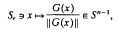
where Sr denotes a sphere in Rn centered at the origin with small radius r > 0.
On the cohomology of Fuchsian groups
-
- Journal:
- Glasgow Mathematical Journal / Volume 16 / Issue 2 / September 1975
- Published online by Cambridge University Press:
- 18 May 2009, pp. 123-140
-
- Article
-
- You have access
- Export citation
Results on common fixed points on complete metric spaces
-
- Journal:
- Glasgow Mathematical Journal / Volume 21 / Issue 2 / July 1980
- Published online by Cambridge University Press:
- 18 May 2009, pp. 165-167
-
- Article
-
- You have access
- Export citation
-
The following theorem was proved in [1].
Theorem 1. Let S and T be continuous, commuting mappings of a complete, bounded metric space (X, d) into itself satisfying the inequality

for all x, y in X, where 0 ≤ c < 1 and p, p′, q, q′ ≥ 0 are fixed integers with p + p′, q + q′ ≥ 1. Then S and T have a unique common fixed point z. Further, if p′ or q′ = 0, then z is the unique fixed point of S and if p or q = 0, then z is the unique fixed point of T.
Hecke invariants of knot groups
-
- Journal:
- Glasgow Mathematical Journal / Volume 15 / Issue 1 / March 1974
- Published online by Cambridge University Press:
- 18 May 2009, pp. 17-26
-
- Article
-
- You have access
- Export citation
Factorization and bounded approximate identities for a class of convolution Banach algebras
-
- Journal:
- Glasgow Mathematical Journal / Volume 28 / Issue 2 / July 1986
- Published online by Cambridge University Press:
- 18 May 2009, pp. 211-214
-
- Article
-
- You have access
- Export citation
Infinite integrals involving products of Legendre functions
-
- Journal:
- Proceedings of the Glasgow Mathematical Association / Volume 3 / Issue 3 / December 1957
- Published online by Cambridge University Press:
- 18 May 2009, pp. 111-118
-
- Article
-
- You have access
- Export citation
Finite 3-groups acting on bordered surfaces†
-
- Journal:
- Glasgow Mathematical Journal / Volume 40 / Issue 3 / September 1998
- Published online by Cambridge University Press:
- 18 May 2009, pp. 463-472
-
- Article
-
- You have access
- Export citation
On Differences of Unitarily Equivalent Self-Adjoint Operators†
-
- Journal:
- Proceedings of the Glasgow Mathematical Association / Volume 4 / Issue 3 / January 1960
- Published online by Cambridge University Press:
- 18 May 2009, pp. 103-107
-
- Article
-
- You have access
- Export citation
-
1. All operators considered in this paper are bounded operators on a Hilbert space. In case A and B are self-adjoint, certain conditions on A, B and their difference

assuring the unitary equivalence of Aand B,

have recently been obtained by Rosenblum [6] and Kato [2]. The present paper will consider the problem of investigating consequences of an assumed relation of type (2) for some unitary U together with an additional hypothesis that the difference H of (1) be non-negative, so that

First, it is easy to see that if only (2) and (3) are assumed, thereby allowing H = 0, relation (2) can hold for A arbitrary with U = I (identity) and B = A. If H = 0 in (3) is not allowed, however (an impossible assumption in the finite dimensional case, incidentally, since then the trace of H is zero and hence H = 0), it will be shown, among other things, that any unitary operator U for which (2) and (3) hold must have a spectrum with a positive measure (as a consequence of (i) of Theorem 2 below). Moreover A (hence B) cannot differ from a completely continuous operator by a constant multiple of the identity (Theorem 1). In case 0 is not in the point spectrum of H, then U is even absolutely continuous (see (iv) of Theorem 2). In § 4, applications to semi-normal operators will be given.
On images and inverse images of Weierstrass points†
-
- Journal:
- Glasgow Mathematical Journal / Volume 19 / Issue 2 / July 1978
- Published online by Cambridge University Press:
- 18 May 2009, pp. 125-128
-
- Article
-
- You have access
- Export citation
-
The classical theory of Weierstrass points on a compact Riemann surface is well-known (see, for example, [3]). Ogawa [6] has defined generalized Weierstrass points. Let Y denote a compact complex manifold of (complex) dimension n. Let E denote a holomorphic vector bundle on Y of rank q. Let Jk(E) (k = 0, 1, …) denote the holomorphic vector bundle of k-jets of E [2, p. 112]. Put rk(E) = rank Jk(E) = q.(n + k)!/n!k!. Suppose that Γ(E), the vector space of global holomorphic sections of E, is of dimension γ(E)>0. Consider the trivial bundle Y × Γ(E) and the map
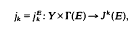
which at a point Q∈Y takes a section of E to its k-jet at Q. Put μ = min(γ(E),rk(E)).
Associate subgroups of orthodox semigroups
-
- Journal:
- Glasgow Mathematical Journal / Volume 36 / Issue 2 / May 1994
- Published online by Cambridge University Press:
- 18 May 2009, pp. 163-171
-
- Article
-
- You have access
- Export citation
An extension of a theorem of Gordon
-
- Journal:
- Proceedings of the Glasgow Mathematical Association / Volume 7 / Issue 1 / January 1965
- Published online by Cambridge University Press:
- 18 May 2009, pp. 39-41
-
- Article
-
- You have access
- Export citation
-
In what follows all small Latin letters denote non-negative integers or functions whose values are non-negative integers. Let N = (n1, …, nj) be a j-dimensional vector and let q = q (k; N) = q(k; n1, …, nj) be the number of partitions of N into just k parts, each part being a vector whose components are non-negative integers. We write

for the generating function of q. We have
 .
.

GMJ volume 2 issue 3 Cover and Front matter
-
- Journal:
- Proceedings of the Glasgow Mathematical Association / Volume 2 / Issue 3 / July 1955
- Published online by Cambridge University Press:
- 18 May 2009, pp. f1-f2
-
- Article
-
- You have access
- Export citation
Localization in non-Noetherian group rings
-
- Journal:
- Glasgow Mathematical Journal / Volume 21 / Issue 2 / July 1980
- Published online by Cambridge University Press:
- 18 May 2009, pp. 151-163
-
- Article
-
- You have access
- Export citation
Finite abelian actions on surfaces
-
- Journal:
- Glasgow Mathematical Journal / Volume 35 / Issue 2 / May 1993
- Published online by Cambridge University Press:
- 18 May 2009, pp. 225-234
-
- Article
-
- You have access
- Export citation
