Refine search
Actions for selected content:
26063 results in Abstract analysis
Right fully idempotent rings need not be left fully idempotent
-
- Journal:
- Glasgow Mathematical Journal / Volume 37 / Issue 2 / May 1995
- Published online by Cambridge University Press:
- 18 May 2009, pp. 155-157
-
- Article
-
- You have access
- Export citation
Flows on hypermaps
-
- Journal:
- Glasgow Mathematical Journal / Volume 30 / Issue 1 / January 1988
- Published online by Cambridge University Press:
- 18 May 2009, pp. 17-29
-
- Article
-
- You have access
- Export citation
On Peiffer central series
-
- Journal:
- Glasgow Mathematical Journal / Volume 40 / Issue 2 / May 1998
- Published online by Cambridge University Press:
- 18 May 2009, pp. 177-185
-
- Article
-
- You have access
- Export citation
Represéntations Galoisiennes paires
-
- Journal:
- Glasgow Mathematical Journal / Volume 27 / October 1985
- Published online by Cambridge University Press:
- 18 May 2009, pp. 223-237
-
- Article
-
- You have access
- Export citation
-
On présente des exemples de représentations de
 de dimension 2, de déterminant pair, qui sont de type diédral (I) ou de conducteur premier et de type quelconque (II), en imitant la construction de Tate (Serre [11]) de représentations de déterminant impair.
 de dimension 2, de déterminant pair, qui sont de type diédral (I) ou de conducteur premier et de type quelconque (II), en imitant la construction de Tate (Serre [11]) de représentations de déterminant impair.
An extension of a theorem on the equivalence between absolute Rieszian and absolute Cesàro summability
-
- Journal:
- Proceedings of the Glasgow Mathematical Association / Volume 4 / Issue 2 / July 1959
- Published online by Cambridge University Press:
- 18 May 2009, pp. 81-83
-
- Article
-
- You have access
- Export citation
-
 be a given series and let
With Flett [4], we say that the series is summable
 , q real, if
where
 Summability |C, k, 0|1 is identical with absolute Cesàro summability (C, k), or summability |C, k|, as defined by Fekete [3].
 be a given series and let
 , q real, if
 Summability |C, k, 0|
Defining-relations for Hurwitz groups
-
- Journal:
- Glasgow Mathematical Journal / Volume 36 / Issue 3 / September 1994
- Published online by Cambridge University Press:
- 18 May 2009, pp. 363-370
-
- Article
-
- You have access
- Export citation
GMJ volume 6 issue 3 Cover and Back matter
-
- Journal:
- Proceedings of the Glasgow Mathematical Association / Volume 6 / Issue 3 / January 1964
- Published online by Cambridge University Press:
- 18 May 2009, pp. b1-b2
-
- Article
-
- You have access
- Export citation
Some Results involving Hypergeometric and E-Functions
-
- Journal:
- Proceedings of the Glasgow Mathematical Association / Volume 2 / Issue 3 / July 1955
- Published online by Cambridge University Press:
- 18 May 2009, pp. 132-138
-
- Article
-
- You have access
- Export citation
-
Recently R. S. Varma [11] gave the generalisation

for the Laplace transform

Since

(1) gives (2) when k = − m + ½.
We shall represent (1) by

and as usual, (2) will be denoted by


Commutator length of abelian-by-nilpotent groups
-
- Journal:
- Glasgow Mathematical Journal / Volume 40 / Issue 1 / March 1998
- Published online by Cambridge University Press:
- 18 May 2009, pp. 117-121
-
- Article
-
- You have access
- Export citation
Pythagorean ratios in arithmetic progression, part II. Four Pythagorean ratios
-
- Journal:
- Glasgow Mathematical Journal / Volume 36 / Issue 1 / January 1994
- Published online by Cambridge University Press:
- 18 May 2009, pp. 45-55
-
- Article
-
- You have access
- Export citation
Groups with few non-nilpotent subgroups
-
- Journal:
- Glasgow Mathematical Journal / Volume 39 / Issue 2 / May 1997
- Published online by Cambridge University Press:
- 18 May 2009, pp. 141-151
-
- Article
-
- You have access
- Export citation
Primary decompositions over domains
-
- Journal:
- Glasgow Mathematical Journal / Volume 38 / Issue 3 / September 1996
- Published online by Cambridge University Press:
- 18 May 2009, pp. 321-326
-
- Article
-
- You have access
- Export citation
A non-smooth extension of Frechet differentiability of the norm with applications to numerical ranges
-
- Journal:
- Glasgow Mathematical Journal / Volume 28 / Issue 2 / July 1986
- Published online by Cambridge University Press:
- 18 May 2009, pp. 121-137
-
- Article
-
- You have access
- Export citation
-
The following result in the theory of numerical ranges in Banach algebras is well known (see [3, Theorem 12.2]). The numerical range of an element F in the bidual
 of a unital Banach algebra A is the closure of the set of values at F of the w*-continuous states of . As a consequence of the results in this paper the following
 of a unital Banach algebra A is the closure of the set of values at F of the w*-continuous states of
 On entire functions with gap power series
-
- Journal:
- Glasgow Mathematical Journal / Volume 12 / Issue 2 / September 1971
- Published online by Cambridge University Press:
- 18 May 2009, pp. 89-97
-
- Article
-
- You have access
- Export citation
-
In this note we consider transcendental entire functions

whose power series contain gaps, i.e.

where Λ = {λk} is a suitable set of positive integers. We denote the set of all such functions f(z) by E(Λ). As usual M(r) = M(r, f) denotes the maximummodulus of f(z) on the circle |z| = r. The order p and the lower order λ of f(z) are defined by
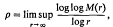
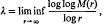
respectively.
Sur une question de localisation
-
- Journal:
- Glasgow Mathematical Journal / Volume 22 / Issue 2 / July 1981
- Published online by Cambridge University Press:
- 18 May 2009, pp. 137-139
-
- Article
-
- You have access
- Export citation
-
II est connu [4] que si A = U(
 ) est l'algèbre enveloppante d'une algèbre de Lie nilpotente de dimension finie sur un corps F de caractéristique 0, tout idéal (complètement) premier P a pourlocalisé R = Ap un anneau régulier au sens de [5]; c'est-à-dire que le radical de Jacobson
  de R est engendrè par une suite centralisante régulière de longueur n = K-dim R, soit (z1…, zn). Dans le cas très particulier où P est l'idéal d'augmentation de U() il suffit de prendre pour (z1…, zn) l'image dans U()p d'une base de sur F adaptée à la suite centrale ascendante de .
 ) est l'algèbre enveloppante d'une algèbre de Lie nilpotente
  de R est engendrè par une suite centralisante régulière de longueur n = K-dim R, soit (z
GMJ volume 16 issue 2 Cover and Front matter
-
- Journal:
- Glasgow Mathematical Journal / Volume 16 / Issue 2 / September 1975
- Published online by Cambridge University Press:
- 18 May 2009, pp. f1-f6
-
- Article
-
- You have access
- Export citation
Automatic continuity of certain isomorphisms between regular Banach function algebras
-
- Journal:
- Glasgow Mathematical Journal / Volume 39 / Issue 3 / September 1997
- Published online by Cambridge University Press:
- 18 May 2009, pp. 333-343
-
- Article
-
- You have access
- Export citation
GMJ volume 7 issue 2 Cover and Front matter
-
- Journal:
- Proceedings of the Glasgow Mathematical Association / Volume 7 / Issue 2 / July 1965
- Published online by Cambridge University Press:
- 18 May 2009, pp. f1-f2
-
- Article
-
- You have access
- Export citation
On weak approximation and convexification in weighted spaces of vector-valued continuous functions
-
- Journal:
- Glasgow Mathematical Journal / Volume 31 / Issue 1 / January 1989
- Published online by Cambridge University Press:
- 18 May 2009, pp. 59-64
-
- Article
-
- You have access
- Export citation
-
Let X be a completely regular Hausdorff space. A Nachbin family of weights is a set V of upper-semicontinuous positive functions on X such that if u, υ ∈ V then there exists w ∈ V and t > 0 so that u, υ ≤ tw. For any Hausdorff topological vector space E, the weighted space CV0(X, E) is the space of all E-valued continuous functions f on X such that υf vanishes at infinity for all υ ∈ V. CV0(X, E) is equipped with the weighted topologywv = wv(X, E) which has as a base of neighbourhoods of zero the family of all sets of the form

where υ ∈ Vand W is a neighbourhood of zero in E. If E is the scalar field, then the space CV0(X, E) is denoted by CV0(X). The reader is referred to [4, 6, 8] for information on weighted spaces.
On groups which are the product of abelian subgroups
-
- Journal:
- Glasgow Mathematical Journal / Volume 26 / Issue 2 / July 1985
- Published online by Cambridge University Press:
- 18 May 2009, pp. 151-156
-
- Article
-
- You have access
- Export citation
-
If the group G=AB is the product of two abelian subgroups A and B, then G is metabelian by a well-known result of Itô [8], so that the commutator subgroup G' of G is abelian. In the following we are concerned with the following condition:
There exists a normal subgroup

which is contained in A or B.
Recently, Holt and Howlett in [7] have given an example of a countably infinite p-group G = AB, which is the product of two elementary abelian subgroups A and B with Core(A) = Core (B) = 1, so that in this group (*) does not hold. Also, Sysak in [13] gives an example of a product G = AB of two free abelian subgroups A and B with Core(A)=Core(B)=l.
