Refine search
Actions for selected content:
26070 results in Abstract analysis
Perfect codes in the graphs Ok and L(Ok)
-
- Journal:
- Glasgow Mathematical Journal / Volume 21 / Issue 2 / July 1980
- Published online by Cambridge University Press:
- 18 May 2009, pp. 169-172
-
- Article
-
- You have access
- Export citation
GMJ volume 10 issue 2 Cover and Back matter
-
- Journal:
- Glasgow Mathematical Journal / Volume 10 / Issue 2 / July 1969
- Published online by Cambridge University Press:
- 18 May 2009, pp. b1-b2
-
- Article
-
- You have access
- Export citation
Categorical universality of regular double p-algebras
-
- Journal:
- Glasgow Mathematical Journal / Volume 32 / Issue 3 / September 1990
- Published online by Cambridge University Press:
- 18 May 2009, pp. 329-340
-
- Article
-
- You have access
- Export citation
Embeddings of nonorientable surfaces with totally reducible focal set
-
- Journal:
- Glasgow Mathematical Journal / Volume 36 / Issue 1 / January 1994
- Published online by Cambridge University Press:
- 18 May 2009, pp. 11-16
-
- Article
-
- You have access
- Export citation
On certain relations between products of bilateral hypergeometric series
-
- Journal:
- Proceedings of the Glasgow Mathematical Association / Volume 3 / Issue 3 / December 1957
- Published online by Cambridge University Press:
- 18 May 2009, pp. 141-144
-
- Article
-
- You have access
- Export citation
-
Darling [3] in 1932 and Bailey [2] in 1933 gave certain theorems on products of hypergeometric series. Again in 1948 Sears [4] used the relation which expresses the
 series in terms of M other series of the same type to derive transformations between products of both basic and ordinary hypergeometric series. In this paper I give certain general theorems on products of bilateral hypergeometric series together with some of their interesting special cases.
 series in terms of M other series of the same type to derive transformations between products of both basic and ordinary hypergeometric series. In this paper I give certain general theorems on products of bilateral hypergeometric series together with some of their interesting special cases.
Toeplitz operators and algebras of bounded analytic functions on the disk
-
- Journal:
- Glasgow Mathematical Journal / Volume 33 / Issue 2 / May 1991
- Published online by Cambridge University Press:
- 18 May 2009, pp. 181-185
-
- Article
-
- You have access
- Export citation
-
Here and throughout, A is a closed subalgebra of H∞ that contains the disk algebra and M(A) denotes the maximal ideal space of A. Because A contains the function fo(z) = z, we can define the fiber Mλ(A) of M(A) for λ ε ∂D (the unit circle) in the usual way; i.e., Mλ(A) = {φ ∈ M(A): fo(φ) = λ}. The Bergman space
 of the unit disk D is the L2(D, dx dy)-closure of A. Let
  be the orthogonal projection. For f ∈ L∞(D, dx dy), define the multiplication operator Mf: L2(D, dx dy)→ L2, (D, dx dy) by
and define the Toeplitz operator
 by
by
 of the unit disk D is the L
 be the orthogonal projection. For f ∈ L
 by
by
Some projective representations of finite abelian groups
-
- Journal:
- Glasgow Mathematical Journal / Volume 29 / Issue 2 / July 1987
- Published online by Cambridge University Press:
- 18 May 2009, pp. 197-203
-
- Article
-
- You have access
- Export citation
-
In this paper, we continue the work initiated by Morris [5] and Saeed-ul-Islam [6,7] and determine complete sets of inequivalent irreducible projective representations (which we shall write as i.p.r.) of finite Abelian groups with respect to some additional factor sets.
We consider an Abelian group

which will be referred to as an Abelian group of type (a1, …, am).
GMJ volume 25 issue 1 Cover and Back matter
-
- Journal:
- Glasgow Mathematical Journal / Volume 25 / Issue 1 / January 1984
- Published online by Cambridge University Press:
- 18 May 2009, p. b1
-
- Article
-
- You have access
- Export citation
Semigroup identities on units of integral group rings
-
- Journal:
- Glasgow Mathematical Journal / Volume 39 / Issue 1 / January 1997
- Published online by Cambridge University Press:
- 18 May 2009, pp. 1-6
-
- Article
-
- You have access
- Export citation
The semigroup of doubly-stochastic matrices
-
- Journal:
- Proceedings of the Glasgow Mathematical Association / Volume 7 / Issue 4 / July 1966
- Published online by Cambridge University Press:
- 18 May 2009, pp. 178-183
-
- Article
-
- You have access
- Export citation
Boundaries of nonpositively curved groups of the form G × ℤn
-
- Journal:
- Glasgow Mathematical Journal / Volume 38 / Issue 2 / May 1996
- Published online by Cambridge University Press:
- 18 May 2009, pp. 177-189
-
- Article
-
- You have access
- Export citation
On the asymptotic behaviour of nonlinear systems of ordinary differential equations
-
- Journal:
- Glasgow Mathematical Journal / Volume 26 / Issue 2 / July 1985
- Published online by Cambridge University Press:
- 18 May 2009, pp. 161-170
-
- Article
-
- You have access
- Export citation
-
In this paper we study the asymptotic behaviour of the following systems of ordinary differential equations:
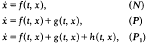
where the identically zero function is a solution of (N) i.e. f(t, 0)=0 for all time t. Suppose one knows that all the solutions of (N) which start near zero remain near zero for all future time or even that they approach zero as time increases. For the perturbed systems (P) and (P1) the above property concerning the solutions near zero may or may not remain true. A more precise formulation of this problem is as follows: if zero is stable or asymptotically stable for (N), and if the functions g(t, x) and h(t, x) are small in some sense, give conditions on f(t, x) so that zero is (eventually) stable or asymptotically stable for (P) and (P1).
Simultaneous Extension of Partial Endomorphisms of Groups
-
- Journal:
- Proceedings of the Glasgow Mathematical Association / Volume 2 / Issue 1 / April 1954
- Published online by Cambridge University Press:
- 18 May 2009, pp. 37-46
-
- Article
-
- You have access
- Export citation
GMJ volume 24 issue 2 Cover and Front matter
-
- Journal:
- Glasgow Mathematical Journal / Volume 24 / Issue 2 / July 1983
- Published online by Cambridge University Press:
- 18 May 2009, pp. f1-f2
-
- Article
-
- You have access
- Export citation
Isometric representation of M(G) on B(H)
-
- Journal:
- Glasgow Mathematical Journal / Volume 23 / Issue 2 / July 1982
- Published online by Cambridge University Press:
- 18 May 2009, pp. 119-122
-
- Article
-
- You have access
- Export citation
Matrix transformations of some sequence spaces—II
-
- Journal:
- Glasgow Mathematical Journal / Volume 11 / Issue 2 / July 1970
- Published online by Cambridge University Press:
- 18 May 2009, pp. 162-166
-
- Article
-
- You have access
- Export citation
-
This paper is a continuation of [1]. We begin with the notations for the sequence spaces considered in this paper. Let Γ be the space of sequences x = {xp} of complex numbers such that |xp|1/p⃗0 as p⃗∞. Γ can also be regarded as the space of integral functions f(z) =
 . The sequence space Γ is a vector space over the complex numbers with seminorms
 . The sequence space Γ is a vector space over the complex numbers with seminorms
Mean curvature and shape operator of isometric immersions in real-space-forms
-
- Journal:
- Glasgow Mathematical Journal / Volume 38 / Issue 1 / January 1996
- Published online by Cambridge University Press:
- 18 May 2009, pp. 87-97
-
- Article
-
- You have access
- Export citation
Asymmetry in the lattice of kernel functors
-
- Journal:
- Glasgow Mathematical Journal / Volume 33 / Issue 1 / January 1991
- Published online by Cambridge University Press:
- 18 May 2009, pp. 95-97
-
- Article
-
- You have access
- Export citation
-
Much of the research done by different authors on the lattice of kernel functors (equivalently, linear topologies) has been summarized by Golan in [2]. More recently, the rings whose lattices of kernel functors are linearly ordered were introduced in [3] as a categorical generalization of valuation rings in the non-commutative case. Results (and examples) in [3] show that there is an abundance of non-commutative rings R whose lattices
 (R), both in Mod-R and R-Mod, are simultaneously linearly ordered; however, the question of the symmetry of this condition remained open. Here we will prove that, for every natural number n≥3, there exists a ring Rn such that (Mod-Rn) is a linearly ordered lattice of n elements, whereas (Rn-Mod) is not linearly ordered.
 (R), both in Mod-R and R-Mod, are simultaneously linearly ordered; however, the question of the symmetry of this condition remained open. Here we will prove that, for every natural number n≥3, there exists a ring R
The distribution of cube-full numbers
-
- Journal:
- Glasgow Mathematical Journal / Volume 33 / Issue 3 / September 1991
- Published online by Cambridge University Press:
- 18 May 2009, pp. 287-295
-
- Article
-
- You have access
- Export citation
On univalent polynomials
-
- Journal:
- Glasgow Mathematical Journal / Volume 11 / Issue 2 / July 1970
- Published online by Cambridge University Press:
- 18 May 2009, pp. 102-107
-
- Article
-
- You have access
- Export citation
-
Let Pn be the class of normalised polynomials of the form

of degree n which are univalent in U = {|z| < 1}. In this note we discuss the coefficients of polynomials in Pn and in some of its subclasses.
