Refine search
Actions for selected content:
26076 results in Abstract analysis
On the closed graph theorem
-
- Journal:
- Glasgow Mathematical Journal / Volume 17 / Issue 2 / July 1976
- Published online by Cambridge University Press:
- 18 May 2009, pp. 89-97
-
- Article
-
- You have access
- Export citation
A note on regular local Noether lattices
-
- Journal:
- Glasgow Mathematical Journal / Volume 15 / Issue 2 / September 1974
- Published online by Cambridge University Press:
- 18 May 2009, pp. 159-161
-
- Article
-
- You have access
- Export citation
On a dual integral equation with a trigonometric kernel
-
- Journal:
- Glasgow Mathematical Journal / Volume 18 / Issue 2 / July 1977
- Published online by Cambridge University Press:
- 18 May 2009, pp. 175-177
-
- Article
-
- You have access
- Export citation
-
In this note we formally solve the following dual integral equations:


where h is a constant and the Fourier cosine transform of u–1 φ(u) is assumed to exist. These dual equations arise in a crack problem in elasticity theory.

Congruences and Green's relations on regular semigroups
-
- Journal:
- Glasgow Mathematical Journal / Volume 13 / Issue 2 / September 1972
- Published online by Cambridge University Press:
- 18 May 2009, pp. 167-175
-
- Article
-
- You have access
- Export citation
Representations of rank one algebraic monoids
-
- Journal:
- Glasgow Mathematical Journal / Volume 30 / Issue 2 / May 1988
- Published online by Cambridge University Press:
- 18 May 2009, pp. 237-241
-
- Article
-
- You have access
- Export citation
A characterization of normed M-spaces
-
- Journal:
- Glasgow Mathematical Journal / Volume 24 / Issue 1 / January 1983
- Published online by Cambridge University Press:
- 18 May 2009, pp. 89-92
-
- Article
-
- You have access
- Export citation
The principal ideal theorem in prime Noetherian rings
-
- Journal:
- Glasgow Mathematical Journal / Volume 28 / Issue 1 / January 1986
- Published online by Cambridge University Press:
- 18 May 2009, pp. 63-68
-
- Article
-
- You have access
- Export citation
Strong bands of groups of left quotients
-
- Journal:
- Glasgow Mathematical Journal / Volume 38 / Issue 2 / May 1996
- Published online by Cambridge University Press:
- 18 May 2009, pp. 237-242
-
- Article
-
- You have access
- Export citation
-
An interesting concept of semigroups (and also rings) of (left) quotients, based on the notion of group inverse in a semigroup, was developed by J. B. Fountain, V. Gould and M. Petrich, in a series of papers (see [5]-[12]). Among the most interesting are semigroups having a semigroup of (left) quotients that is a union of groups. Such semigroups have been widely studied. Recall from [3] that a semigroup has a group of left quotients if and only if it is right reversible and cancellative. A more general result was obtained by V. Gould [10]. She proved that a semigroup has a semilattice of groups as its semigroup of left quotients if and only if it is a semilattice of right reversible, cancellative semigroups. This result has been since generalized by A. El-Qallali [4]. He proved that a semigroup has a left regular band of groups as its semigroup of left quotients if and only if it is a left regular band of right reversible, cancellative semigroups. Moreover, he proved that such semigroups can be also characterised as punched spined products of a left regular band and a semilattice of right reversible, cancellative semigroups. If we consider the proofs of their theorems, we will observe that the principal problem treated there can be formulated in the following way: Given a semigroup S that is a band B of right reversible, cancellative semigroups Si, i ε B, to each Si, we can associate its group of left quotients Gi. When is it possible to define a multiplication of
 such that Q becomes a semigroup having S as its left order, and especially, that Q becomes a band B of groups Gi, i E B?Applying the methods developed in [1] (see also [2]), in the present paper we show how this problem can be solved for Qto become a strong band of groups (that is in fact a band of groups whose idempotents form a subsemigroup, by [16, Theorem 2]. Moreover, we show how Gould's and El-Quallali's constructions of semigroups of left quotients of a semilattice and a left regular band of right reversible, cancellative semigroups, can be simplified.
 such that Q becomes a semigroup having S as its left order, and especially, that Q becomes a band B of groups G
Representation of primes by binary quadratic forms of discriminant –256q and –128q
-
- Journal:
- Glasgow Mathematical Journal / Volume 35 / Issue 2 / May 1993
- Published online by Cambridge University Press:
- 18 May 2009, pp. 261-268
-
- Article
-
- You have access
- Export citation
-
Recently, P. Kaplan and K. S. Williams [10] considered (as an example) the representation of primes by binary quadratic forms of discriminant –768. These forms fall into 4 genera, each consisting of two classes. In particular, they considered the forms
F=3X2+642 and G = 12X2+12XY+19Y2.
It follows from genus theory (as explained in [10]) that every prime p ≡ 19 mod 24 is represented by exactly one of the forms F and G. Based on numerical data, they conjectured that a prime p ≡ 19 mod 24 is represented by
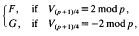
where
Vo = 2, V1 = -4, Vn+2=-4Vn+1 -Vn (n∨0).
Clifford algebras and isotropes
-
- Journal:
- Glasgow Mathematical Journal / Volume 29 / Issue 2 / July 1987
- Published online by Cambridge University Press:
- 18 May 2009, pp. 249-257
-
- Article
-
- You have access
- Export citation
GMJ volume 1 issue 1 Cover and Front matter
-
- Journal:
- Proceedings of the Glasgow Mathematical Association / Volume 1 / Issue 1 / January 1952
- Published online by Cambridge University Press:
- 18 May 2009, pp. f1-f7
-
- Article
-
- You have access
- Export citation
On the nonexistence of Lp solutions of certain nonlinear differential equations
-
- Journal:
- Glasgow Mathematical Journal / Volume 8 / Issue 2 / July 1967
- Published online by Cambridge University Press:
- 18 May 2009, pp. 133-138
-
- Article
-
- You have access
- Export citation
Order and norm convergence in Banach lattices
-
- Journal:
- Glasgow Mathematical Journal / Volume 15 / Issue 1 / March 1974
- Published online by Cambridge University Press:
- 18 May 2009, p. 13
-
- Article
-
- You have access
- Export citation
A Note on Some Inequalities
-
- Journal:
- Proceedings of the Glasgow Mathematical Association / Volume 4 / Issue 1 / December 1958
- Published online by Cambridge University Press:
- 18 May 2009, pp. 7-15
-
- Article
-
- You have access
- Export citation
GMJ volume 29 issue 1 Cover and Back matter
-
- Journal:
- Glasgow Mathematical Journal / Volume 29 / Issue 1 / January 1987
- Published online by Cambridge University Press:
- 18 May 2009, p. b1
-
- Article
-
- You have access
- Export citation
The spectral theorem in Banach algebras
-
- Journal:
- Glasgow Mathematical Journal / Volume 13 / Issue 1 / March 1972
- Published online by Cambridge University Press:
- 18 May 2009, pp. 49-55
-
- Article
-
- You have access
- Export citation
Characterization of affine ruled surfaces
-
- Journal:
- Glasgow Mathematical Journal / Volume 39 / Issue 1 / January 1997
- Published online by Cambridge University Press:
- 18 May 2009, pp. 17-20
-
- Article
-
- You have access
- Export citation
Associated Basic Hypergeometric Series
-
- Journal:
- Proceedings of the Glasgow Mathematical Association / Volume 1 / Issue 4 / December 1953
- Published online by Cambridge University Press:
- 18 May 2009, pp. 182-184
-
- Article
-
- You have access
- Export citation
Curves with zero derivative in F-spaces
-
- Journal:
- Glasgow Mathematical Journal / Volume 22 / Issue 1 / January 1981
- Published online by Cambridge University Press:
- 18 May 2009, pp. 19-29
-
- Article
-
- You have access
- Export citation
-
Let X be an F-space (complete metric linear space) and suppose g:[0, 1] → X is a continuous map. Suppose that g has zero derivative on [0, 1], i.e.

for 0≤t≤1 (we take the left and right derivatives at the end points). Then, if X is locally convex or even if it merely possesses a separating family of continuous linear functionals, we can conclude that g is constant by using the Mean Value Theorem. If however X* = {0} then it may happen that g is not constant; for example, let X = Lp(0, 1) (0≤p≤1) and g(t) = l[0,t] (0≤t≤1) (the characteristic function of [0, t]). This example is due to Rolewicz [6], [7; p. 116].
Abstract integral spaces and minimal extensions
-
- Journal:
- Glasgow Mathematical Journal / Volume 12 / Issue 2 / September 1971
- Published online by Cambridge University Press:
- 18 May 2009, pp. 166-178
-
- Article
-
- You have access
- Export citation
