Refine search
Actions for selected content:
26076 results in Abstract analysis
GMJ volume 33 issue 2 Cover and Back matter
-
- Journal:
- Glasgow Mathematical Journal / Volume 33 / Issue 2 / May 1991
- Published online by Cambridge University Press:
- 18 May 2009, pp. b1-b2
-
- Article
-
- You have access
- Export citation
Uniform distribution of sequences in rings of integral quaternions
-
- Journal:
- Glasgow Mathematical Journal / Volume 23 / Issue 1 / January 1982
- Published online by Cambridge University Press:
- 18 May 2009, pp. 21-29
-
- Article
-
- You have access
- Export citation
Some recurrence relations and series for the generalised laplace transform
-
- Journal:
- Proceedings of the Glasgow Mathematical Association / Volume 4 / Issue 3 / January 1960
- Published online by Cambridge University Press:
- 18 May 2009, pp. 119-121
-
- Article
-
- You have access
- Export citation
-
The Laplace transform

has been generalised by Varma [4] by the relation

which reduces to (1.1) when k = -m + ½ by virtue of the identity

We shall define πk, m, λ (p) by the relation

The object of this paper is to obtain some recurrence formulae and series for πk, m, λ (p) and to use them to obtain recurrence formulae and series for MacRobert's E-function.
A note on Saleh's paper ‘Almost continuity implies closure continuity’†
-
- Journal:
- Glasgow Mathematical Journal / Volume 40 / Issue 3 / September 1998
- Published online by Cambridge University Press:
- 18 May 2009, p. 473
-
- Article
-
- You have access
- Export citation
Linear fractional transforms of companion matrices
-
- Journal:
- Glasgow Mathematical Journal / Volume 20 / Issue 2 / July 1979
- Published online by Cambridge University Press:
- 18 May 2009, pp. 129-132
-
- Article
-
- You have access
- Export citation
-
Questions about polynomials can be turned into questions about matrices by associating with the polynomial

(over an arbitrary field) its companion matrix

which has p/an as its characteristic polynomial. This technique is often used in stability theory, as indicated in [1]; companion matrices also occur in the theory of the rational canonical form.
Coperfect monoids
-
- Journal:
- Glasgow Mathematical Journal / Volume 29 / Issue 1 / January 1987
- Published online by Cambridge University Press:
- 18 May 2009, pp. 73-88
-
- Article
-
- You have access
- Export citation
-
Throughout this paper S will denote a given monoid, that is, a semigroup with an identity. A set A is a right S-system if there is a map φ: A × S → A satisfying

for any element a of A and any elements s, t of S. For φ(a, s) we write as and we refer to right S-systems simply as S-systems. One has the obvious definitions of an S-subsystem and an S-homomorphism.
Jacobi elliptic algebras of SO(3)
-
- Journal:
- Glasgow Mathematical Journal / Volume 39 / Issue 1 / January 1997
- Published online by Cambridge University Press:
- 18 May 2009, pp. 115-120
-
- Article
-
- You have access
- Export citation
Polynomially bounded multisequences and analytic continuation
-
- Journal:
- Glasgow Mathematical Journal / Volume 23 / Issue 1 / January 1982
- Published online by Cambridge University Press:
- 18 May 2009, pp. 41-52
-
- Article
-
- You have access
- Export citation
-
Given a polynomially bounded multisequence {fm}, where m = (m1, …, mk) ∈ ℤk, we will consider 2k power series in exp(iz1), …, exp(izk), each representing a holomorphic function within its domain of convergence. We will consider this same multisequence as a linear functional on a class of functions defined on the k-dimensional torus by a Fourier series,
 , with the proper convergence criteria. We shall discuss the relationships that exist between the linear functional properties of the multisequence and the analytic continuation of the holomorphic functions. With this approach we show that a necessary and sufficient condition that the multisequence be given by a polynomial is that each of the power series represents, up to a unit factor, the same function that is entire in the variables
 , with the proper convergence criteria. We shall discuss the relationships that exist between the linear functional properties of the multisequence and the analytic continuation of the holomorphic functions. With this approach we show that a necessary and sufficient condition that the multisequence be given by a polynomial is that each of the power series represents, up to a unit factor, the same function that is entire in the variables
Algebras of bounded finite dimensional representation type
-
- Journal:
- Glasgow Mathematical Journal / Volume 37 / Issue 3 / September 1995
- Published online by Cambridge University Press:
- 18 May 2009, pp. 289-302
-
- Article
-
- You have access
- Export citation
GMJ volume 25 issue 1 Cover and Front matter
-
- Journal:
- Glasgow Mathematical Journal / Volume 25 / Issue 1 / January 1984
- Published online by Cambridge University Press:
- 18 May 2009, pp. f1-f7
-
- Article
-
- You have access
- Export citation
Minimum topological genus of compact bordered Klein surfaces admitting a prime-power automorphism
-
- Journal:
- Glasgow Mathematical Journal / Volume 37 / Issue 2 / May 1995
- Published online by Cambridge University Press:
- 18 May 2009, pp. 221-232
-
- Article
-
- You have access
- Export citation
Spectral decomposition of spherical immersions with respect to the Jacobi operator
-
- Journal:
- Glasgow Mathematical Journal / Volume 40 / Issue 2 / May 1998
- Published online by Cambridge University Press:
- 18 May 2009, pp. 205-212
-
- Article
-
- You have access
- Export citation
An Expansion in Terms of Associated Legendre Functions
-
- Journal:
- Proceedings of the Glasgow Mathematical Association / Volume 1 / Issue 1 / January 1952
- Published online by Cambridge University Press:
- 18 May 2009, pp. 13-15
-
- Article
-
- You have access
- Export citation
-
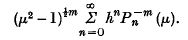
If the right-hand side of the expansion

is integrated m times from 1 to µ, it becomes
Unique factorization in Cayley arithmetics and cryptology
-
- Journal:
- Glasgow Mathematical Journal / Volume 33 / Issue 3 / September 1991
- Published online by Cambridge University Press:
- 18 May 2009, pp. 267-273
-
- Article
-
- You have access
- Export citation
-
Let
 be the classical Cayley algebra defined over the reals with basis
  where
where  gives a quaternion algebra ℋ4 with i0 = 1, i1i2i3 = −1, i1i4 = i5, i2i4 = i6 and i3i4 = i7. The multiplication table of the imaginary basic units follows: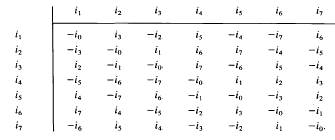
 be the classical Cayley algebra defined over the reals with basis
  where
where  gives a quaternion algebra ℋ
Semigroups of continuous selfmaps for which Green's
 and ℐ relations coincide
-
- Journal:
- Glasgow Mathematical Journal / Volume 20 / Issue 1 / January 1979
- Published online by Cambridge University Press:
- 18 May 2009, pp. 25-28
-
- Article
-
- You have access
- Export citation
-
For algebraic terms which are not defined, one may consult [2]. The symbol S(X) denotes the semigroup, under composition, of all continuous selfmaps of the topological space X. When X is discrete, S(X) is simply
 the full transformation semigroup on the set X. It has long been known that Green's relations and ℐ coincide for [2, p. 52] and F. A. Cezus has shown in his doctoral dissertation [1, p. 34] that and ℐ also coincide for S(X) when X is the one-point compactification of the countably infinite discrete space. Our main purpose here is to point out the fact that among the 0-dimensional metric spaces, Cezus discovered the only nondiscrete space X with the property that and ℐ coincide on the semigroup S(X). Because of a result in a previous paper [6] by S. Subbiah and the author, this property (for 0-dimensional metric spaces) is in turn equivalent to the semigroup being regular. We gather all this together in the following
 and ℐ relations coincide
 the full transformation semigroup on the set X. It has long been known that Green's relations
 Elementary equivalence and the commutator subgroup
-
- Journal:
- Glasgow Mathematical Journal / Volume 23 / Issue 2 / July 1982
- Published online by Cambridge University Press:
- 18 May 2009, pp. 115-117
-
- Article
-
- You have access
- Export citation
Finite full transformation semigroups as collections of random functions
-
- Journal:
- Glasgow Mathematical Journal / Volume 30 / Issue 2 / May 1988
- Published online by Cambridge University Press:
- 18 May 2009, pp. 203-211
-
- Article
-
- You have access
- Export citation
-
The collection of all self-maps on a non-empty set X under composition is known in algebraic semigroup theory as the full transformation semigroup on X and is written
 x. Its importance lies in the fact that any semigroup S can be embedded in the full transformation semigroup
  (where S1 is the semigroup S with identity 1 adjoined, if S does not already possess one). The proof is similar to Cayley's Theorem that a group G can be embedded in SG, the group of all bijections of G to itself. In this paper X will be a finite set of order n, which we take to be
  and so we shall write Tn for X.

 (where S
 and so we shall write T
Perfect codes in the graphs Ok and L(Ok)
-
- Journal:
- Glasgow Mathematical Journal / Volume 21 / Issue 1 / January 1980
- Published online by Cambridge University Press:
- 18 May 2009, pp. 169-172
-
- Article
-
- You have access
- Export citation
Spectra of conjugated ideals in group algebras of abelian groups of finite rank and control theorems
-
- Journal:
- Glasgow Mathematical Journal / Volume 38 / Issue 3 / September 1996
- Published online by Cambridge University Press:
- 18 May 2009, pp. 309-320
-
- Article
-
- You have access
- Export citation
-
Throughout kwill denote a field. If a group Γ acts on aset A we say an element is Γ-orbital if its orbit is finite and write ΔΓ(A) for the subset of such elements. Let I be anideal of a group algebra kA; we denote by I+ the normal subgrou(I+1)∩A of A. A subgroup B of an abelian torsion-free group A is said to be dense in A if A/B is a torsion-group. Let I be an ideal of a commutative ring K; then the spectrum Sp(I) of I is the set of all prime ideals P of K such that I≤P. If R is a ring, M is an R-module and x ɛ M we denote by
 the annihilator of x in R. We recall that a group Γ is said to have finite torsion-free rank if it has a finite series in which each factoris either infinite cyclic or locally finite; its torsion-free rank r0(Γ) is then defined to be the number of infinite cyclic factors in such a series.
 the annihilator of x in R. We recall that a group Γ is said to have finite torsion-free rank if it has a finite series in which each factoris either infinite cyclic or locally finite; its torsion-free rank r
On reducibility of ultrametric almost periodic linear representations
-
- Journal:
- Glasgow Mathematical Journal / Volume 37 / Issue 1 / January 1995
- Published online by Cambridge University Press:
- 18 May 2009, pp. 83-98
-
- Article
-
- You have access
- Export citation
