Refine search
Actions for selected content:
26076 results in Abstract analysis
Homology Operations and Power Series
-
- Journal:
- Glasgow Mathematical Journal / Volume 26 / Issue 1 / January 1985
- Published online by Cambridge University Press:
- 18 May 2009, p. 105
-
- Article
-
- You have access
- Export citation
Square integrable highest weight representations
-
- Journal:
- Glasgow Mathematical Journal / Volume 39 / Issue 3 / September 1997
- Published online by Cambridge University Press:
- 18 May 2009, pp. 296-321
-
- Article
-
- You have access
- Export citation
Generalisation of an embedding theorem for groups
-
- Journal:
- Proceedings of the Glasgow Mathematical Association / Volume 4 / Issue 4 / September 1960
- Published online by Cambridge University Press:
- 18 May 2009, pp. 171-177
-
- Article
-
- You have access
- Export citation
Integrals involving products of modified Bessel functions of the second kind
-
- Journal:
- Proceedings of the Glasgow Mathematical Association / Volume 6 / Issue 2 / July 1963
- Published online by Cambridge University Press:
- 18 May 2009, pp. 70-74
-
- Article
-
- You have access
- Export citation
-
It is proposed to establish the two following integrals.

where n is a positive integer, x is real and positive, μi and ν are complex, and Δ (n; a) represents the set of parameters
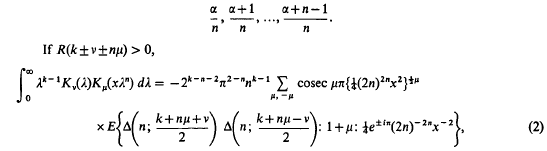
where n is a positive integer and x is real and positive.
GMJ volume 8 issue 1 Cover and Front matter
-
- Journal:
- Glasgow Mathematical Journal / Volume 8 / Issue 1 / January 1967
- Published online by Cambridge University Press:
- 18 May 2009, pp. f1-f6
-
- Article
-
- You have access
- Export citation
Soluble Groups with Finite Wielandt length
-
- Journal:
- Glasgow Mathematical Journal / Volume 31 / Issue 3 / September 1989
- Published online by Cambridge University Press:
- 18 May 2009, pp. 329-334
-
- Article
-
- You have access
- Export citation
Coranks of a quasi-projective module and its endomorphism ring
-
- Journal:
- Glasgow Mathematical Journal / Volume 36 / Issue 3 / September 1994
- Published online by Cambridge University Press:
- 18 May 2009, pp. 381-383
-
- Article
-
- You have access
- Export citation
On orders solely of abelian groups
-
- Journal:
- Glasgow Mathematical Journal / Volume 29 / Issue 1 / January 1987
- Published online by Cambridge University Press:
- 18 May 2009, pp. 105-108
-
- Article
-
- You have access
- Export citation
-
Let n =
 be the factorization of an integer n(>1) into prime powers, and set Φ(n):=
  . In particular, for squarefree n, Φ(n) = phi;(n). Consider the set
 .
.It is known (from [5]) that A consists precisely of those integers n for which there is no non-abelian group of order n. It is also known (from [7]) that the set

consists solely of integers n with the property that every group of order n is cyclic. We set C′ = A – C.
 be the factorization of an integer n(>1) into prime powers, and set Φ(n):=
  . In particular, for squarefree n, Φ(n) = phi;(n). Consider the set
An elementary inequality in function theory
-
- Journal:
- Glasgow Mathematical Journal / Volume 10 / Issue 2 / July 1969
- Published online by Cambridge University Press:
- 18 May 2009, pp. 162-168
-
- Article
-
- You have access
- Export citation
Conjugacy of free finite group actions on infranilmanifolds
-
- Journal:
- Glasgow Mathematical Journal / Volume 32 / Issue 2 / May 1990
- Published online by Cambridge University Press:
- 18 May 2009, pp. 239-240
-
- Article
-
- You have access
- Export citation
GMJ volume 3 issue 4 Cover and Front matter
-
- Journal:
- Proceedings of the Glasgow Mathematical Association / Volume 3 / Issue 4 / July 1958
- Published online by Cambridge University Press:
- 18 May 2009, pp. f1-f2
-
- Article
-
- You have access
- Export citation
Comparison of complexes of modules of generalized fractions and generalized Hughes complexes
-
- Journal:
- Glasgow Mathematical Journal / Volume 37 / Issue 1 / January 1995
- Published online by Cambridge University Press:
- 18 May 2009, pp. 55-64
-
- Article
-
- You have access
- Export citation
Universal fields of fractions for polycyclic group algebras
-
- Journal:
- Glasgow Mathematical Journal / Volume 23 / Issue 2 / July 1982
- Published online by Cambridge University Press:
- 18 May 2009, pp. 103-113
-
- Article
-
- You have access
- Export citation
-
Let G be a polycyclic-by-finite group and let K[G] denote its group algebra over the field K. In this paper we discuss localization in K[G] and in particular we prove that every faithful completely prime ideal is localizable. Furthermore, using a sequence of localizations, we show that, for G polyinfinite cyclic, the classical right quotient ring
 (K[G]) is in fact a universal field of fractions for K[G]. Finally we offer an example of a domain K[G] which does not have a universal field of fractions.
 (K[G]) is in fact a universal field of fractions for K[G]. Finally we offer an example of a domain K[G] which does not have a universal field of fractions.
A structure theorem for SI-Modules
-
- Journal:
- Glasgow Mathematical Journal / Volume 34 / Issue 1 / January 1992
- Published online by Cambridge University Press:
- 18 May 2009, pp. 83-89
-
- Article
-
- You have access
- Export citation
Projective structures on an annulus and Hankel forms
-
- Journal:
- Glasgow Mathematical Journal / Volume 33 / Issue 3 / September 1991
- Published online by Cambridge University Press:
- 18 May 2009, pp. 247-266
-
- Article
-
- You have access
- Export citation
Matrix representations of semigroups
-
- Journal:
- Glasgow Mathematical Journal / Volume 8 / Issue 1 / January 1967
- Published online by Cambridge University Press:
- 18 May 2009, pp. 1-13
-
- Article
-
- You have access
- Export citation
GMJ volume 37 issue 1 Cover and Front matter
-
- Journal:
- Glasgow Mathematical Journal / Volume 37 / Issue 1 / January 1995
- Published online by Cambridge University Press:
- 18 May 2009, pp. f1-f2
-
- Article
-
- You have access
- Export citation
A note on the characterisation of eigencurves for certain two parameter eigenvalue problems in ordinary differential equations
-
- Journal:
- Glasgow Mathematical Journal / Volume 35 / Issue 1 / January 1993
- Published online by Cambridge University Press:
- 18 May 2009, pp. 63-67
-
- Article
-
- You have access
- Export citation
-
We are interested in two parameter eigenvalue problems of the form

subject to Dirichlet boundary conditions

The weight function 5 and the potential q will both be assumed to lie in L2[0,1]. The problem (1.1), (1.2) generates eigencurves

in the sense that for any fixed λ, ν(λ) is the nth eigenvalue ν, (according to oscillation indexing) of (1.1), (1.2). These curves are in fact analytic functions of λ and have been the object of considerable study in recent years. The survey paper [1] provides background in this area and itemises properties of eigencurves.

The centre of a hereditary local ring
-
- Journal:
- Proceedings of the Glasgow Mathematical Association / Volume 5 / Issue 3 / January 1962
- Published online by Cambridge University Press:
- 18 May 2009, pp. 101-102
-
- Article
-
- You have access
- Export citation
On Certain Dual Integral Equations
-
- Journal:
- Proceedings of the Glasgow Mathematical Association / Volume 5 / Issue 1 / January 1961
- Published online by Cambridge University Press:
- 18 May 2009, pp. 21-24
-
- Article
-
- You have access
- Export citation
-
In his book on Fourier Integrals, Titchmarsh [l] gave the solution of the dual integral equations


for the case α > 0, by some difficult analysis involving the theory of Mellin transforms. Sneddon [2] has recently shown that, in the cases v = 0, α = ±½, the problem can be reduced to an Abel integral equation by making the substitution

or

It is the purpose of this note to show that the general case can be dealt with just as simply by putting

The analysis is formal: no attempt is made to supply details of rigour.
