Refine search
Actions for selected content:
26072 results in Abstract analysis
Normal curvature of minimal submanifolds in a sphere
-
- Journal:
- Glasgow Mathematical Journal / Volume 39 / Issue 1 / January 1997
- Published online by Cambridge University Press:
- 18 May 2009, pp. 29-33
-
- Article
-
- You have access
- Export citation
-
Simons [5] has proved a pinching theorem for compact minimal submanifolds in a unit sphere, which led to an intrinsic rigidity result. Sakaki [4] improved this result of Simons for arbitrary codimension and has proved that if the scalar curvature S of the minimal submanifold Mn of Sn+P satisfies
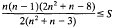
then either Mn is totally geodesic or S= 2/3 in which case n = 2 and M2 is the Veronese surface in a totally geodesic 4-sphere. This result of Sakaki was further improved by Shen [6] but only for dimension n=3, where it is shown that if S>4, then M3 is totally geodesic (cf. Theorem 3, p. 791).
Fitting classes of certain metanilpotent groups
-
- Journal:
- Glasgow Mathematical Journal / Volume 36 / Issue 2 / May 1994
- Published online by Cambridge University Press:
- 18 May 2009, pp. 185-195
-
- Article
-
- You have access
- Export citation
GMJ volume 3 issue 1 Cover and Back matter
-
- Journal:
- Proceedings of the Glasgow Mathematical Association / Volume 3 / Issue 1 / December 1956
- Published online by Cambridge University Press:
- 18 May 2009, pp. b1-b2
-
- Article
-
- You have access
- Export citation
The Least Commutative Congruence on a simple regular ω-semigroup†
-
- Journal:
- Glasgow Mathematical Journal / Volume 32 / Issue 1 / January 1990
- Published online by Cambridge University Press:
- 18 May 2009, pp. 13-23
-
- Article
-
- You have access
- Export citation
GMJ volume 34 issue 2 Cover and Back matter
-
- Journal:
- Glasgow Mathematical Journal / Volume 34 / Issue 2 / May 1992
- Published online by Cambridge University Press:
- 18 May 2009, pp. b1-b2
-
- Article
-
- You have access
- Export citation
On ternary quadratic forms that represent zero
-
- Journal:
- Glasgow Mathematical Journal / Volume 35 / Issue 1 / January 1993
- Published online by Cambridge University Press:
- 18 May 2009, pp. 13-23
-
- Article
-
- You have access
- Export citation
Remarks on the range of a vector measure
-
- Journal:
- Glasgow Mathematical Journal / Volume 36 / Issue 2 / May 1994
- Published online by Cambridge University Press:
- 18 May 2009, pp. 157-161
-
- Article
-
- You have access
- Export citation
The evaluation functionals associated with an algebra of bounded operators
-
- Journal:
- Glasgow Mathematical Journal / Volume 10 / Issue 1 / January 1969
- Published online by Cambridge University Press:
- 18 May 2009, pp. 73-76
-
- Article
-
- You have access
- Export citation
-
In this note we shall employ the notation of [1] without further mention. Thus X denotes a normed space and P the subset of X × X′ given by

Given a subalgebra
 of B(X), the set {Φ(X,f):(x,f) ∈ P} of evaluation functional on is denoted by II. We shall prove that if X is a Banach space and if contains all the bounded operators of finite rank, then Π is norm closed in ′. We give an example to show that Π need not be weak* closed in ″. We show also that FT need not be norm closed in ″ if X is not complete.
 of B(X), the set {Φ(X,f):(x,f) ∈ P} of evaluation functional on
 A decomposition theorem for submeasures
-
- Journal:
- Glasgow Mathematical Journal / Volume 26 / Issue 1 / January 1985
- Published online by Cambridge University Press:
- 18 May 2009, pp. 69-74
-
- Article
-
- You have access
- Export citation
Convexity conditions for non-locally convex lattices
-
- Journal:
- Glasgow Mathematical Journal / Volume 25 / Issue 2 / July 1984
- Published online by Cambridge University Press:
- 18 May 2009, pp. 141-152
-
- Article
-
- You have access
- Export citation
-
First we recall that a (real) quasi-Banach space X is a complete metrizable real vector space whose topology is given by a quasi-norm
 satisfying


where C is some constant independent of x1 and x2. X is said to be p-normable (or topologically p-convex), where 0 < p ≤ l, if for some constant B we have

for any x1, …, xn, є X. A theorem of Aolci and Rolewicz (see [18]) asserts that if in C = 21/p-1, then X is p-normable. We can then equivalently re-norm X so that in (1.4) B = 1.
 satisfying
Basis properties for semigroups
-
- Journal:
- Glasgow Mathematical Journal / Volume 30 / Issue 1 / January 1988
- Published online by Cambridge University Press:
- 18 May 2009, pp. 101-109
-
- Article
-
- You have access
- Export citation
A Note on an asymmetric mixed boundary value problem for a half space with a cylindrical cavity
-
- Journal:
- Proceedings of the Glasgow Mathematical Association / Volume 7 / Issue 1 / January 1965
- Published online by Cambridge University Press:
- 18 May 2009, pp. 45-47
-
- Article
-
- You have access
- Export citation
Totally real pseudo-umbilical submanifolds of a quaternion space form
-
- Journal:
- Glasgow Mathematical Journal / Volume 40 / Issue 1 / March 1998
- Published online by Cambridge University Press:
- 18 May 2009, pp. 109-115
-
- Article
-
- You have access
- Export citation
Completely continuous movements in topological vector spaces
-
- Journal:
- Proceedings of the Glasgow Mathematical Association / Volume 3 / Issue 3 / December 1957
- Published online by Cambridge University Press:
- 18 May 2009, pp. 135-141
-
- Article
-
- You have access
- Export citation
Commutative Extension of Partial Automorphisms of Groups
-
- Journal:
- Proceedings of the Glasgow Mathematical Association / Volume 1 / Issue 4 / December 1953
- Published online by Cambridge University Press:
- 18 May 2009, pp. 170-181
-
- Article
-
- You have access
- Export citation
Abstract theory of packings and coverings. II
-
- Journal:
- Proceedings of the Glasgow Mathematical Association / Volume 4 / Issue 2 / July 1959
- Published online by Cambridge University Press:
- 18 May 2009, pp. 96-100
-
- Article
-
- You have access
- Export citation
Minimal theta functions
-
- Journal:
- Glasgow Mathematical Journal / Volume 30 / Issue 1 / January 1988
- Published online by Cambridge University Press:
- 18 May 2009, pp. 75-85
-
- Article
-
- You have access
- Export citation
-
Let
 be a positive definite binary quadratic form with real coefficients and discriminant b2 − 4ac = −1.
Among such forms, let
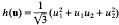 . The Epstein zeta function of f is denned to be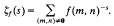
Rankin [7], Cassels [1], Ennola [5], and Diananda [4] between them proved that for every real s > 0,

We prove a corresponding result for theta functions. For real α > 0, let
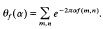
This function satisfies the functional equation

(This may be proved by using the formula (4) below, and then twice applying the identity (8).)
 be a positive definite binary quadratic form with real coefficients and discriminant b
 . The Epstein zeta function of f is denned to be
Eta-products which are simultaneous eigenforms of Hecke operators
-
- Journal:
- Glasgow Mathematical Journal / Volume 35 / Issue 3 / September 1993
- Published online by Cambridge University Press:
- 18 May 2009, pp. 307-323
-
- Article
-
- You have access
- Export citation
-
The Dedekind eta-function is defined for any τ in the upper half-plane by
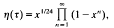
where x = exp(2πiτ) and x1/24 = exp(2πiτ/24). By an eta-product we shall mean a function

where N ≥ 1 and eachrδ ∈ ℤ. In addition, we shall always assume that
 is an integer. Using the Legendre-Jacobi symbol (—), we define a Dirichlet character ∈ by
when a is odd. If p is a prime for which ∈(p) ≠ 0and if F is a function with a Fourier series
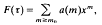
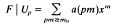
then we define a Hecke operator Tp by

where
and
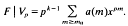
 is an integer. Using the Legendre-Jacobi symbol (—), we define a Dirichlet character ∈ by
Residuation theory and matrix multiplication on orthomodular lattices
-
- Journal:
- Glasgow Mathematical Journal / Volume 10 / Issue 1 / January 1969
- Published online by Cambridge University Press:
- 18 May 2009, pp. 60-65
-
- Article
-
- You have access
- Export citation
-
In this paper we consider mappings induced by matrix multiplication which are defined on lattices of matrices whose coordinates come from a fixed orthomodular lattice L (i.e. a lattice with an orthocomplementation denoted by ′ in which a ≦ b ⇒ a ∨ (a′ ∧ b) = b).
 will denote the set of all m × n matrices over L with partial order and lattice operations defined coordinatewise. For conformal matrices A and B the (i,j)th coordinate of the matrix product AB is defined to be (AB)ij = Vk(Aik ∧ BkJ). We assume familiarity with the notation and results of [1]. is an orthomodular lattice and the (lattice) centre of is defined as
  , where we say that A commutes with B and write
  . In § 1 it is shown that mappings from into characterized by right multiplication X → XP (P ∈ ) are residuated if and only if p ∈ ℘ (). (Similarly for left multiplication.) This result is used to show the existence of residuated pairs. Hence, in § 2 we are able to extend a result of Blyth [3] which relates invertible and cancellable matrices (see Theorem 3 and its corollaries). Finally, for right (left) multiplication mappings, characterizations are given in § 3 for closure operators, quantifiers, range closed mappings, and Sasaki projections.
 will denote the set of all m × n matrices over L with partial order and lattice operations defined coordinatewise. For conformal matrices A and B the (i,j)th coordinate of the matrix product AB is defined to be (AB)
 , where we say that A commutes with B and write
  . In § 1 it is shown that mappings from
 On Sands' questions concerning strong and hereditary radicals
-
- Journal:
- Glasgow Mathematical Journal / Volume 28 / Issue 1 / January 1986
- Published online by Cambridge University Press:
- 18 May 2009, pp. 1-3
-
- Article
-
- You have access
- Export citation
